
The parts of an NEC contract and which one answers your question
Core clauses, Options, Contract Data, Scope and Z clauses: where each sits and how to trace one question through all of them.
On this page
An NEC contract is built from blocks: core clauses that apply to every job, a main Option for how you are paid, a dispute Option, optional extras, and the details specific to your project. Together they form one contract. Reading the printed core clauses on their own will not tell you how you are paid or when anything is due. This guide uses the NEC4 Engineering and Construction Contract (ECC). Short contracts are simpler and numbered differently.
The blocks and who fills them
| Block | What it does | Who chooses |
|---|---|---|
| Core clauses (sections 1 to 9) | Rules common to every ECC | Fixed by the form |
| Main Option (A to F) | How the Contractor is paid | The Client picks one |
| Dispute Option (W1, W2 or W3) | How disputes are handled | The Client |
| Secondary Options (X and Y) | Extras such as delay damages or bonds | The Client, only those needed |
| Z clauses | Extra conditions written for this job | The Client, sometimes negotiated |
| Schedule of Cost Components | What counts as Defined Cost | Form fixes it, rates come from Contract Data |
| Contract Data | Names, dates, periods, rates | Part one by the Client, part two by you |
| Scope | What is to be provided and the constraints | The Client, plus any of your proposals included |
| Site Information | Describes the site and surroundings | The Client |
| Pricing document | Activity Schedule (A, C) or Bill of Quantities (B, D) | You |
| First programme | Named in Contract Data or submitted after award | You |
In NEC3 the Scope is the Works Information and the Client is the Employer. The layout is otherwise much the same.
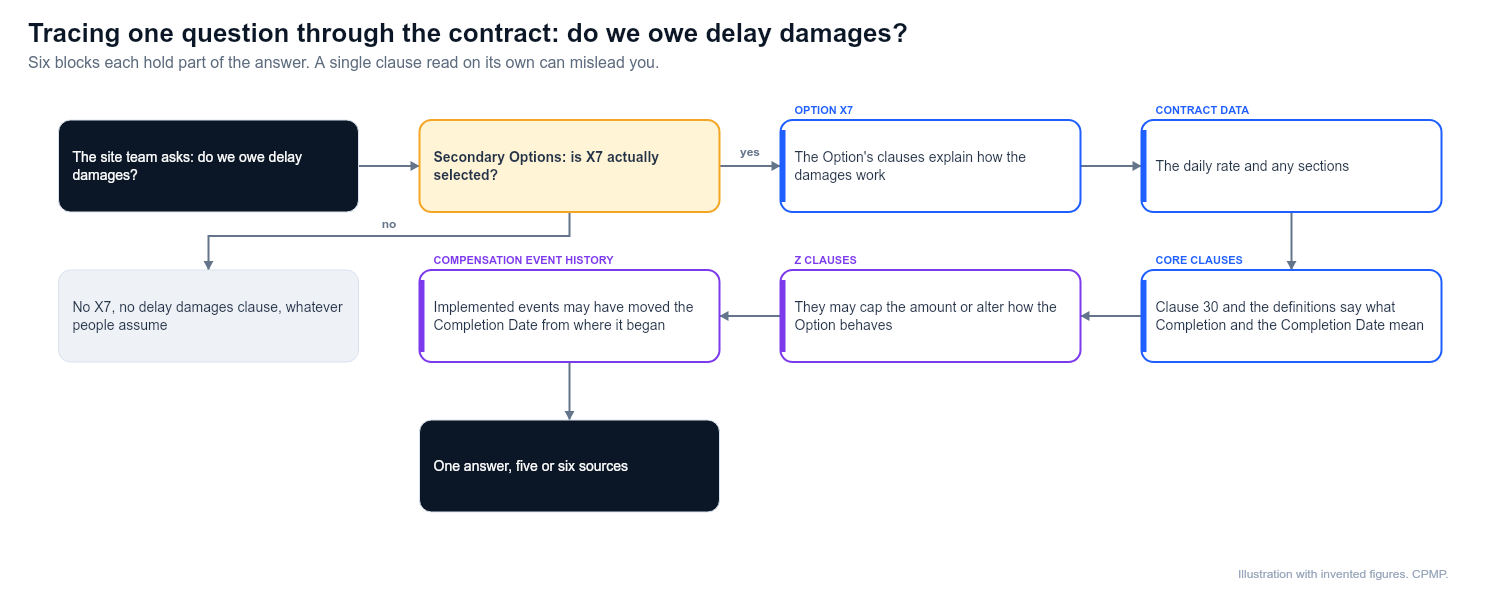
Tracing one question: "Do we owe delay damages?"
A site team asks this. The answer is spread across several blocks:
- Secondary Options. Is X7 actually selected? If not, there is no delay damages clause, whatever people assume.
- The Option's clauses. They explain how the damages work.
- Contract Data. It gives the daily rate and any sections.
- Core clauses. Clause 30 and the definitions say what Completion and the Completion Date mean.
- Z clauses. They may cap the amount or alter how the Option behaves.
- Compensation event history. Implemented events may have moved the Completion Date from where it began.
One answer, five or six sources. That is why a single clause read alone can mislead you.
When the documents disagree
The ECC has no neat order-of-precedence clause. If the Project Manager or you spot a conflict or unclear point, you tell the other and the Project Manager instructs how it is resolved (17.1). Whether that creates a compensation event depends on the circumstances, so check. Some clients add a precedence rule, and it will normally sit in the Z clauses.
What people get wrong
- Assuming a secondary Option applies. Retention, delay damages and bonds only exist if selected.
- Skipping the main Option clauses. They define things such as what "Prices" means.
- Treating Contract Data as a form. It fixes the period for reply and programme intervals, which set your deadlines.
- Hiding obligations in the Scope. A payment term tucked into a specification can collide with the conditions.
- Forgetting the short forms. They use a different structure.
A file checklist for day one
- Core clauses plus your chosen main, dispute and secondary Options, with the version date
- Contract Data parts one and two, completed
- Z clauses, or confirmation there are none
- Scope and Site Information, with every document and revision listed
- Activity Schedule or Bill of Quantities
- Any programme the Contract Data names
- The agreement or award letter and anything else stated to be part of the contract
Related guides
- Contract Data explained
- The Scope explained
- Z clauses: what they are and how to read them
- Contract Data checklist before you sign
This guide is general information, not legal advice. Check it against your contract.