
The NEC Project Manager: what they can decide and what happens if they go quiet
What the Project Manager can and cannot do under NEC, how far to trust them, and the protections you have when they stay silent.
On this page
On an NEC job almost everything you send goes to one person: the Project Manager. They manage the contract for the Client. They instruct, accept or refuse your submissions, deal with compensation events, assess what you are due and decide when you have reached Completion. They are not a party to the contract, but in the NEC4 Engineering and Construction Contract (ECC) nearly every procedure passes through their hands. The title is the same in NEC3.
Where their power comes from
Their authority is built from particular clauses, with no general right to steer the job. Where the contract names an action as theirs, they can take it. If it does not, they have no contractual power to do it, however senior they are. The ones you will meet most:
- Changing the Scope or a Key Date (14.3). This usually makes a compensation event, 60.1(1) or 60.1(4).
- Delegating actions to someone else (14.2), after telling you.
- Accepting or refusing your submissions (13.4). A refusal needs a stated reason.
- Accepting your programme (31.3), but only for the reasons the contract allows.
- Stopping work or preventing a start (34.1), another compensation event.
- Assessing compensation events themselves (64.1), but only in listed cases.
- Assessing the amount due on each assessment date (50.1).
- Certifying Completion, within one week (30.2).
Whose side are they on?
The Client appoints them, and where the contract truly leaves a choice open they may weigh the Client's interests. They must also act as the contract says (10.1) and in mutual trust and co-operation (10.2). In NEC3 both ideas sit in 10.1. A workable rule:
- Where the contract leaves it open, for example whether to alter the Scope, expect them to follow what the Client prefers.
- Where the contract sets a test or method, such as whether something is a compensation event or how to assess it, the test decides. A Client's budget does not change the answer.
If you are pressed to give up a valid compensation event, the entitlement does not vanish. The argument tends to move to an adjudicator, and time and cost grow meanwhile.
What happens if they do not act
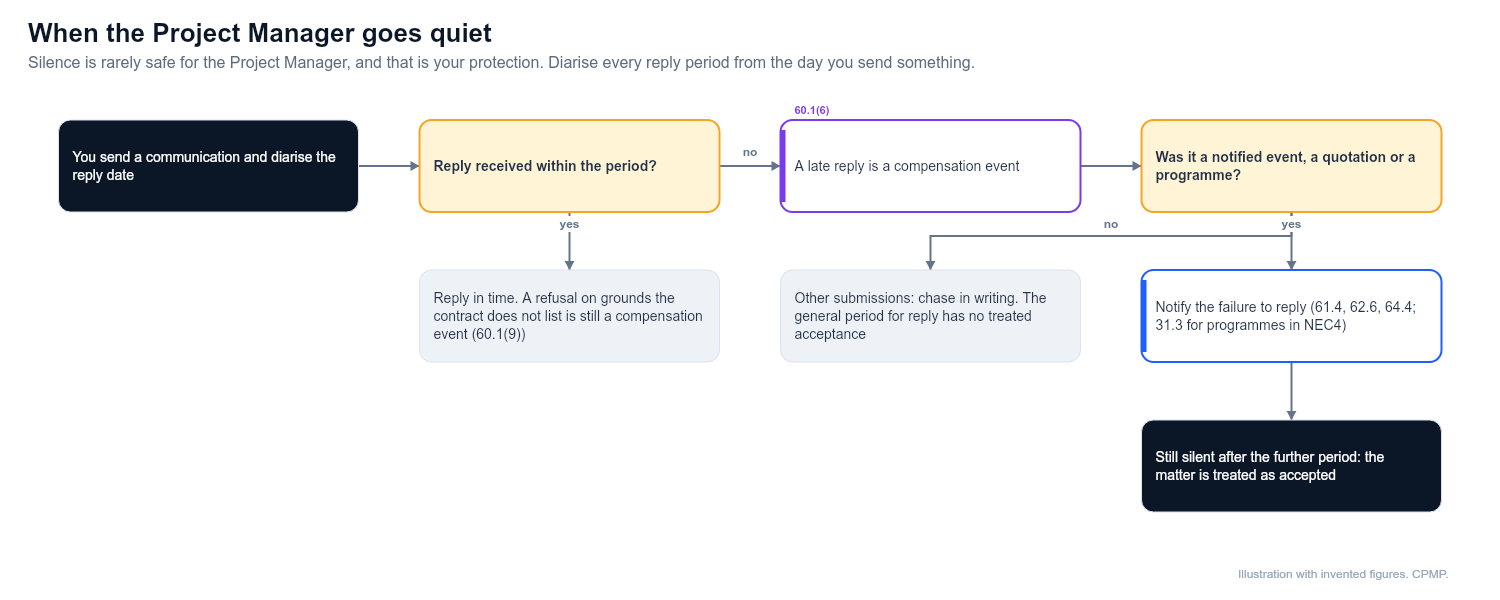
Silence is rarely safe for them, and that is your protection.
- A late reply to one of your communications is a compensation event (60.1(6)).
- If nothing comes back on a notified event, a quotation or a programme, you can notify the failure. If silence continues, the matter is treated as accepted. The clauses are 61.4, 62.6 and 64.4, plus 31.3 for programmes, which is new in NEC4.
- Refusing an acceptance on grounds the contract does not list is a compensation event (60.1(9)).
- Reversing a decision they have already told you is a compensation event (60.1(8)).
So diarise every reply period from the day you send something, and send the follow-up notice if the date passes.
What they cannot do
- Alter the contract itself. Changing the conditions, as opposed to the Scope, needs both parties (12.3).
- Take away your responsibility. Acceptance does not change your duty to Provide the Works or your design liability (14.1).
- Borrow the Supervisor's powers. Telling you to search for a Defect is the Supervisor's job (43.1), unless it has been delegated.
- Rely on internal Client limits against you. Check any Z clause, and do not let their approval chain run past a reply period.
An example
Imagine a pumping station refit where the Project Manager emails: "Client would like the penstock upgraded, please make that happen." You carry on and later notify a compensation event. They reply that nothing was formally instructed.
That reply is unlikely to stand: the email came from the correct role, in a recordable form, and asked for a Scope change. Still, avoid the argument: write back asking them to confirm it as an instruction under 14.3, notify the event under 61.1 yourself, and ask for the quotation request, all the same day.
Who holds the role
Contract Data gives their name. They could be a Client employee or an outside consultant, and the Client may replace them just by notifying you (14.4). If they are stretched across several jobs, your clock does not pause, so keep your reply diary tight.
Related guides
- The NEC Supervisor
- The Client's role under NEC
- Failure to reply: treated acceptance
- The Project Manager works for the Client: are they impartial?
This guide is general information, not legal advice. Check it against your contract.