
The NEC Supervisor: tests, Defects and when their actions cost the Client
What the NEC Supervisor does and cannot do, how their actions create compensation events, and how to work with them on tests and Defects.
On this page
The Supervisor is the person who checks that what you build matches what the contract requires. They carry out tests and inspections, instruct searches for Defects, notify any Defect they find and issue the Defects Certificate. They do not manage cost, time or change, which sit with the Project Manager. Both NEC3 and NEC4 Engineering and Construction Contracts (ECC) have the role. Clause numbers below are NEC4, with NEC3 in brackets where they differ.
What the Supervisor does
- Tells you before they begin their own tests and inspections, and tells you the results (41.3; NEC3 40.3).
- Lets you watch any test they run, if you wish (41.3).
- Carries out tests without causing unnecessary delay (41.5; NEC3 40.5).
- Confirms when Plant and Materials have passed a required test before delivery (42.1; NEC3 41.1).
- Instructs a search for a Defect and gives reasons (43.1; NEC3 42.1).
- Notifies each Defect promptly once found (43.2; NEC3 42.2).
- Issues the Defects Certificate (44.3; NEC3 43.3).
Which tests and inspections happen, and who does each, comes from the Scope (the Works Information in NEC3) and the law. A thin Scope means thin supervision. If you expect a hold point, check it is actually written in.
What they cannot do
- Change the Scope. That is the Project Manager's power (14.3). A site comment asking for better than the Scope requires is not an instruction you can price unless the Project Manager gives it.
- Accept a Defect. That is the Project Manager's decision, normally after a quotation (45.2).
- Assess the cost of a repeat test. The Project Manager does that, and you pay (41.6).
- Direct your method. Their checks concern the result, not how you build, unless the Scope says otherwise.
- Release you from responsibility. Passing a test does not alter your duty to Provide the Works (14.1).
When their actions earn you money
Three compensation events turn on what the Supervisor does.
- 60.1(10): a search finds no Defect, unless the search was needed only because you gave too little notice of covering up work that needed testing.
- 60.1(11): their test or inspection causes unnecessary delay.
- 60.1(8): they go back on a decision they already gave you.
A late reply from them can also fall under 60.1(6). When the Supervisor causes the event, the Project Manager is the one who must notify it (61.1), so the two roles need a working link. If a search instruction never reaches the Project Manager, you have a compensation event nobody has notified. Keep your own notification clock in mind.
A worked example
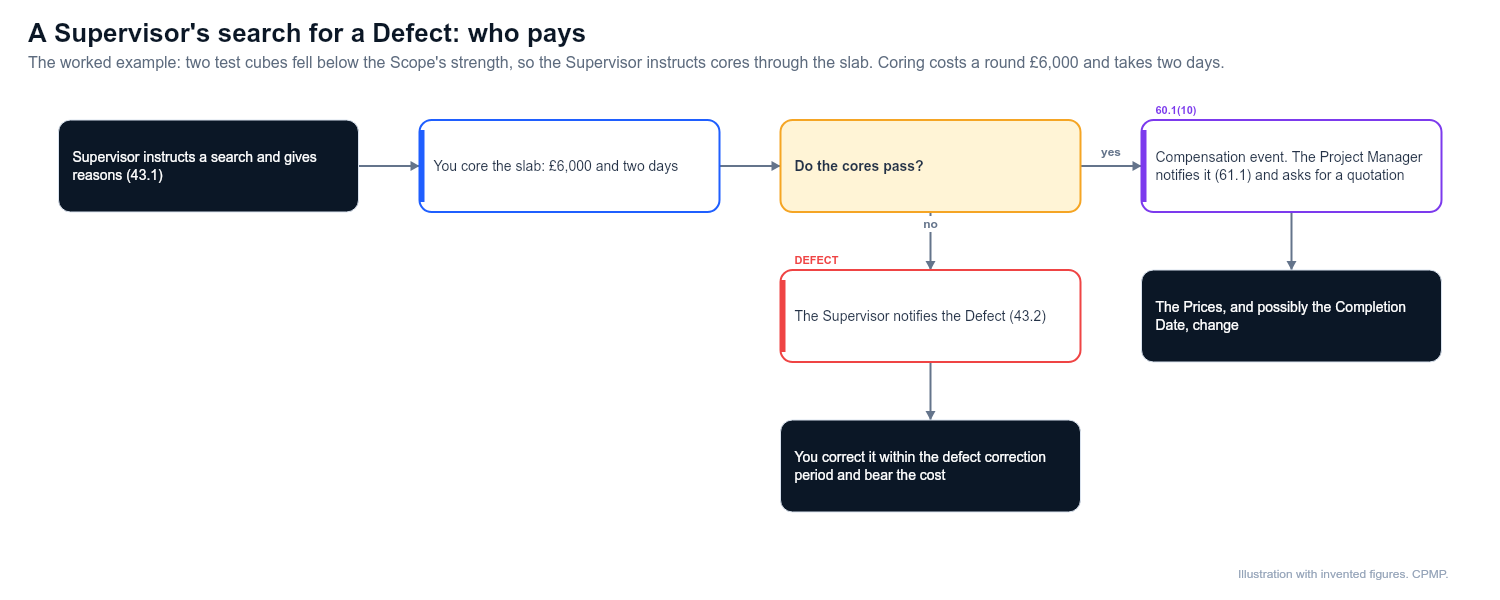
On a pumping station job, the Supervisor doubts one concrete pour and instructs you to core the slab, saying two test cubes fell below the Scope's strength. Coring costs a round £6,000 and takes two days.
- If the cores pass: it is a compensation event under 60.1(10). You expect a notification and a quotation request, and the Prices and possibly the Completion Date change.
- If the cores fail: it is a Defect. The Supervisor notifies it, you correct it within the defect correction period and bear the cost.
Good practice is for the Supervisor to record their reasons and tell the Project Manager first. For you, the lesson is to give the notice the Scope requires before covering any work that needs testing.
The Defects Certificate
The Supervisor issues it at the end of the defects process. With nothing outstanding it arrives at the defects date. With notified Defects still open, timing depends on how they are dealt with and the last defect correction period. It lists uncorrected Defects, or says there are none. The final assessment follows it, so chase it if it is late.
Working with the Supervisor
- Read the Scope for tests, hold points and who does what, and raise gaps early through the Project Manager.
- Agree notice arrangements for covering up work, and record them in your quality records.
- Treat notifications as separate items (13.7). A Defect buried in meeting notes is a poor record.
- Ask who the Supervisor has delegated to, and what each delegate may do (14.2).
- Share a Defect register with the Project Manager and meet regularly.
Related guides
- Tests and inspections
- The Defects Certificate explained
- A test failed: who pays for retesting?
- The NEC Project Manager
This guide is general information, not legal advice. Check it against your contract.