
Float and time risk allowance explained
What float and time risk allowance mean under NEC, why clause 31.2 asks for both, and how they affect compensation events.
On this page
Float and time risk allowance are two of the most misunderstood parts of an NEC programme. Clause 31.2 requires each programme submitted for acceptance to show provisions for both, and getting them right protects the Contractor when a compensation event happens.
Float
Float is spare time. Total float is the time an activity can be delayed without delaying the finish. Free float is the time it can be delayed without delaying any following activity. On the critical path, total float is zero or lowest.
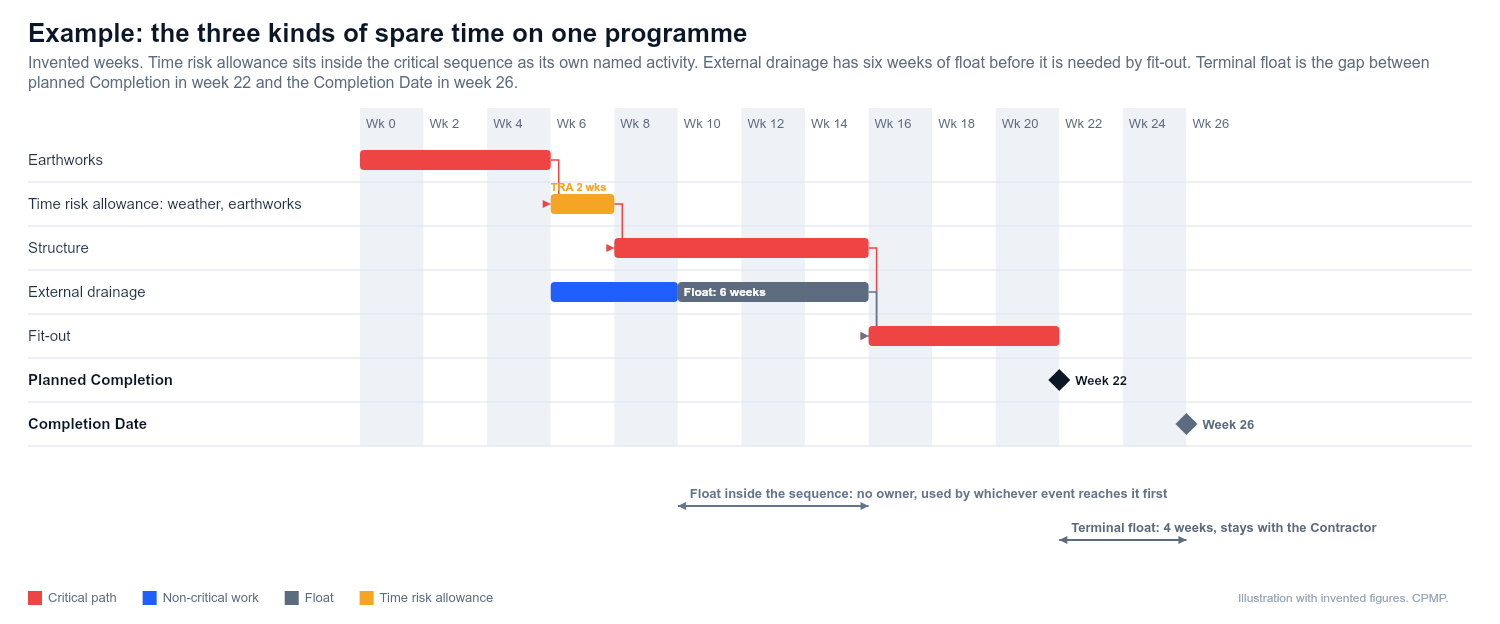
Under NEC the important float is usually the gap between planned Completion and the Completion Date. If the Contractor plans to finish before the Completion Date, that gap is float. Planners call it terminal float; it is not a defined NEC term. Float inside the sequence has no owner in the contract: a compensation event on an activity that has float before planned Completion can use that float up without any extra time, while the gap after planned Completion stays with the Contractor, because delay is measured from planned Completion and the Completion Date moves by the same amount (NEC4 63.5, NEC3 63.3).
Time risk allowance
A time risk allowance is time the Contractor includes in the programme for risks it is responsible for. It is not float. It is a deliberate allowance, inside or alongside an operation, for risks that stay with the Contractor, such as plant breakdown, productivity, rework or weather that falls short of a compensation event. Do not include allowances for events that would be compensation events, such as unforeseeable physical conditions, as those are dealt with through the contract's own mechanism.
Clause 31.2 requires time risk allowances to be identified and set out. That means they need to be visible, not hidden inside longer activity durations. A programme with none visible can be refused for missing required information, which is one of the four reasons in clause 31.3.
Why the difference matters
When a compensation event delays the work, the Completion Date is changed by the amount planned Completion is delayed on the Accepted Programme. So:
- If a compensation event uses up time that was only float before planned Completion, planned Completion may not move, and there is no change to the Completion Date. The event can still change the Prices if, for example, a crew or plant hire has to be extended.
- A time risk allowance is part of how long the Contractor plans to take, so it stays part of the operation's planned time. When a compensation event is assessed, the assessment also includes risk allowances for cost and time for matters with a significant chance of happening that are not compensation events (NEC4 63.8, NEC3 63.6), so show any allowance in a quotation next to the base duration and say what it covers. A clear programme makes this much easier to defend.
This can be amended by Z clauses, so check yours.
Showing both on the programme
- Show planned Completion separately from the Completion Date, with the gap visible as a labelled activity or lag-free link to the Completion Date milestone.
- Put time risk allowance in its own activities, named clearly, for example "Time risk allowance: weather, earthworks".
- Place it where the risk sits, not all at the end.
- Do not use constraints to create or hide float.
- Keep a record of how much time each allowance represents and why.
Common problems
- Time risk allowance is built into durations and cannot be found.
- Negative float is shown, but the programme still claims to meet the Completion Date.
- A large block of float appears at the end because logic is missing, not because time has been planned.
- The programme shows no gap at all between planned Completion and the Completion Date, so there is nowhere for a Client delay to land without moving the date.
Practical test
Open your programme and ask three questions. Can I point to the float? Can I point to every time risk allowance? Could a Project Manager find both in under a minute? If the answer to any is no, fix it before you submit.
This guide is general information, not legal advice. Check it against your contract.