
The Project Manager has not replied to my programme: what now?
A practical guide to chasing a silent Project Manager after a programme submission under NEC, including reply periods, records and escalation.
On this page
You submitted a programme and the Project Manager has gone quiet. This guide is written from the Contractor's side. If you are a Subcontractor, the same approach applies against the Contractor, but check your subcontract for the periods.
The short answer
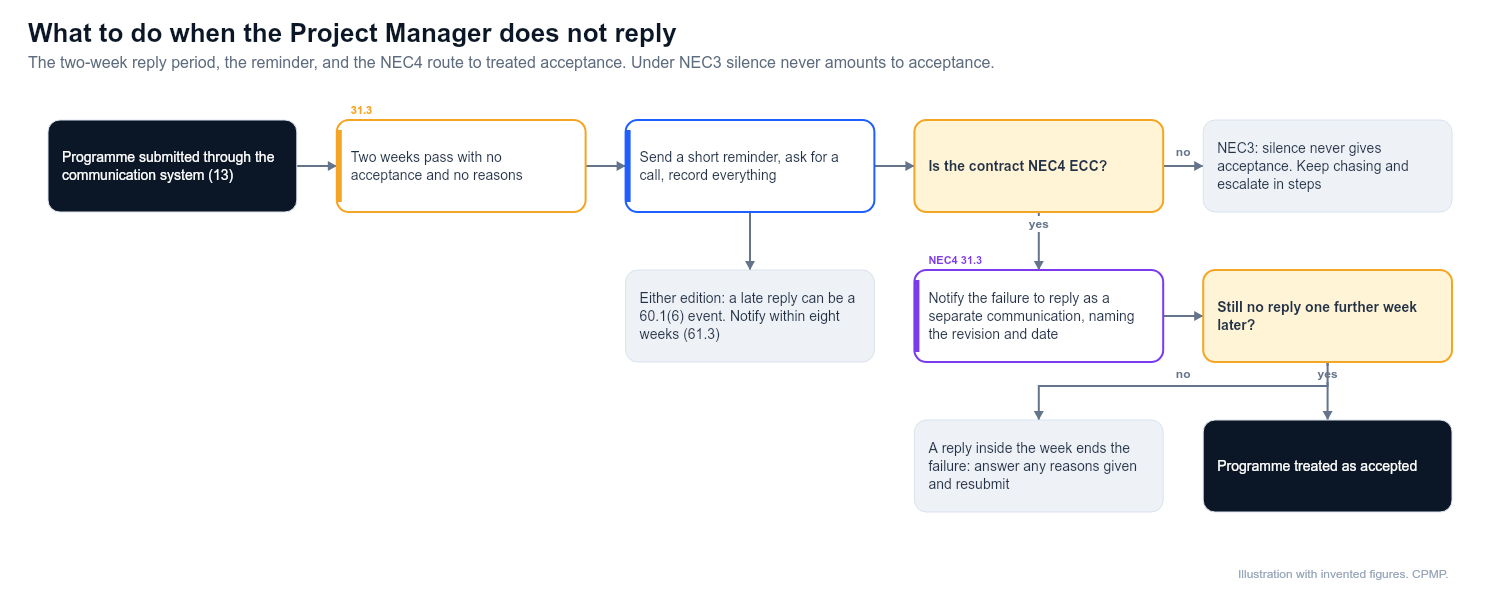
Clause 31.3 requires the Project Manager to accept the programme or give reasons for not accepting it within two weeks. If that has passed, send a short written reminder through the communication system straight away and keep a record. Under NEC4 ECC you can go further: notify the failure to reply, and if there is still no reply one further week later, the programme is treated as accepted. NEC3 has no such rule. Silence is not a reason to stop, and it is something you must document, because it affects your rights.
What to do, step by step
- Check what you actually sent. Confirm the programme went through the contract's communication system (clause 13) and that you have proof of the date. A programme sent only to a site engineer may not count.
- Count the period. The programme clause gives the Project Manager two weeks from submission (three weeks for a Contractor replying to a Subcontractor's programme under the NEC4 ECS). That is separate from the general period for reply in the Contract Data (clause 13.3). Asking an informal question does not stop the two weeks, and 31.3 has no extension mechanism of its own. Check for Z clauses that change the periods.
- Send a reminder. Keep it short: what you sent, when, the clause, the date the period ended, and a request for a reply by a stated date. Be polite. Clause 10.2 expects co-operation. Under NEC4 ECC, make the failure notification a communication of its own, not a line in a progress report (13.7), and name the programme revision and submission date.
- Ask for a meeting. Silence is often workload, not hostility. A call to the Project Manager's team often unlocks it. Follow up with an email confirming what was said.
- Consider a compensation event. Under 60.1(6), a failure by the Project Manager to reply to your communication within the required period is a compensation event in both NEC3 and NEC4. It changes the Prices or dates only if the lateness had an effect, and you must notify within the eight weeks in clause 61.3 (seven weeks under the NEC4 ECS). See missed the eight-week deadline.
- Escalate in steps. Move from the Project Manager to their line manager or the Client's representative, in writing, still polite. Describe the facts and the effect on the work.
- Think about the dispute resolution Option. If the silence is causing real loss, the dispute resolution Option in your contract (adjudication, or in NEC4 possibly a Dispute Avoidance Board under W3) may be relevant. Take legal advice before going down that route.
- Keep working. Continue to update your programme and plan to it. See revised programme submission timeline.
What to record
- Date and method of the original submission, and file name.
- The date the reply period ended.
- Every reminder, call and meeting, with who attended.
- Any instructions or comments received that touch the programme.
- The effect of the silence: resources held, work resequenced, costs incurred.
What not to do
- Do not treat silence as acceptance until the NEC4 steps have been completed: your notification, then a further week with no reply. Under NEC3 silence is never acceptance.
- Do not send aggressive emails. They damage the relationship and rarely help.
- Do not wait months before chasing.
- Do not bury the reminder in a long email on other subjects.
- Do not rely on a verbal "it's fine". Get it in writing.
When to get help
Ask a planner to review the programme if you suspect the delay is because of a problem with the content, for example a completion date later than the Completion Date. Ask a commercial manager or legal adviser if the silence is causing cost or if you are considering a compensation event notification or formal dispute steps. Be aware that whether a programme missing required information can gain treated acceptance is not settled, so send a complete programme.
Example
A Contractor submits a revised programme on 1 March. By 22 March there is no reply. It emails the Project Manager on 22 March citing the programme clause, asks for a response within five working days and proposes a call. The call happens on 25 March, the Project Manager promises comments, and the Contractor confirms this by email the same day. The comments arrive on 5 April. The Contractor keeps the chain of emails together in one folder.
Related guides
- The Project Manager has not accepted my programme
- Keeping records under NEC
- Why NEC programmes are not accepted
This guide is general information, not legal advice. Check it against your contract.