
When the Project Manager ignores your programme: treated acceptance under NEC4
How a silent Project Manager can end up with your NEC4 programme treated as accepted, the timeline, the steps to take and the open questions.
On this page
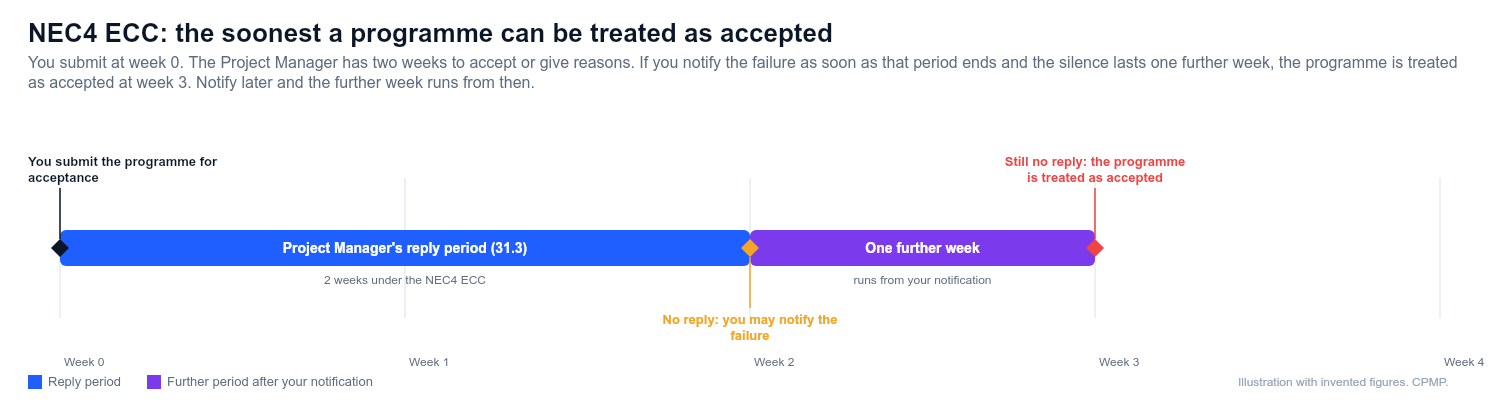
Under NEC4, if the Project Manager (the person the Client appoints to run the contract) says nothing for two weeks after you submit a programme, you can notify that failure, and if there is still no answer a week later the programme is treated as accepted. People call this deemed acceptance. The contract's own phrase is "treated as acceptance".
The rule is new in NEC4. NEC3 ECC has nothing like it, so under NEC3 silence never gives a programme the Accepted Programme status. See what the Accepted Programme is.
In plain English
Silence alone does nothing. You have to send a notice, and then wait a further week. If you do not send the notice, nothing happens, however long the Project Manager stays quiet.
The timeline
- Day 0: you submit the programme for acceptance.
- End of week 2: the period for the Project Manager's reply runs out with no acceptance and no stated reasons.
- Any time afterwards: you may notify the failure. It is your choice, and the clock does not start until you do.
- One week after the notification: if the failure still continues, the programme is treated as accepted.
Three weeks after submission is the soonest it can happen. Leave the notification for a month and the status arrives a month later too.
| Form | Reply period | Extra period after your notification |
|---|---|---|
| NEC4 ECC | 2 weeks | 1 week |
| NEC4 ECS (Contractor and Subcontractor) | 3 weeks | 2 weeks |
| NEC3 ECC | 2 weeks | none, no treated acceptance |
Other forms and Z clauses may vary these. Check yours.
What to do as the contractor
- Send the notification as a stand-alone communication, not a line in a progress report. Clause 13.7 expects separate communications for notifications.
- Identify the programme by revision number and submission date, so nobody can argue about which one you mean.
- Diarise the extra week, then record the date the status took effect and the fact that no reply came.
- Decide whether to use it. If you know the programme has real faults, you may be better to fix them. Treated acceptance helps only if the programme is sound.
What to expect from the other side
Once your notification lands, the Project Manager has only a week to rescue the position, and it may land while they are away. A reply inside that week, accepting or giving a listed reason, ends the failure. If the status has already arrived, their remaining worries can be raised when the next revision comes in.
Example: why it matters
A depot refurbishment with invented timings. Revision 6 shows the Client delivering its signalling equipment in week 18. Revision 5 had shown week 22. The Project Manager does not reply. You notify the failure, and a week later revision 6 is treated as accepted.
The equipment arrives in week 22, as the Client always assumed. Measured from week 18, that is now late and may be a compensation event under 60.1(3). If revision 5 had stayed the baseline, the same delivery would have been on time. A quick review of the dates would have taken an hour.
Open questions
The wording stops at saying the programme is treated as accepted. It is silent on a programme that leaves out required information or ignores the Scope. One argument is that such a programme cannot earn the status. The other is that the Project Manager had their chance to object and let it pass. We know of no settled answer, so build your plans on neither. Submit complete programmes and chase for replies.
Treated acceptance does not change the Completion Date or Key Dates, and your responsibilities under 14.1 stay as they were.
Related guides
- Project Manager has not replied to my programme
- Failure to reply and treated acceptance
- NEC3 vs NEC4 programme changes
- Revised programme submission timeline
This guide is general information, not legal advice. Check it against your contract.