
Missed the eight-week compensation event deadline: is the claim lost?
What happens if you notify a compensation event after eight weeks, the exception when the Project Manager should have notified it, and what to do now.
On this page
You have just realised a compensation event happened more than eight weeks ago and nobody notified it. You are wondering whether the claim is gone. This guide is written for the Contractor; a Subcontractor should check the time limits in the subcontract, which may differ.
The short answer
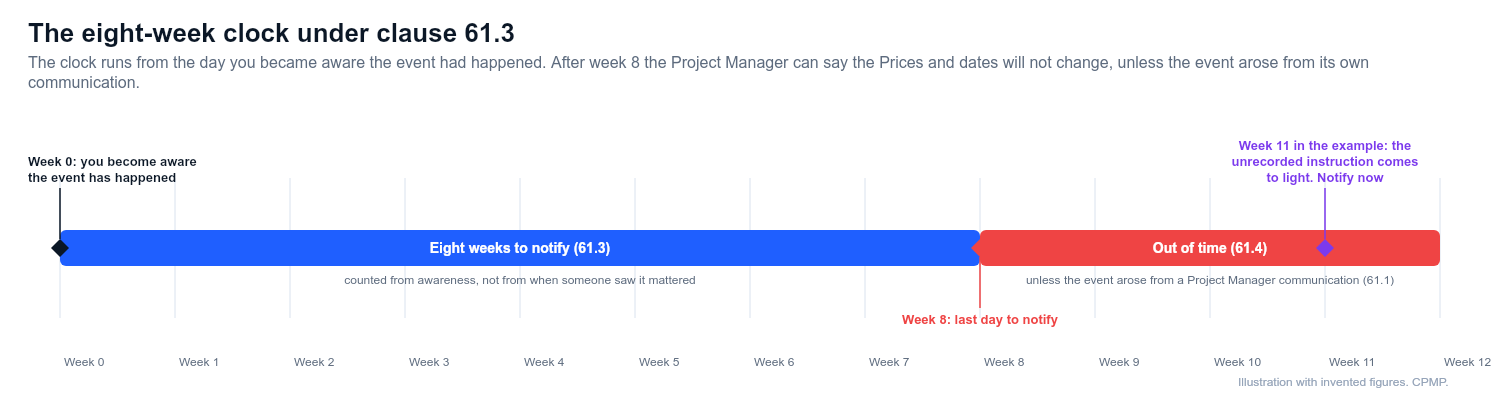
Not necessarily lost, but at risk. Under clause 61.3, the Contractor must notify a compensation event within eight weeks of becoming aware that it has happened (seven weeks under the NEC4 subcontract). If it does not, the Project Manager can reply under 61.4 that the Prices and dates will not change. NEC4 lists late notification as a reason; NEC3 does not list it, but the bar still applies through 61.3. The exception is an event arising from an instruction, notification, certificate or changed decision of the Project Manager or Supervisor, which the Project Manager should have notified itself. Work out which side of that line you are on before doing anything else.
What to do, step by step
- Pin down the date you became aware. The clock runs from when you became aware that the event had happened, not from when someone realised it had contractual significance. If the foreman knew on Monday, assume the Contractor knew on Monday. Look for the earliest document or email that shows you knew. Be honest, because the other side will look for it too.
- Check whether the Project Manager should have notified it. This applies where the event arose from a Project Manager or Supervisor instruction, notification, certificate or changed decision (61.1). Find the instruction and its date. It does not apply to late access, Others' work, missed replies, ground conditions, weather or the Client's liabilities and breach, which have no such communication behind them.
- Count the weeks properly. Count from the date of awareness, and check how your contract measures time and whether any Z clause changes the period.
- Notify now regardless. A late notification is better than none. If the exception applies, the late notice does no harm. If it does not, you have lost nothing you had not already lost, and the other side may not take the point.
- State the facts clearly. Include what happened, when, when you became aware, and why you say the Project Manager should have notified it, if you do.
- Give an early warning if the same cause is still affecting the work.
- Watch the reply clock. The Project Manager has one week to decide (61.4). If it says nothing, notify that failure, and if there is still no reply two weeks later it is treated as accepting that the event is a compensation event and as having instructed quotations. If it rejects the event only on time grounds, escalate it internally.
- Check for other routes. A second, separate event (for example a further late drawing) is a new event with its own eight weeks, and an earlier communication that really was a notification of the event may already have started the process. Whether a time bar can be overcome by waiver or similar arguments is a legal question, so take legal advice before relying on it.
What to record
- The date and means by which you first became aware.
- Documents showing the Project Manager's involvement in the event.
- Any earlier early warning, meeting minute or email that mentions the event, even if it was not labelled a notification.
- Records of cost and time effect from the date of the event.
- Any response from the Project Manager, including any statement that the event was or was not accepted.
What not to do
- Do not sit on it hoping the Project Manager will deal with it.
- Do not backdate anything or alter a record.
- Do not assume an early warning counts as a compensation event notification. They are different things.
- Do not accept the first rejection without checking the exception.
- Do not claim you only just became aware if the records show otherwise.
- Do not plan on the time bar being waived. Treat it as absolute unless a legal adviser tells you otherwise.
- Do not forget what it costs under your main Option. Under Options A and B you bear the cost and the Completion Date does not move. Under C and D the cost is still paid as Defined Cost unless disallowed, but the target does not rise. Under E the cost is paid unless disallowed, so mainly time is lost, and delay damages may follow if Option X7 applies.
When to get help
Speak to your commercial manager the day you find the problem. If the sums are significant, or the Project Manager has rejected the event on time grounds, get legal advice promptly. Ask a CPMP planner to check the programme evidence so that, if the claim goes ahead, the time effect is properly shown. See delay analysis basics.
Example
A Contractor finds that a verbal instruction to alter a pipe route was given eleven weeks ago by the Project Manager, with no written record. It checks the site diary, finds a note made on the day, and sees that the Project Manager never notified an event. It notifies the event immediately and says the Project Manager should have notified it. Whether the Project Manager accepts that is a matter for the contract and the evidence.
Related guides
- Compensation event notification checklist
- Told on site to do extra work
- Time bars for subcontractors
- Keeping records under NEC
This guide is general information, not legal advice. Check it against your contract.