
How to track NEC reply periods so deadlines never slip
Set up a tracker for NEC periods for reply: what to record, what each missed deadline triggers, and a worked example with dates.
On this page
NEC deadlines fail in practice because nobody calculates the reply date on the day the clock starts. A simple tracker fixes that, built on three habits. Log whatever starts each clock. Calculate the reply date at once. Act the same day if one is missed. Clause 13.3 points to the Contract Data for the default period, while the clauses on compensation events, programmes and payment set theirs.
In plain English
A period for reply is the time one side has to answer the other. Some answers are routine. Others, if missed, start a chain that ends with treated acceptance, meaning the other side's silence counts as agreement. A good tracker shows the date and also what follows if the date passes.
What each row should hold
- The reference of the communication
- The start date: usually submission or instruction, but read the clause to be sure
- The clause and period, so the reasoning is visible
- The reply date everyone works to
- Any extension: when agreed, the new date, and where recorded (clauses 13.5 and 62.5)
- A named owner and a deputy, so leave does not break the chain
- The consequence of lateness, which tells you how hard to chase
The last item is the one most trackers leave out. A late answer to a routine query is bad manners. A late reply to a quotation can open the route to treated acceptance.
What lateness triggers (NEC4 ECC)
If the Project Manager is late:
- With a reply to a notified event: you may notify the failure, and a further two weeks of silence means the event is accepted (clause 61.4).
- With a reply to your quotation: same pattern, two further weeks (clause 62.6).
- With their own assessment: you notify, and two further weeks leaves your quotation treated as accepted (clause 64.4).
- With a reply on your programme: you notify, and one further week brings acceptance (clause 31.3).
- With any other reply the contract requires from them or the Supervisor: this may be a compensation event if it has a knock-on effect (clause 60.1(6)).
If you are late:
- With a quotation: the Project Manager can make their own assessment (clause 64.1).
- With notifying an event: you risk the Prices and dates staying as they are (clause 61.3).
Note that a late Project Manager does not produce automatic acceptance. You must give the second notification first, so write that step into your procedure. NEC3 has the same mechanism for clauses 61.4, 62.6 and 64.4, again with two further weeks, but not for programmes.
Worked example
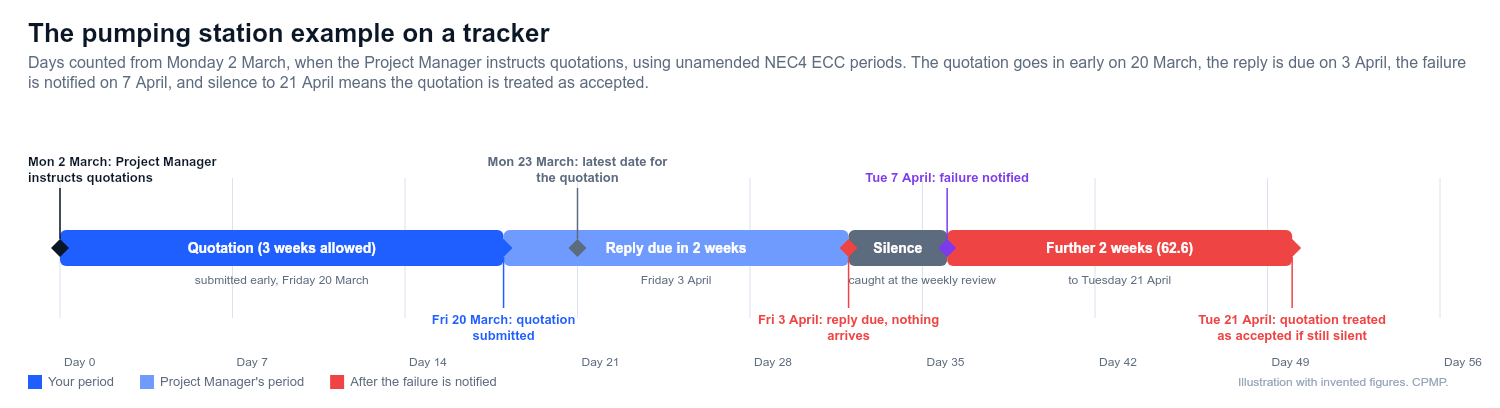
Invented dates on a pumping station job, using unamended periods.
- Monday 2 March. The Project Manager notifies an event and asks for quotations. Three weeks gives you Monday 23 March.
- Friday 20 March. You submit. Two weeks for their reply gives Friday 3 April.
- Friday 3 April. Silence. Cover for the Project Manager's leave was never arranged.
- Tuesday 7 April. Your weekly review catches it and you notify the failure. Two further weeks runs to Tuesday 21 April.
- Before 21 April. The deputy might accept, ask for a revision or say the Project Manager will assess. If none of that happens, your quotation counts as accepted, and the event goes ahead at your price.
An extension agreed before 3 April would have avoided the lot.
Counting traps
- Days or weeks. Where Option Y(UK)2 applies, days are counted without bank holidays, Good Friday and Christmas Day (clause Y2.1). Do not assume weeks work the same way.
- No agreed convention. Settle at kick-off how the first day is counted. If in doubt, act a day early.
- Different forms. The NEC4 subcontract allows four weeks, not two, for answering a quotation. Name the contract on every row.
- Late extensions. The agreement must come before the reply is due.
- Amended figures. A Z clause or Contract Data entry may alter a period, so use the figures from your own documents, not memory.
Related guides
This guide is general information, not legal advice. Check it against your contract.