
Preparing an NEC subcontract package: what the Contractor should include
What a main contractor should include in an NEC subcontract package, from Subcontract Contract Data to scope, programme requirements and Z clauses.
On this page
A good subcontract package saves months of argument later. A poor one hands the Subcontractor an excuse and leaves you carrying the gap between what you promised the Client and what you bought. This guide is for the main Contractor.
Start from the main contract
Before you write anything, list what the main contract requires of subcontracted work. Clause 26 of the main ECC keeps the Contractor responsible for Providing the Works as if it had not subcontracted (26.1). You submit the proposed Subcontractor's name for the Project Manager's acceptance before appointing (26.2), and the subcontract documents with pricing removed (26.3) unless they are an unamended NEC subcontract or the Project Manager agrees otherwise. Non-NEC documents can be refused if they leave out the mutual trust and co-operation wording, and on the cost-based Options you also provide pricing information (26.4). Appointing a Subcontractor for substantial work before acceptance is a termination reason (R13), so start early. Check what the Contract Data and Z clauses say about subcontractors.
What goes in the package
| Item | Why it matters |
|---|---|
| Form of subcontract and version | ECS, short subcontract, NEC3 or NEC4. Say which, and which Options apply. |
| Subcontract Contract Data | Part one is yours, part two is the Subcontractor's. Leave nothing blank by accident. |
| Subcontract Scope | A clear statement of what is included and excluded, with specifications and drawings listed by revision. |
| Programme requirements | What the Subcontractor submits, when, in what format and how often it is updated. |
| Dates | Starting date, Completion Date and any Key Dates, tied to your main programme. |
| Working Areas and access | Where they work, what you provide, and when. |
| Z clauses | Any additional or amended conditions, listed and checked against the main contract. |
| Commercial documents | Price, activity schedule or bill, payment dates, and the payment and dispute provisions. |
Scope: be specific
Write the Subcontract Scope so that someone who has never seen the main contract can tell what is in and what is out. Point to the relevant parts of the main Scope (Works Information in NEC3) rather than pasting them without thought. List interfaces with other trades and who is responsible for each. Ambiguity in scope is the most common source of compensation events.
Programme requirements
Say exactly what you expect. State whether the Subcontractor submits a first programme, how detailed it must be, what software or format you need, what it must show (logic, resources, float, key interfaces), and how often it is updated. Align this with the main contract's programme clauses, such as clause 31 for the first programme and its content, and clause 32.2 for revisions. Check the Contract Data periods in your own contract. See clause 31 programme checklist and revised programme submission timeline.
Decide how you will respond. Under the unamended NEC4 ECS you have three weeks to accept a programme or give one of the four permitted reasons for not accepting, and if you stay silent and the Subcontractor notifies the failure, the programme is treated as accepted after a further two weeks. That period is set to let you meet your own deadlines to the Client, so protect it. If no first programme is identified in the Subcontract Data, 25% of the Price for Work Done to Date is held back until one is submitted (50.5). See why NEC programmes are not accepted.
Getting back-to-back right
Back-to-back does not mean copying every main contract term. It means that:
- Dates fit. The Subcontract Completion Date and Subcontractor's Key Dates come before your Key Dates, with room for your own testing and handover.
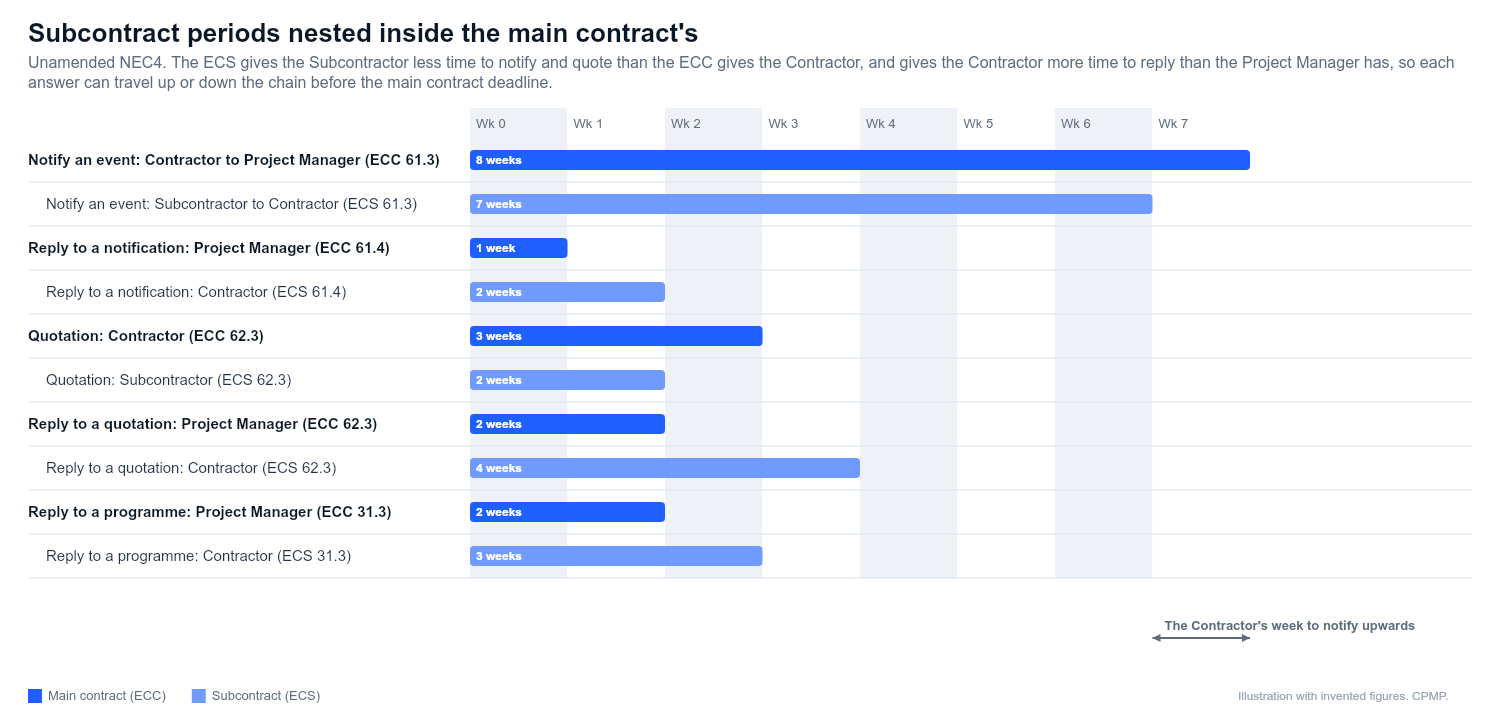
- Notification periods fit. The Subcontractor's period to notify an event must be short enough for you to notify the Client within yours. Eight weeks under clause 61.3 of the main ECC is the Contractor's limit, so your subcontract period must leave you time. The unamended NEC4 ECS does this with seven weeks to notify an event (61.3), two weeks to quote (62.3), two weeks for the Contractor to reply to a notification (61.4), four weeks to reply to a quotation (62.3) and three weeks to reply to a programme (31.3), against two in the ECC. Amendments often remove that margin, so check your actual periods.
- Payment dates fit. Leave room between your Client payment cycle and your payment obligation. Remember that pay-when-paid terms are generally unenforceable under the Construction Act, so plan cash flow with that in mind and take legal advice.
- Dispute resolution fits. Choose a dispute resolution Option that works alongside the main contract. The NEC4 ECS lets the Contractor bring the Subcontractor into a main contract adjudication on the same matter, using the main contract Adjudicator named in the Subcontract Data.
- Z clauses fit. Any Z clause that applies to you from the Client should be considered for flow down, and any change to risk should be written in deliberately.
Check before you issue
- Read the whole package as the Subcontractor would. Does it say who instructs, who assesses, and who replies?
- Check every cross-reference and every defined term.
- Check that nothing in the Scope contradicts the Contract Data.
- Agree and record clarifications before signing.
Treat the package as heavily amended and check Z clauses against your main contract. See NEC subcontracts explained for how the two contracts connect.
Related guides
- NEC subcontracts explained
- Time bars for subcontractors
- Clause 31 programme checklist
- Avoiding disputes under NEC
This guide is general information, not legal advice. Check it against your contract.