
Time bars for subcontractors: your own deadlines under an NEC subcontract
Why a subcontractor's notification periods come from the subcontract, not the main contract, and how to track the deadlines that can cost you money.
On this page
A time bar is a deadline after which you lose a right if you have not acted. NEC contracts have several. The most common mistake subcontractors make is assuming the main contract's deadline is the only one that matters. It is not, and it is often not the one that applies to you.
Two sets of deadlines
A subcontractor is bound by two things.
- The subcontract. Your notification periods are in your subcontract and its Contract Data. They bind you and the Contractor.
- The Contractor's position under the main contract. The Contractor has its own deadlines to the Client. In the main ECC, clause 61.3 requires the Contractor to notify a compensation event within eight weeks of becoming aware, or lose entitlement to a change in the Prices, Completion Date or a Key Date. The bar does not catch an event that arises from an instruction, notification, certificate or changed decision of the Project Manager or Supervisor, because those are events the Project Manager should have notified itself.
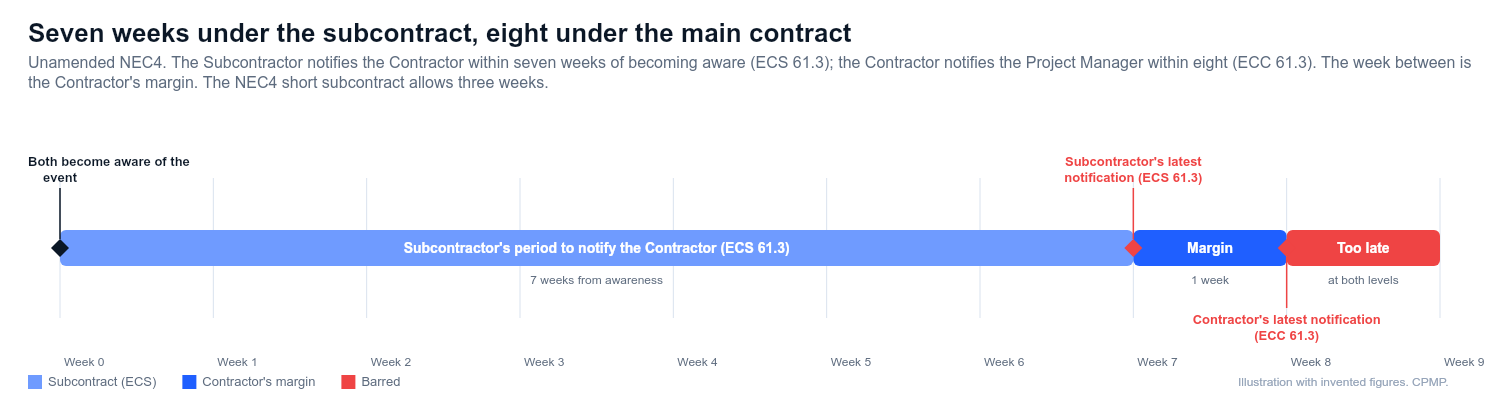
The second does not give you extra time. The Contractor needs your information early so that it can notify the Client in time. So a subcontract will often give you a shorter period than the Contractor has: the unamended NEC4 ECS gives you seven weeks, against the ECC's eight. If you notify late, you may lose your right against the Contractor, and the Contractor may also lose its own right against the Client because of your delay.
Do not copy the main contract's number
Eight weeks is the main ECC figure. Under the unamended NEC4 ECS it is seven weeks (61.3), and under the NEC4 Engineering and Construction Short Subcontract it is three weeks. NEC3 subcontracts and heavily amended Z clauses can differ again. Always read the period in your own subcontract and Contract Data, and check any Z clause that changes it. Never assume a number from a guide, a colleague or a previous job.
The deadlines to list on day one
Make a short table for each subcontract and keep it with the programme.
| Event | Where to find the period | Who it runs to |
|---|---|---|
| Notifying a compensation event | Your subcontract clause 61.3 (seven weeks under the unamended NEC4 ECS) and Subcontract Data | The Contractor |
| Submitting a quotation after being asked | The quotation clause in your subcontract (two weeks under the unamended NEC4 ECS, 62.3) | The Contractor |
| Replying to a communication | The clause on communications and the period for reply | Both parties |
| Giving early warning | The early warning clause | Both parties |
| Submitting or updating your programme | The programme clause and Contract Data | The Contractor |
| Payment applications and notices | Payment clause and Contract Data | Both parties |
| Referring a dispute | The dispute resolution Option | Either party |
The communications clause (clause 13 in the main ECC) also sets out how notices must be sent and the period for reply, and your subcontract will have its own. Failing to follow the form or send it to the right address can make a notice invalid.
How to avoid missing a deadline
- Log the clock. Write the date you became aware of an event. The period usually runs from awareness, not from when the cost arrives.
- Notify early and in writing. A short, accurate notice sent in time is worth far more than a perfect one sent late. You can add detail in the quotation.
- Use the right channel. Use the communication system your subcontract requires and send it to the person named.
- Tell the Contractor what you need. Ask what its deadline is under the main contract and give it your information in time to meet it.
- Diary the periods. Add each period and its end date to your programme or commercial tracker. See keeping records under NEC.
- Watch for early warnings. Failing to give an early warning can reduce what you recover, even where there is no formal time bar. See noticed a problem, do I give early warning.
What if you have missed one
Do not assume it is fatal. Check the wording. Some bars apply only to certain events, and the compensation event bar does not apply to events arising from an instruction, notification, certificate or changed decision of the person who instructs you. There is also an outer limit: no compensation event can be notified after the Defects Certificate under the NEC4 subcontract. If a deadline has been missed, notify now and say so honestly. The main contract position is explained in missed the eight week deadline, but the same questions apply: which clause, which event, and who should have acted. Take legal advice if a significant sum depends on it.
Related guides
- NEC subcontracts explained
- Compensation events in plain English
- Missed the eight week deadline
- Subcontractor asked to do extra work with no written instruction
This guide is general information, not legal advice. Check it against your contract.