
How to run NEC subcontracts so the timings line up
A main contractor's guide to keeping subcontract and main contract clocks aligned under NEC4, with a period comparison table and a simple weekly routine.
On this page
If you are the main contractor, running NEC subcontracts is mostly a timing job. A notice from a Subcontractor has to reach the Project Manager (the person who runs the main contract for the Client) before the main contract deadline, and the Project Manager's answer has to travel back down before the subcontract deadline. The NEC4 Engineering and Construction Subcontract (ECS) builds in a margin for this, but only if you act the day something arrives. Subcontractors should read the guide for subcontractors.
In plain English
You stay responsible to the Client for the whole job, even for work you sublet. The subcontract gives you slightly more time than the main contract in each direction, but that spare week is lost if you sit on a document.
Before you let the package
- Get the Subcontractor accepted. Submit the name under clause 26.2 and do not appoint until the Project Manager accepts.
- Submit the documents without prices. This is not needed for an unamended NEC subcontract or where the Project Manager agrees otherwise (26.3). A non-NEC document can be refused if it leaves out the mutual trust wording.
- Pass on pricing information on cost-based Options unless agreed otherwise (26.4).
- Match the dates. Subcontract Data should fit your programme for Completion, Key Dates, access and assessment intervals.
How the periods fit together
| Step | Main contract | Subcontract | What the gap gives you |
|---|---|---|---|
| Notify an event | 8 weeks | 7 weeks | A week to notify upwards |
| Reply to a notification | 1 week | 2 weeks | A week to pass the answer down |
| Quote | 3 weeks | 2 weeks | A week to check and add your own effect |
| Reply to a quotation | 2 weeks | 4 weeks | Time to hear upstream and pass it on |
| Reply to a programme | 2 weeks | 3 weeks | A week to pass the answer down |
| Payment certificate | 1 week | 2 weeks | A week after yours |
| Payment | 3 weeks | 4 weeks | A week after you receive funds, if dates match |
These are unamended forms. Bespoke or amended subcontracts often change the numbers, and that is where gaps open up.
A typical day-one routine
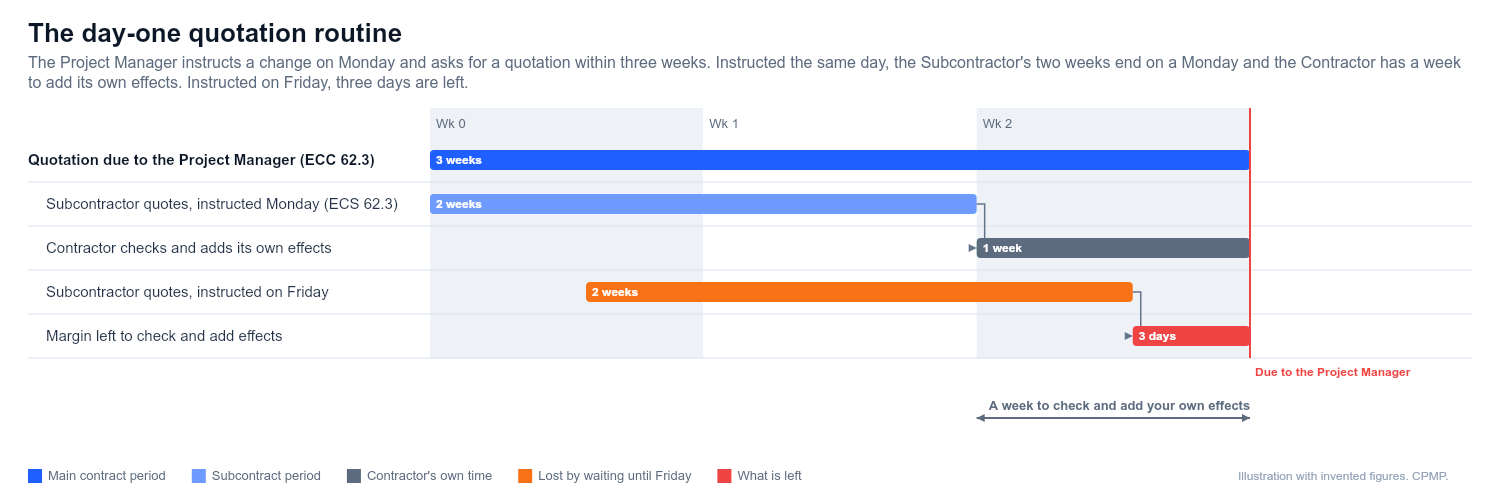
Suppose the Project Manager instructs a change on Monday and asks you for a quotation within three weeks. Instruct your Subcontractor to quote the same day. Their two weeks end on a Monday, you add your own effects over the next week, and you submit to the Project Manager with days to spare. If you wait until Friday, most of your margin has gone before anyone has started pricing.
What people get wrong
- Treating every subcontract event as a main contract event. Something you caused can be a compensation event under the subcontract but not upstream. That cost stays with you.
- Forwarding without checking. A wrong subcontract quotation only hurts you once the Project Manager accepts it.
- Different weather or ground information. The subcontract may use different Site Information or dates, leaving you in the middle.
- Warnings that stop at your desk. A Subcontractor's early warning does not reach the Project Manager unless you pass it on.
- Assuming pay when paid works. Making payment conditional on receipt is generally restricted by the Construction Act, except in insolvency cases. Check before you rely on it.
- Running disputes separately. Two decisions on the same facts can conflict, so read your dispute Option before you need it.
A simple subcontract routine
- Link your main and subcontract registers, so one event shows both clocks.
- Give each package manager their reply dates weekly.
- Invite critical Subcontractors to early warning meetings where it helps (15.2 lets others attend by agreement).
- Fold Subcontractor programme updates into your own revised programme.
Related guides
- Back-to-back NEC subcontracts
- Preparing a subcontract package
- Early warnings for subcontractors
- Ending an NEC subcontract
This guide is general information, not legal advice. Check it against your contract.