
How to stop a disagreement becoming a dispute under NEC
Habits that stop NEC disagreements becoming formal disputes: early warnings, timely notices, honest programmes, records and the right conversations.
On this page
Most NEC disputes did not start as disputes. They started as a missed notice, a late quotation, a programme that no one trusted, or a conversation nobody wrote down. NEC is designed to surface problems early and deal with them in time. This guide sets out the habits that make that real.
Start from the contract's purpose
Clause 10.2 in NEC4 (10.1 in NEC3) requires the parties to act in a spirit of mutual trust and co-operation. It is not a soft aspiration. A party that works to the contract's timetables, tells the other side early and answers promptly is in a far stronger position if a dispute does arise.
Habits that keep disagreements small
1. Use early warnings properly
Give the early warning when you become aware of a matter that could increase cost, delay completion or impair performance (clause 15.1 in NEC4, 16.1 in NEC3). Call the early warning meeting (15.2 in NEC4, 16.2 in NEC3) and record the actions. See the early warning register template. If the other side ignores a warning, see the Client ignored my early warning.
2. Notify compensation events on time
The Contractor must notify a compensation event it believes has happened within eight weeks of becoming aware, or may lose entitlement (clause 61.3), unless the Project Manager should have notified it. Put a diary on it. See missed the eight-week deadline.
3. Keep quotations moving
Submit quotations with details of the assessment and a revised programme where the programme for remaining work is altered (clause 62.2). Check clause 62 and the Contract Data for the timings. See CE quotation template and guide.
4. Keep the programme honest
Submit revised programmes at the intervals in the Contract Data and when instructed (clause 32.2). Respond to the Project Manager's reasons for not accepting a programme quickly (clause 31.3 deals with acceptance). An out-of-date programme is the root of many delay disputes. See Clause 31 programme checklist.
5. Write things down
Confirm decisions and instructions in writing using the communication system (clause 13). A short email after a meeting stating what was agreed costs nothing and prevents most arguments about what was said.
6. Pay and assess on time
Assessment and payment have fixed rhythms (clauses 50 and 51). Late or low payments cause a large share of formal disputes. See how payment works under NEC.
Spot the warning signs
| Sign | What to do |
|---|---|
| The other side stops answering | Chase in writing, citing the period for reply in the contract. |
| Quotations are repeatedly rejected | Ask for specific reasons and a meeting. |
| The same issue is raised more than twice | Escalate to a senior commercial person on both sides. |
| Numbers on each side differ widely | Reconcile line by line before positions harden. |
| People stop talking informally | Call a meeting and restore the relationship. |
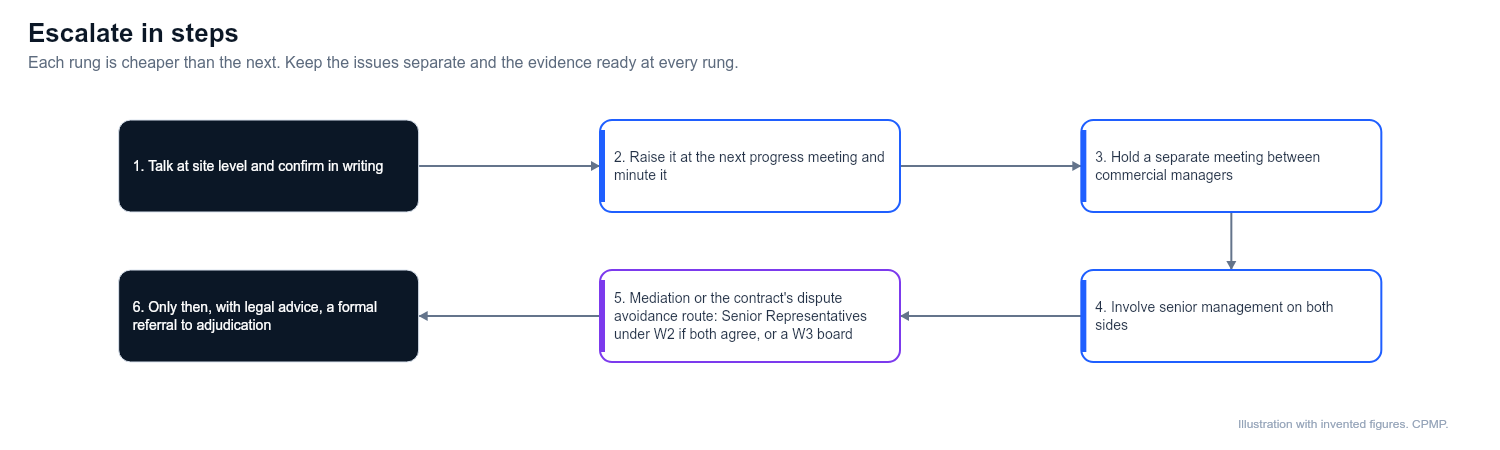
Escalate in steps
- Talk at site level and confirm in writing.
- Raise it at the next progress meeting and minute it.
- Hold a separate meeting between commercial managers.
- Involve senior management on both sides.
- Consider mediation or the contract's dispute avoidance route if available. Option W3 in NEC4 provides for a Dispute Avoidance Board, but it replaces adjudication and is generally not suited to contracts covered by the Construction Act, so check your contract. Under W2 the parties can also agree to use Senior Representatives.
- Only then, with legal advice, consider a formal referral. See adjudication under NEC.
Separate the issues
Do not let a payment complaint, a delay claim and a Defect argument merge into one fight. Take each separately, with its own record and its own letter.
Keep the evidence ready
You should be able to explain any position in a few documents: the notice, the programme, the quotation, the instruction, the record. See keeping records under NEC. Good records also make agreement easier, because both sides can see the facts.
Related guides
This guide is general information, not legal advice. Check it against your contract.