
My subcontractor says there has been a compensation event
How a main contractor should handle a subcontractor's compensation event notification: check it, respond in time, assess it and pass it up the chain.
On this page
A subcontractor has sent you a notification saying a compensation event has happened and that they are due time and money. You need to decide quickly what it means for you and the Client. This guide is written for the main Contractor.
The short answer
Do not ignore it and do not just reject it. Check it against your subcontract, reply within the period for reply, and decide whether the same event also affects your own main contract. Failing to respond, or failing to notify upward in time, can cost you rights against the Client even if the Subcontractor was wrong.
What to do, step by step
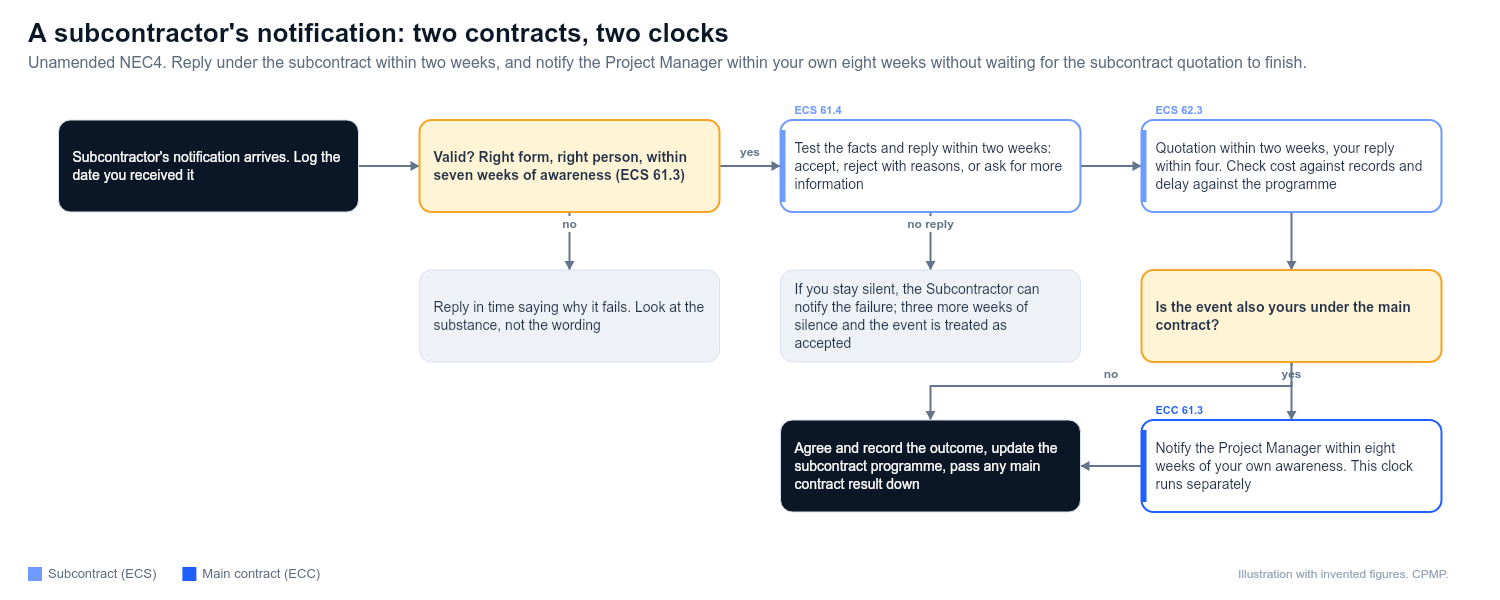
- Log the date you received it. Under the unamended NEC4 subcontract (ECS) you have two weeks to reply to a compensation event notification (61.4), and your clock may already be running. Check the communications clause, your Subcontract Data and any Z clauses, because the period can be amended. Clause 13 of the main ECC is the model for how communications work.
- Check it is valid. Did it come in the right form, to the right person, and within the Subcontractor's own notification period? Under the unamended NEC4 ECS that is seven weeks from becoming aware (61.3), not the main ECC's eight. See time bars for subcontractors.
- Identify the event. Match what they say happened to the list of compensation events in your subcontract. Check the exact wording in your contract.
- Test the facts. Did the event happen? Was it caused by you, the Client, another trade or the Subcontractor? Look at your own records.
- Reply in writing within the period. Accept the event, reject it with reasons, or ask for more information. A silent response can leave you worse off than a reasoned refusal: under the unamended NEC4 ECS, if you do not reply the Subcontractor can notify the failure, and if it continues for a further three weeks the event is treated as accepted and as an instruction to submit quotations.
- Ask for the quotation if the event is accepted or may be, with details of cost, programme effect and a revised programme. Under the unamended NEC4 ECS the Subcontractor has two weeks to quote once instructed to, and you have four weeks to reply to the quotation (62.3). For the main contract see clause 62 and CE quotation template and guide.
- Assess it. Check cost against rates and records, and check any delay claim against the programme. See delay analysis basics.
- Pass it up. If the event is also yours, notify a compensation event to the Project Manager within the eight weeks in clause 61.3 of the main ECC (NEC4 and NEC3), or whatever period your contract states. The main contract clock runs separately from the subcontract one, so do this without waiting for the subcontract quote to finish.
- Agree and record the outcome, and update the subcontract programme and dates.
What to record
- The Subcontractor's notification, the date and method of receipt.
- Your reply and the date sent.
- Your assessment, with working and sources.
- Site records that confirm or contradict the event.
- The matching main contract notification, if there is one.
- The revised subcontract programme and any change to dates.
What not to do
- Do not let the reply period lapse.
- Do not reject a notification only because it is badly worded. Look at the substance.
- Do not agree an event with the Subcontractor and then fail to notify the Client.
- Do not assume the Client will accept the Subcontractor's number.
- Do not mix events together. Assess each separately.
When to get help
Involve your commercial manager if the sum is significant or the event also touches the main contract. Bring in a planner when the delay claim is complex or the effect on your own critical path is unclear. Take legal advice if the Subcontractor says you have waived your rights by not replying, or if the dispute is heading for adjudication. See adjudication under NEC.
Example
A Subcontractor notifies a compensation event because the Contractor changed the access route. The Contractor checks the instruction and finds it did give the change. It replies within its period accepting the event in principle and asks for a quotation. It sees that the change came from the Client's design change, so it notifies a compensation event to the Project Manager within its own eight weeks, which is a week longer than the subcontract allows the Subcontractor. When the main contract event is assessed, it passes the outcome down.
Related guides
- Compensation events in plain English
- CE quotation template and guide
- Time bars for subcontractors
- NEC subcontracts explained
This guide is general information, not legal advice. Check it against your contract.