
Running NEC communications day to day: notices, logs and systems
A practical guide to clause 13: what counts as a valid communication, keeping notices separate, and the log that stops you losing an entitlement.
On this page
Every right you have on an NEC contract rests on someone sending, receiving and recording the right message in time. Three habits protect you: send each notification on its own, know the moment each message takes effect, and log every item against the date its reply is due.
In plain English
Under NEC, a message only counts if it can be read, copied and kept. A conversation in the site cabin does not. Notices must travel on their own rather than inside something else. Anything with a contractual consequence goes in a log with its reply date, so nothing expires unnoticed.
What clause 13 asks of you
- Form (13.1). Readable, copyable and recordable, in the language of the contract. Emails and system messages can qualify. Phone calls cannot.
- When it takes effect (13.2, NEC4). If the Scope names a communication system, the message takes effect through that. If not, it takes effect when it reaches the last address notified, or the one in the Contract Data (the project-specific details section).
- Reply time (13.3). The period for reply applies unless the contract gives that item its own time.
- Replying to a submission (13.4). Anyone refusing to accept must say why, in enough detail that you can put it right.
- Extending a period (13.5). Both sides must agree before the reply is due, and the agreement is recorded.
- Separate notices (13.7). Notifications, and in NEC4 certificates, must not be mixed with other communications.
- Withholding acceptance (13.8). If the reason is one the contract gives, it is not a compensation event. For any other reason it may be (clause 60.1(9)).
NEC3 is plainer. Its clause 13.2 makes a message effective once it arrives, at the address most recently notified or else the one given in the Contract Data. A communication system is not mentioned, so where the Works Information or a Z clause requires one, work out how the two sit together.
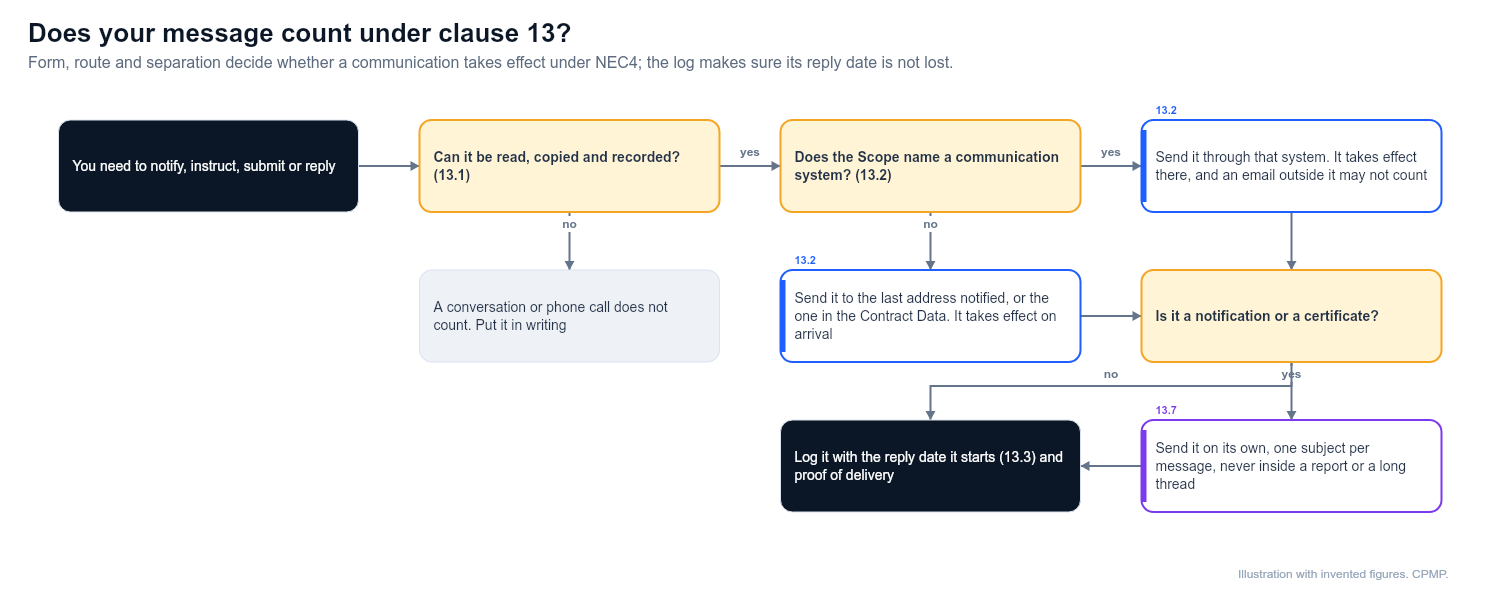
Keep each notice on its own
Put a notice inside a progress report or far down an email thread and you hand the other side a ready argument that it was never validly given. The fix costs nothing. Send one notification per message with a subject line that says what it is, for example "CE-014 Notification: buried culvert at chainage 240". Agree a reference prefix for each type so anyone can find it two years on.
What you will send most
Notifications (early warnings, compensation events, Defects, failures to reply), instructions from the Project Manager (the person the Client appoints to run the contract), submissions for acceptance such as programmes and subcontractor names, quotations, and certificates for payment, Completion and Defects.
Building a log that works
Give every item its own row with:
- Reference and type, and the clause you act under
- Who sent it, who received it, and when
- Whether a reply is due, and the date and basis for it
- What came back, when, and a few words on content
- Any extension, with the date agreed and the new deadline
- A link to the document, plus proof of delivery if it did not go through a contract system
Systems and meetings
Where the Scope names a system, use it for everything the contract requires. An email sent outside it may fail to count however clear it was. Where none is named, settle a project mailbox and subject format at the kick-off meeting.
Minutes show what was discussed, yet they rarely work as an instruction or acceptance. Where a meeting decision needs contractual force, follow it with the proper communication. The same goes for a word in the corridor, and doubly for anyone telling you to just crack on.
What people get wrong
- Reply-all chains. The key point sits in email five of a long thread and no one can find it. Begin a fresh message.
- Writing to a person rather than a role. When they leave, their mailbox is shut. Use the notified address.
- Vague wording. "Please note the delay" does not clearly notify anything. Name the clause.
- Calling everything a formal notice. Important ones get buried and relationships strain. Keep casual contact casual, and log only contract actions.
Related guides
This guide is general information, not legal advice. Check it against your contract.