
NEC contract kick-off meeting: who attends, what to agree and what to avoid
How to use a kick-off meeting to get your team and the Client's team running the same NEC procedures from day one, with an agenda and a live exercise.
On this page
A kick-off meeting is where you and the other side agree, out loud and in front of the right people, how the NEC procedures will actually run. The contract does not require one, so it is worth only what you put into it. Aim to leave with names against jobs and dates in diaries, not with a warm feeling.
Hold it around the starting date and allow two to three hours. It is cheap insurance in the first month of a job.
In plain English
NEC runs on short deadlines and written notices. If nobody agrees who does what on day one, the first missed deadline will teach you the lesson at your own expense.
Who should come
- The Project Manager (the person the Client appoints to run the contract day to day) and anyone holding delegated actions.
- The Supervisor (who checks quality and tests on site).
- Your project lead, planner, commercial lead and site manager.
- The Client's representative, if the Client makes decisions the Project Manager depends on.
- Major subcontractors whose timing is critical.
Planners and site managers matter more than senior directors, because they spot events and run the clocks.
Agenda, grouped by what it settles
Behaviour and people
- What working with mutual trust means in practice (clauses 10.1 and 10.2).
- Who acts for whom, who covers leave, and who the key people are (14.2).
Paperwork
- How communications travel, how they are numbered, and what counts as a separate notice (13.1, 13.2, 13.7).
- The period for reply, and how an extension is asked for and recorded (13.3, 13.5).
- The first Early Warning Register, first meeting date and meeting pattern (15.1 to 15.4).
Time and money
- Programme software and format, first submission date, revision interval, float and time risk allowance (31.1, 31.2, 32.2).
- Compensation events: how much detail quotations need and how often they are reviewed (61 to 64).
- Payment: first assessment date, application format, records for cost-based Options (50.1, 50.2, 52).
Delivery
- Quality plan timing, notice for tests, and what the Supervisor wants to witness (40.2, 41.3).
- Subcontract packages, acceptance of names and documents, and how notices pass through (26.2, 26.3).
- Who escalates to whom if something stalls, before any formal dispute.
Start with a one-page summary of the contract: main and secondary Options, changed periods, Z clauses and Key Dates from the Contract Data.
The exercise worth doing
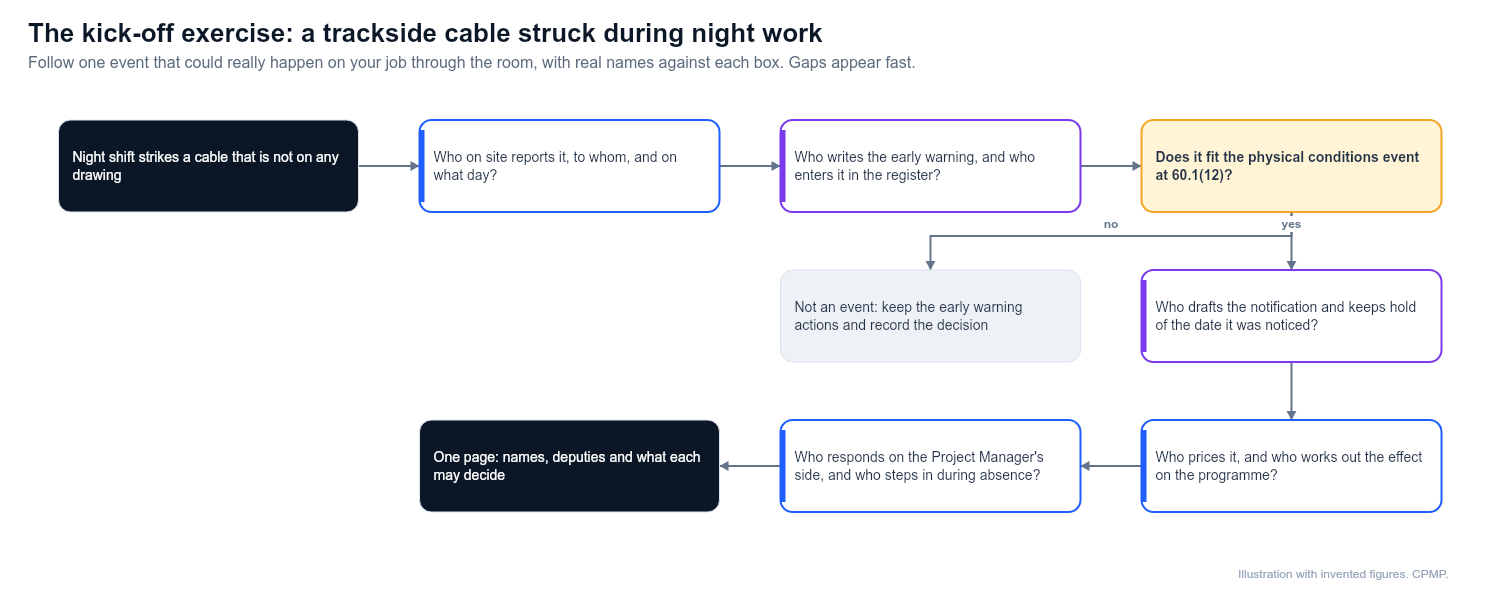
Take an event that could really happen on your job and follow it through with real names. Example, a rail possession: a trackside cable, not on any drawing, is struck during night work. Ask the room:
- Which person on site reports it, to whom, and on what day?
- Who writes the early warning, and who enters it in the register?
- Who judges whether it fits the physical conditions event at 60.1(12)?
- Who drafts the notification and keeps hold of the date it was noticed?
- Who prices it, and who works out the effect on the programme?
- Who responds on the Project Manager's side, and who steps in during absence?
Gaps appear fast. Typically nobody on site has heard of the eight-week limit, or the Project Manager has one technical adviser who cannot respond in time.
Leave with
- One page naming everyone, their role, their deputy and what they may decide.
- A reference scheme for each kind of communication.
- Diary dates: first early warning meeting, the next two commercial meetings, first programme submission.
- The first assessment date, or a named person who will confirm it.
- One owner per register.
Traps
- Changing the contract by remark. Someone saying "we won't bother with that notice" can leave you exposed. Record any genuine process change formally.
- Treating minutes as notices. Send instructions or warnings separately.
- Turning it into a general start-up. Safety and logistics need their own sessions.
- Never repeating it. Run a short version for new starters.
If the contract is NEC3, use risk reduction meetings and the Risk Register in place of early warnings.
Related guides
- Your first four weeks on an NEC contract
- Running an early warning meeting
- Mutual trust and co-operation
- Registers every NEC contract needs
This guide is general information, not legal advice. Check it against your contract.