
The Accepted Programme explained: which programme counts and why it matters
How a programme becomes the Accepted Programme under NEC, what it controls for delay and access, and the mistakes that leave contractors exposed.
On this page
The Accepted Programme is a single document at any moment. It is whichever programme the Contract Data (the part of the contract holding project-specific entries) names, or the most recent one the Project Manager has accepted. Each new acceptance retires the one before, and all time questions are answered against the current version.
The definition sits at clause 11.2(1) in NEC3 ECC and in the same place in the NEC4 subcontract. The capital letters matter: the plan on the site office wall, or a revision you sent last week and have not heard back on, is not the Accepted Programme.
In plain English
The Accepted Programme is the agreed yardstick. Delay, access and Client-supplied items are all judged against it, so you want the right one in force and you want to know exactly which version it is.
How a programme gets the status
- Named in the Contract Data. A tender programme or other document is written into the contract and counts from the start (NEC3 and NEC4).
- Accepted by the Project Manager. They notify acceptance under 31.3 (NEC3 and NEC4).
- Treated as accepted. The Project Manager fails to reply, you notify that failure, and a further week passes (31.3). This applies in NEC4 only. See deemed acceptance of a programme.
What the status does for you
It does four jobs.
- Delay is measured from it. To work out how far an event pushes the Completion Date or a Key Date, you compare against this programme (NEC4 63.5, NEC3 63.3).
- It tests the Client's promises. If site access or Client-provided items come later than the dates shown on it, that points to events under 60.1(2) and 60.1(3).
- It sets expectations for Others. If the Client or other parties do their work outside the times it shows, that can be an event too (60.1(5)).
- It decides who prices the time. Without one, the Project Manager forms their own view of the programme for the remaining work and assesses the event on that (64.2).
What it does not do
It does not change the Completion Date. A programme can show planned Completion after that date and still be accepted; the date itself only moves when the contract says so, typically through an implemented compensation event. The gap between the two is covered in terminal float.
It also does not shift risk onto the Project Manager. Clause 14.1 keeps your duties, and any design liability, with you. Someone accepting a poor sequence does not make it their fault.
Example: which version applies?
A pumping station contract, invented dates.
| Date | What happens | Accepted Programme |
|---|---|---|
| 5 May | Revision 3 accepted | Revision 3 |
| 2 June | Revision 4 submitted | Revision 3 |
| 9 June | Project Manager instructs a change, which fixes the dividing date for the event | Revision 3 |
| 13 June | Revision 4 accepted | Revision 4 |
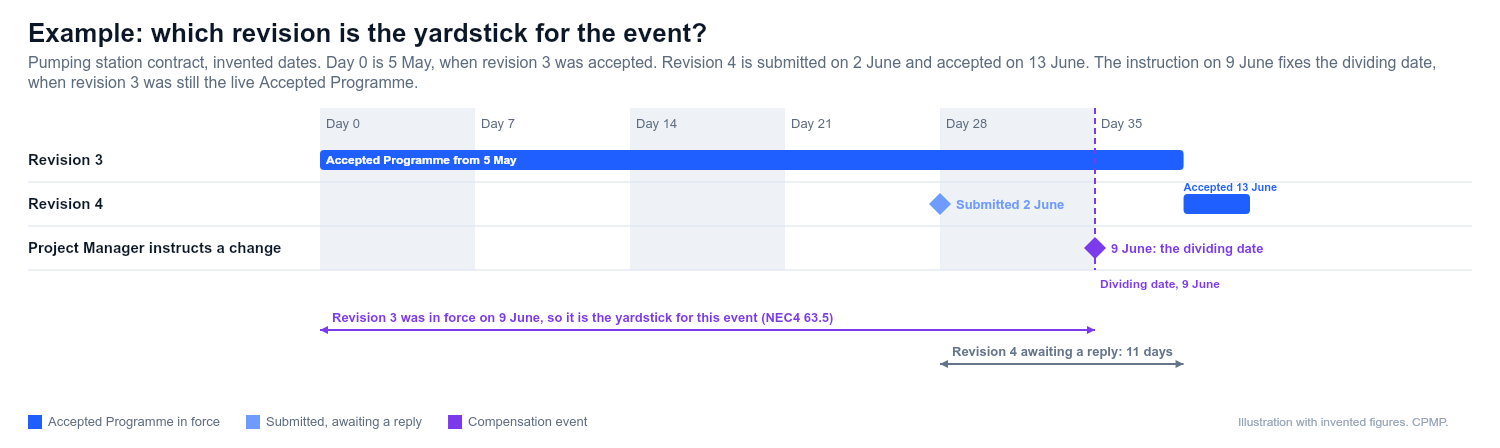
The change is dated 9 June, so under NEC4 revision 3 is the yardstick, because it was the live one on that day. That holds even though revision 4 gets accepted four days later and before your quotation is due. You should still bring revision 3 up to date for what happened before 9 June, so the old picture is not carried forward blindly. NEC3 63.3 says nothing about the dividing date, which means the same facts may be argued differently under that edition.
What people get wrong
- Thinking that sending it in is enough. Under NEC3 only acceptance counts. Under NEC4 you can also get there by the treated-acceptance route.
- Not keeping a log. Note each revision number, when it was accepted and which reply made it so. Disputed assessments often turn on this.
- Running without one. Months can pass with no Accepted Programme, which leaves you under 64.2 and facing the payment deduction described in submitting the first programme.
- Accepting dates you did not check. After acceptance, the access and Client-supply dates it shows are the ones that count, so test them against what the Client can really deliver.
Related guides
- Clause 31 programme checklist
- No accepted programme
- Programme and compensation events
- Revised programme submission timeline
This guide is general information, not legal advice. Check it against your contract.