
Defects under NEC: how the process works in plain English
A plain-English walk through how NEC handles Defects: the Supervisor, notifying, correcting, the Defects Date and what happens to uncorrected Defects.
On this page
Defects are one of the areas where site teams and commercial teams most often talk past each other. The NEC process is short and fairly simple, but it relies on the right person doing the right thing in writing. This guide explains the flow in plain English. It refers only generally to the Defects clauses (about clauses 40 to 46 of the ECC), so always read the actual wording in your own contract.
What a Defect is
A Defect is a part of the works that is not in accordance with the Scope (Works Information in NEC3), or, where the Contractor designs part of the works, a part that does not comply with the applicable law or with the design the Project Manager has accepted. Acceptance of a design does not change the Contractor's responsibility (clause 14.1). It is a defined term, so it does not just mean "something someone does not like". If the Scope does not require it, it is probably a change, not a Defect.
Who does what
| Person | Role in the Defects process |
|---|---|
| Supervisor | Searches for and notifies Defects, and checks that corrections have been made |
| Contractor | Corrects Defects, and must also notify any Defect it becomes aware of |
| Project Manager | Deals with the cost and programme side, including uncorrected Defects |
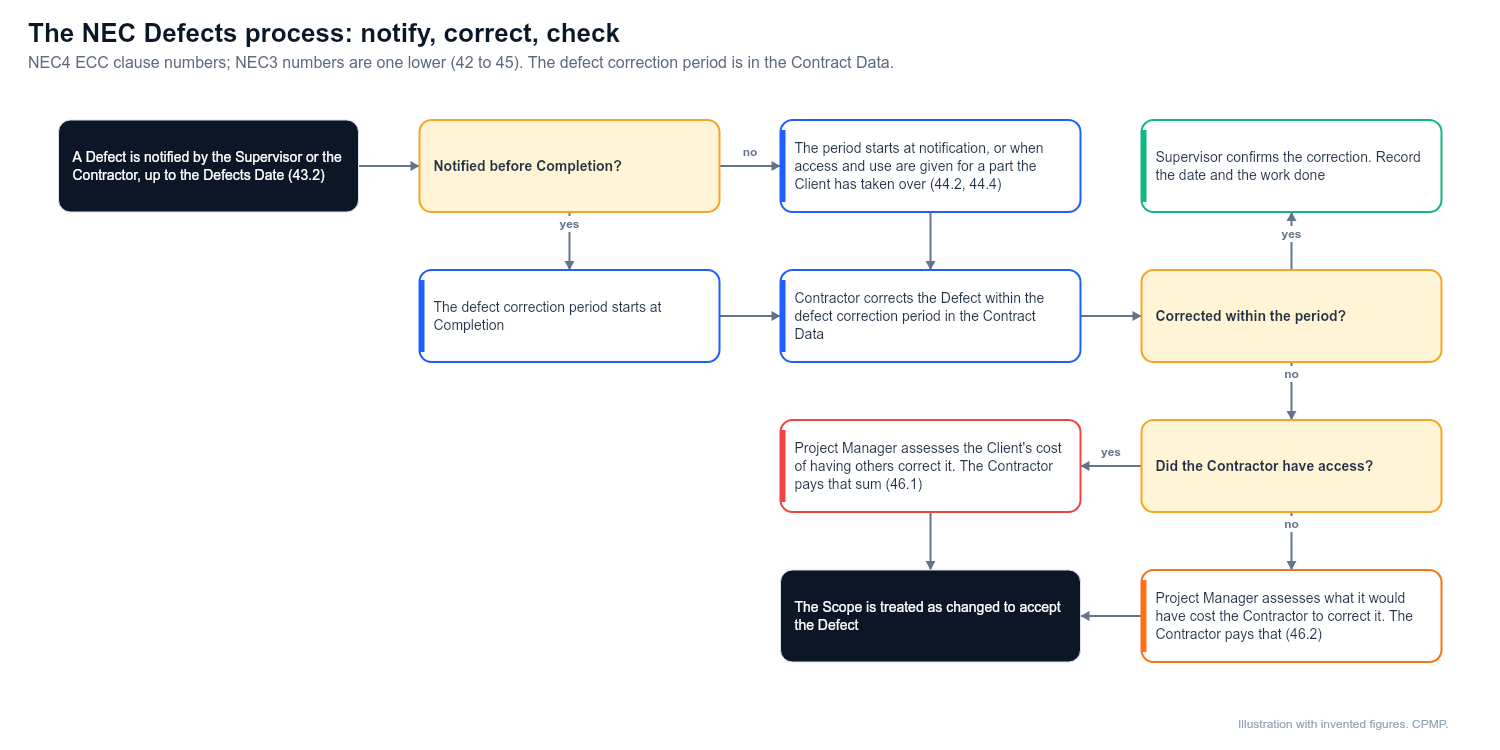
Under clause 43.2 in NEC4 (42.2 in NEC3), the Supervisor and the Contractor each notify the other of a Defect as soon as they become aware of it, up to the Defects Date. The Project Manager and the Client are not named in that clause. A Defect raised by anyone else is not a Defect notification under the contract. Say so politely and ask for it to come through the Supervisor.
The process, in order
- Looking for Defects. The Supervisor can search for Defects and may instruct tests and inspections. The contract sets out the Contractor's duty to give access and to help. Check the clauses on tests and inspections in your contract.
- Notifying. The Supervisor notifies the Contractor of a Defect. This is a communication under clause 13, so it must be in writing and in the form required by the communication system, and the reader should be able to tell exactly what and where the Defect is.
- Correcting. The Contractor corrects the Defect, whether or not it has been notified. The time allowed is the defect correction period in the Contract Data. For a Defect notified before Completion, the period starts at Completion; for one notified after Completion, it starts when the Defect is notified. Where the Contractor needs access to a part the Client has taken over, the period starts once access and use are given (44.2 and 44.4 in NEC4; 43.2 and 43.4 in NEC3). Check the periods in your Contract Data and any Z clauses.
- Checking. The Supervisor confirms whether the Defect has been corrected. Keep your own record of the date and the work done.
- Accepting. Either the Contractor or the Project Manager can propose changing the Scope so that a Defect does not have to be corrected (45.1 in NEC4, 44 in NEC3). If both are willing to consider it, the Contractor quotes lower Prices, an earlier Completion Date or both. Nothing changes unless the Project Manager accepts the quotation, and the correction period keeps running while you talk.
- Uncorrected Defects. If the Contractor had access but did not correct a Defect within the correction period, the Project Manager assesses the cost to the Client of having others correct it, and the Contractor pays that amount (46.1 in NEC4, 45.1 in NEC3). If the Contractor was not given access before the Defects Date, the Project Manager assesses the cost the Contractor would have incurred correcting it (46.2, 45.2). In both cases the Scope is treated as changed to accept the Defect.
The Defects Date
The Defects Date is a number of weeks in the Contract Data, counted from Completion of the whole of the works. It is the cut-off for searching for and notifying Defects through the contract's process, and it moves if Completion moves. It is not the end of the Contractor's liability: the Client's rights over any Defect that was never found or notified survive the Defects Certificate, under the general law. The Supervisor issues the Defects Certificate (44.3 in NEC4, 43.3 in NEC3) listing notified Defects not yet corrected, or stating that there are none. In NEC4 it is issued on the Defects Date if nothing notified is outstanding; otherwise when the final correction period ends or the last notified Defect is put right, whichever is first. NEC3 issues it once both the Defects Date and the final correction period have passed. Check any Z clause changes in your own contract.
Practical points for Contractors
- Keep a Defects register: reference, date notified, who notified, location, date corrected, date checked.
- Answer every notification in writing, even if you simply agree.
- Do not leave a disputed Defect unanswered. See The Supervisor has notified a Defect I disagree with.
- Plan the correction work into your programme. Remedial work competes for the same resources as the rest of the job.
- Be careful what you call "snagging". An informal snag list from site is not necessarily a set of notified Defects, so confirm what has actually been notified.
Subcontractors
Under the Engineering and Construction Subcontract the same process runs between the Contractor and the Subcontractor, with the Contractor acting in the roles that the main contract gives to the Project Manager and Supervisor. Check that the periods in your subcontract line up with those in the main contract, because a gap between them leaves someone carrying the risk.
Related guides
- Completion, take over and the Defects Date explained
- Keeping records under NEC
- Avoiding disputes under NEC
This guide is general information, not legal advice. Check it against your contract.