
What the NEC Defects Certificate is and what follows from it
The Defects Certificate lists uncorrected Defects or says there are none. See when it is issued, what it triggers and what it does not release.
On this page
Many people read the Defects Certificate as a pass mark. It is closer to a snag list with a deadline. The Supervisor (the person who checks quality for the Client) issues it when the defects process runs out, and it either names the notified Defects (work that does not meet the Scope) that you have left uncorrected, or says that none remain. The clause is 44.3 in the NEC4 ECC and 43.3 in NEC3.
In plain English
The certificate marks the end of your obligation to fix notified Defects, and it starts the money wrapping up. It does not declare the job perfect and it does not protect you from faults nobody has found yet.
Timing, by edition
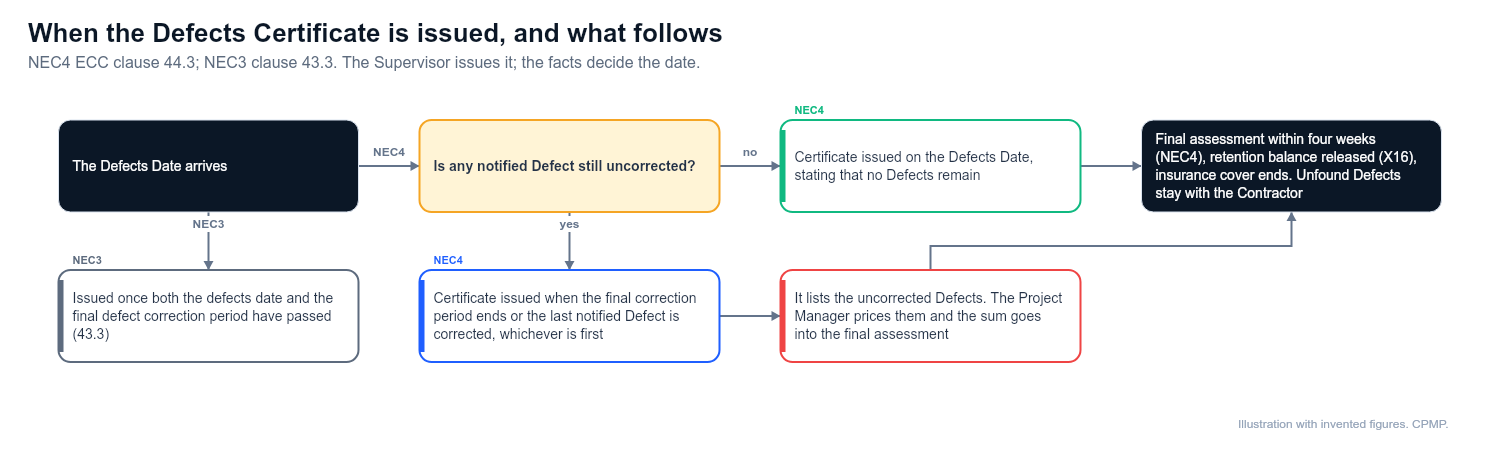
- NEC3: after both the defects date and the final defect correction period have gone by.
- NEC4: on the defects date itself if nothing notified is still open. Where something is open, it arrives at the end of the final correction period or when the last notified Defect is fixed, whichever happens first.
So NEC4 can bring the certificate forward once everything is corrected. The Supervisor does not need the Client's permission: the facts decide. Check your own wording if the contract is amended.
What flows from it
- Final assessment. In NEC4 the Project Manager then has four weeks to assess the final amount due.
- Retention. Under Option X16 nothing is held back after it.
- Insurance. Cover required by the Insurance Table lasts until this certificate or a termination certificate.
- Low performance damages. With Option X17, a listed Defect that leaves performance below the stated level triggers these.
- Design liability cap. Option X18 can limit liability for design Defects that are not listed on it.
- Taken-over parts. Some limits on the Client's liability for parts it has taken over stop at this point.
What it does not do
It is not a clean bill of health. The Client keeps its rights over any Defect that has not been found or notified, and the certificate does not accept the items listed on it. Suppose a drain fails two years on through poor workmanship nobody spotted. The Client may still claim under general law within the limitation period, which can depend on whether the contract was signed as a deed. Take legal advice on any particular case.
Items listed on it
A listed item is a notified Defect still uncorrected. The Project Manager would normally price those as uncorrected Defects and the sum goes into the final assessment. An accurate list therefore matters in money terms to you.
What people get wrong
- Delaying the certificate because a fresh problem turned up after the defects date. New problems do not reopen the notify-and-correct process.
- Treating it as a bargaining chip in final account talks.
- Issuing it with neither a list nor a statement.
Your own checklist
- Keep a register of every notified Defect and how it closed.
- Work out the last correction period from the correct start date.
- Compare your list with the Supervisor's before the date arrives.
- If the certificate is late, ask for it and note the date.
Example
A fictional boundary wall job has one open item as the defects date passes: a coping stone at grid C4, notified 9 March and still not replaced. When its correction period ends without the stone being replaced, the Supervisor issues the certificate naming that single item and stating that no others remain.
Related guides
- Defects under NEC
- Completion, take over and the defects date
- When retention is released
- The final assessment
This guide is general information, not legal advice. Check it against your contract.