
How early warnings work for NEC subcontractors
Who a subcontractor warns, how warnings travel up and down the chain, and why the subcontract time limits are shorter than the main contract's.
On this page
If you are a subcontractor on an NEC subcontract, you warn the Contractor, not the Project Manager. The Contractor plays the Project Manager's part in your subcontract, and nothing you say reaches the main contract unless the Contractor passes it on. The duty sits in clause 15 of the NEC4 Engineering and Construction Subcontract (ECS), and in clause 16 of the NEC3 form.
In plain English
Send your warning up one link of the chain, and expect the Contractor to decide whether the main contract is affected too. Do not assume the main contract's time limits apply to you: they are longer.
What differs from the main contract
- The parties are the Contractor and the Subcontractor, and the Contractor keeps the register.
- The first register is due a week after the subcontract starting date and the first meeting within two weeks of it. Later meetings follow the interval in the Subcontract Data.
- Either party may give the optional warning about the Subcontractor's own cost.
- Under the NEC4 ECS the Contractor may instruct you to join its own meeting with the Project Manager, where a matter touches both contracts. NEC3 has nothing like it: there, you join a main contract risk reduction meeting only if the Project Manager and the Contractor agree.
How a warning travels
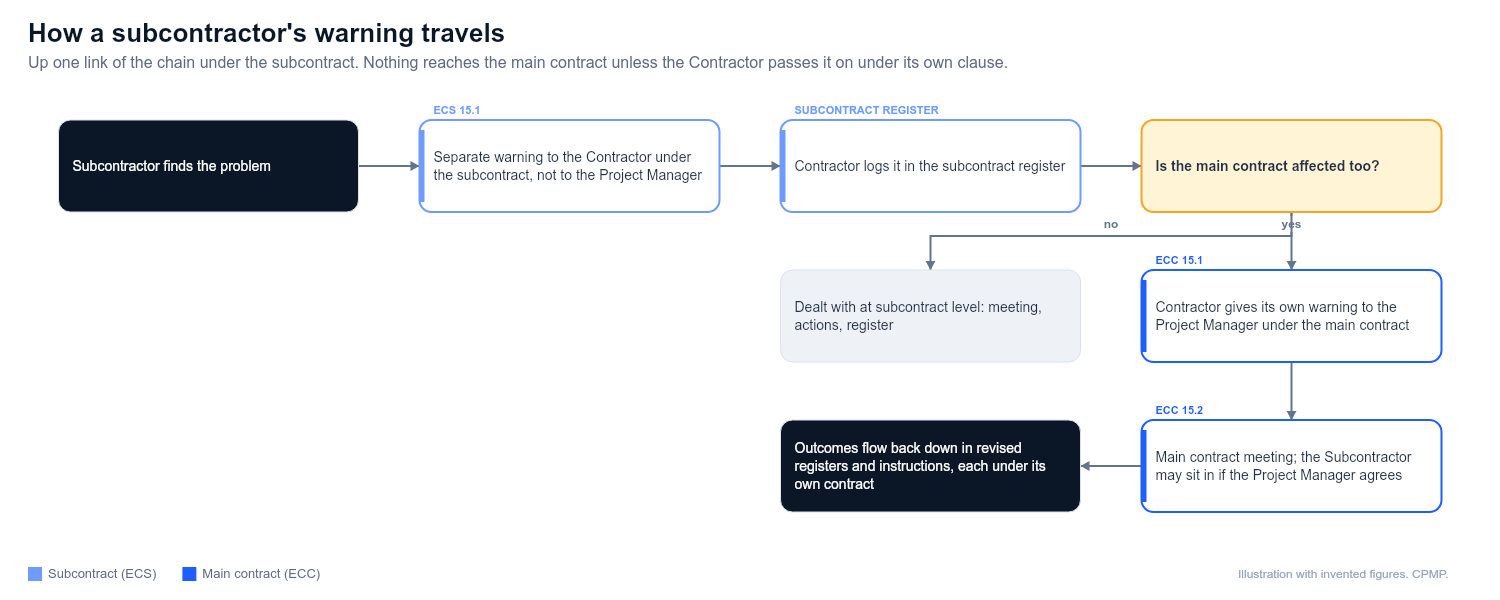
Up, when you find the problem
- Send the Contractor a separate notice under the subcontract.
- The Contractor logs it in the subcontract register.
- The Contractor asks whether the main contract is affected and, if so, warns the Project Manager itself.
- Where talking together would help, the Contractor can propose that you sit in on the main contract meeting; the Project Manager must agree (15.2 of the ECC).
- Outcomes flow back down in the updated registers and in any instruction, each under its own contract.
Down, when the Project Manager or Client raises something
- The Project Manager warns the Contractor.
- The Contractor works out which subcontracts are touched and warns those Subcontractors.
- Under the ECS the Contractor may instruct them to attend the main contract meeting.
A gap in the chain costs both levels
Suppose an experienced subcontractor would have warned and you did not. The Contractor can say so under 61.5 of the subcontract, and your event is valued as if you had (ECS 63.7). Upstream, the Contractor's own position depends on what a contractor of its experience could have warned about, and your lapse does not let it off against the Client. Contractors do best when information really flows, not when forms merely exist.
The clocks are different
The warning timetable mirrors the main contract. The periods for compensation events do not. These are the unamended forms, so check yours.
| Step | NEC4 ECC | NEC4 ECS |
|---|---|---|
| Notify an event (61.3) | 8 weeks | 7 weeks |
| Reply to the notification (61.4) | 1 week | 2 weeks |
| Submit a quotation (62.3) | 3 weeks | 2 weeks |
| Reply to a quotation (62.3) | 2 weeks | 4 weeks |
The shorter notification period leaves the Contractor room to pass your information on. Having warned does not stop your own clock.
Other subcontract types
- NEC3 Short Subcontract (ECSS). Clause 16 contains the warning duty and a duty to co-operate, with no register or formal meetings. A missing warning can still reduce an assessment under 61.3 and 63.5. The NEC4 version has its own numbering, so read your own copy.
- Professional Service Subcontract (NEC4 PSS). Follows the same pattern, with its own list of effects.
- Non-NEC subcontracts. A bespoke or JCT-based form carries no such duty unless someone has added it. A Contractor with an NEC main contract above should think about doing so.
Practical tips
- Address notices to the Contractor, even when you talk daily to the Project Manager's team on site.
- Spell out any main contract impact you suspect; the link is easy to miss.
- Warn about your own subcontract Key Dates, which can differ from the main contract's.
- Pass the duty on to your own suppliers and sub-subcontractors.
Related guides
- An NEC guide for subcontractors
- Should a subcontractor warn the main contractor or the PM?
- Time bars for subcontractors
- NEC subcontracts explained
This guide is general information, not legal advice. Check it against your contract.