
I have noticed a problem that is not a delay yet: do I give an early warning?
When to give an NEC early warning, what it must cover, how to word it, and why giving one is almost always safer than waiting.
On this page
You have spotted something that might cause trouble, such as late design information, a ground condition or a supplier problem, but nothing has slipped yet. You are not sure it counts. This guide is written from the Contractor's side. Early warning is a two-way duty, so a Subcontractor and the Contractor each have it as well, subject to the subcontract.
The short answer
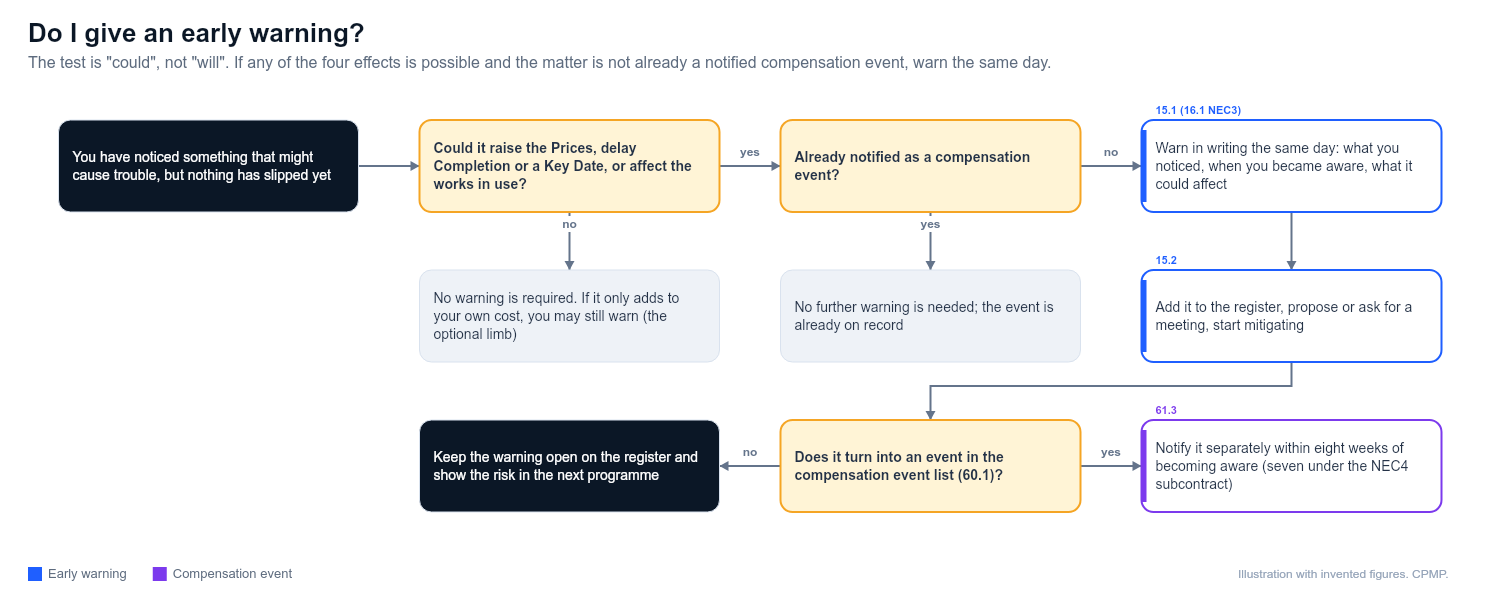
Give the early warning. The early warning clause (15.1 in NEC4, 16.1 in NEC3) requires each party to notify the other as soon as they become aware of any matter that could increase the total of the Prices, delay Completion, delay meeting a Key Date, or impair the performance of the works in use. The Contractor may also warn about anything else that could raise its own total cost. The test is "could", not "will". Waiting until you are sure usually means you are late. You do not need a warning for something already notified as a compensation event, and the Project Manager enters each warning in the early warning register.
What to do, step by step
- Test it against the clause. Ask: could this increase cost, delay Completion or a Key Date, or affect the works in use? If yes to any, it qualifies. Check your version and any Z clauses.
- Write it down the same day. Use the communication system in clause 13. Say what you have noticed, when you became aware, and what it could affect.
- Keep it factual. Describe the matter, the possible effect on time, cost or quality, and what you propose to do about it. Avoid blame.
- Propose or ask for a meeting. Either party may instruct the other to attend an early warning meeting (15.2 in NEC4, 16.2 in NEC3). See running an early warning meeting.
- Add it to the early warning register. See early warning register template.
- Start mitigating. Take reasonable steps to reduce the risk while discussions continue.
- Watch for it becoming a compensation event. If the matter turns into an event in the compensation event list (clause 60.1), the eight-week notification limit in clause 61.3 starts when you become aware that the event has happened (seven weeks under the NEC4 subcontract). Failing to warn does not lose the event, but if an experienced contractor could have warned, the Project Manager can have it assessed as if you had (61.5, then 63.7 in NEC4 or 63.5 in NEC3). See compensation events in plain English.
- Update the programme. Reflect the risk in the next revision, and mention it in the narrative.
What to record
- Date and time you became aware, and how.
- The wording of the early warning and when it was sent.
- Who received it and any reply.
- Photographs, emails, site records and instructions that show the issue.
- Mitigation actions taken and their effect.
- Meeting notes and actions agreed.
What not to do
- Do not wait for certainty. Early warning is for possible problems.
- Do not treat the early warning as a compensation event notice. It is not one.
- Do not issue vague warnings that say nothing. "There may be delays" is not useful.
- Do not use early warnings as a weapon or to cover yourself on every minor item. Over-warning hides real risk.
- Do not rely on a conversation on site. Put it in writing.
When to get help
Ask a planner if you cannot tell how the matter affects the critical path. Ask a commercial manager if it could become a compensation event or if you are unsure whether to notify as well. Take legal advice if a warning has already been ignored and you may rely on it later. See the Client ignored my early warning.
Example
A Contractor learns that a utility diversion needed before excavation may be two weeks late. Nothing has slipped yet. It emails the Project Manager that day: the diversion, the reason it may be late, the activities it could hold up, and an offer to meet. It adds the item to the register, resequences earlier work to protect the critical path, and records both. When the diversion is later confirmed late, the early warning is already on file.
Related guides
This guide is general information, not legal advice. Check it against your contract.