
What if you do not give an NEC early warning? The cost explained
How a missing early warning reduces what you recover on a compensation event under NEC, the Disallowed Cost risk, and how to respond to a 61.5 statement.
On this page
Staying quiet does not lose you a compensation event, but it can cost you part of its value. If the Project Manager (the person the Client appoints to run the contract day to day) concludes that an experienced contractor would have warned, the event can be priced as though you had. The same idea runs through NEC3 and the NEC4 Engineering and Construction Contract (ECC).
In plain English
The entitlement stays; the amount shrinks by whatever a prompt warning would have saved.
Three steps in the clause
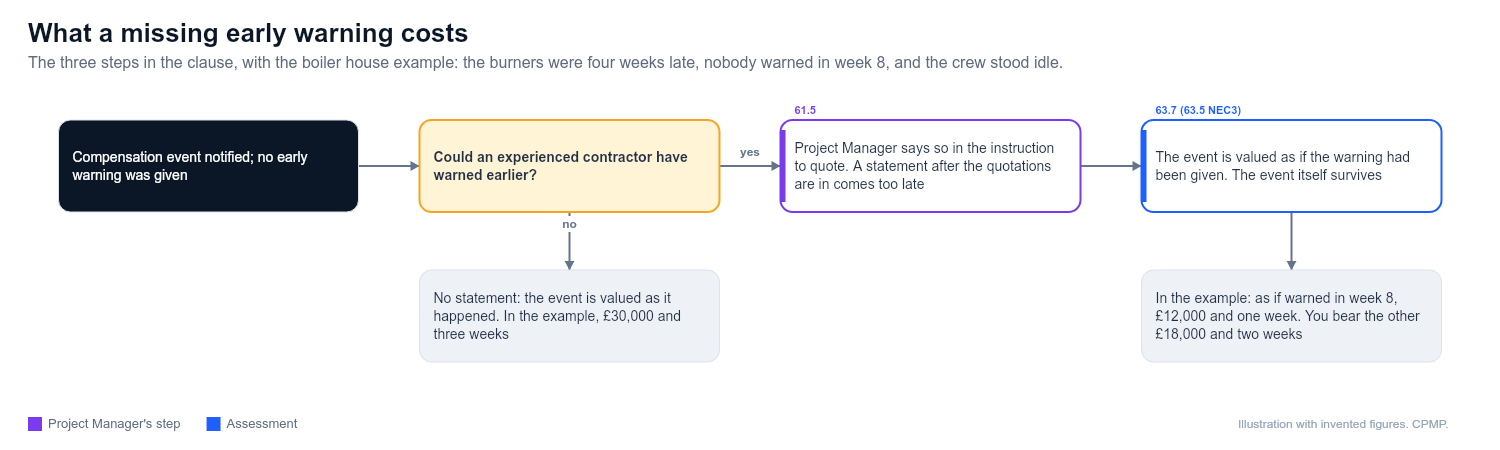
- The Project Manager forms the view that an experienced contractor could have warned and you did not (61.5).
- They must put that in the instruction asking you to quote (61.5), so a statement made once quotations are in comes too late.
- The event is then valued on the footing that the warning was given: 63.7 in NEC4, 63.5 in NEC3.
The test is objective. It is about what an experienced contractor could have done, not about what you personally knew.
A worked example
On an Option A boiler house refurbishment, the Client is to supply two burners, due in week 12 on the Accepted Programme (the programme the Project Manager has accepted as your baseline). In week 8 your buyer learns they are four weeks late. Nobody mentions it. They turn up in week 16 and you notify a compensation event.
- As it happened: the crew stood idle and was remobilised. Cost £30,000 and three weeks.
- With a warning in week 8: the crew moves to other tasks and burner fitting goes to the end. Cost £12,000 and one week.
If the statement holds, you recover the lower pair. You bear £18,000 yourself and have two weeks less time, which hurts if Option X7 delay damages apply. The contract gives no formula for this "as if" valuation, so it is a judgement, and judgements invite argument.
A second exposure on cost-based options
Under Options C, D and E, a cost you incurred only because you failed to give a warning the contract required is Disallowed Cost, so it is never paid. Look at 11.2(26) in NEC4 ECC and 11.2(25) in NEC3 ECC (11.2(26) in NEC3 Option F). This stands apart from the compensation event rule and can touch costs with no event behind them. "Only" is the limiter: the cost must trace to the missing warning, and the optional warning about your own cost does not count as one the contract requires.
What it does not do
- Remove the event.
- Apply by itself: the Project Manager must decide and say so.
- Reach a warning that would have changed nothing.
- Equal the time bar. Missing the period for notifying an event is a much harsher outcome, covered in time bars.
If you are on the receiving end
- Check the statement arrived with the instruction to quote.
- Pin down when anyone in your team first heard, using diaries, emails and supplier letters. Be straight about it.
- Decide what an experienced contractor could have known by then.
- Be realistic about what a warning would have achieved, and whether any option was cheaper.
- Show both figures in your quotation, as it happened and as if warned, so the gap is visible.
If you are the Project Manager
Apply it only where it is justified. Write down the facts, state your view in the instruction and say what you think would have happened. If you also knew and kept quiet, expect that to be put to you.
Related guides
- Early warning and compensation events
- Noticed a problem: do I give an early warning?
- Defined Cost, Fee and Disallowed Cost
- Time bars explained
This guide is general information, not legal advice. Check it against your contract.