
What an NEC early warning is and when you must give one
A plain guide to the NEC early warning duty: what triggers it, who owes it, how it differs from a compensation event notice, and the cost of staying silent.
On this page
An early warning is a notice that something might push up cost, delay the work or damage how the finished job performs. Under NEC either side must give it as soon as they become aware of the matter. This is an obligation in the contract rather than good manners, and it works best when it goes out while there are still cheap ways to deal with the problem.
In plain English
Tell the other side about a possible problem as soon as you know about it, even if you do not yet know how big it is. A warning does not say who is at fault and does not change the price or the dates. It just starts the conversation while there is still room to act.
What triggers the duty
In the NEC4 Engineering and Construction Contract, clause 15.1 (16.1 in NEC3) tells the Contractor and the Project Manager, the person the Client appoints to run the contract day to day, to warn each other of anything they learn that could:
- increase the total of the Prices,
- delay Completion,
- delay meeting a Key Date (a date in the Contract Data by which stated work must be done), or
- reduce how well the works perform once in use.
The Contractor has a further option to warn about other things that could raise its own total cost. That limb is a choice; the four above are compulsory.
Three words carry the weight. "Could" is a low bar: the problem need not be likely. "Aware" means the duty starts when you know, not when you have finished investigating. And the duty runs both ways, so a Project Manager who only expects warnings from the Contractor has misread the clause.
Early warning or compensation event notice?
People mix these up, with costly results.
| Early warning | Compensation event notice | |
|---|---|---|
| Says | This might become a problem | A listed event has happened or is expected |
| Response | Logged on the register and talked through. It is never accepted or refused | A ruling on whether it qualifies, then quotations |
| Moves the Prices or dates? | No, not on its own | Yes, once assessed |
| Clauses (NEC4 ECC) | 15 | 60 to 66 |
A warning does not stop the clock on notifying a compensation event. If the matter is also a listed event, you need the separate notice.
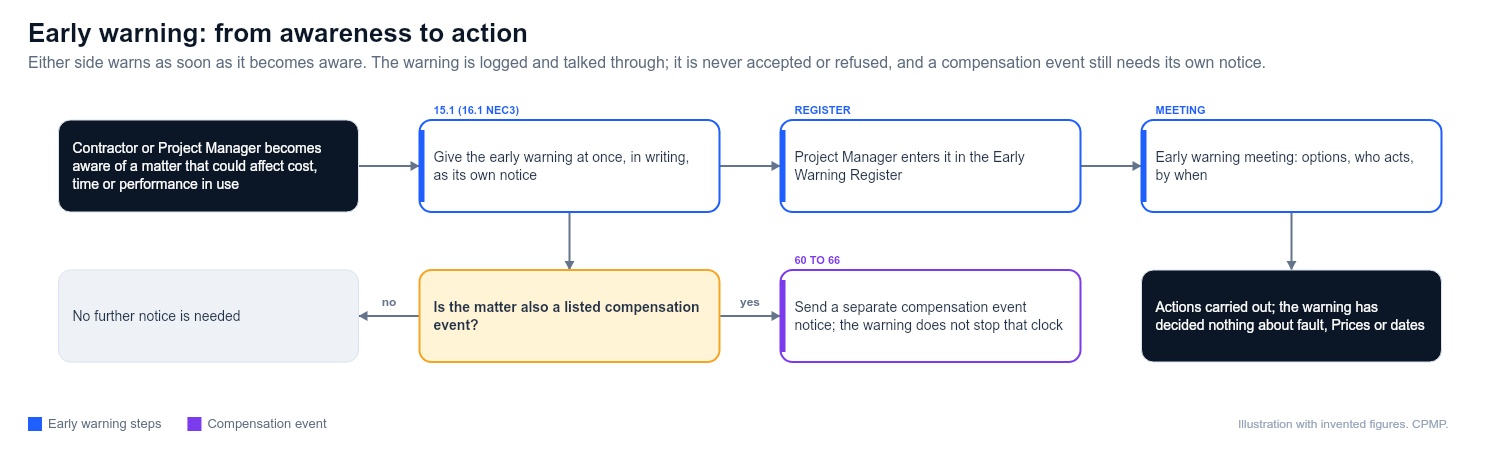
Why the contract asks for it
- Options narrow fast. A clash found on a drawing can be redesigned; found on site it means rework.
- Each side sees only part of the picture. You see suppliers and crews; the Project Manager sees what the Client intends and what is happening next door.
- Joint answers are often cheaper than either side acting alone.
What happens if you stay silent
If an experienced contractor could have warned and the Contractor did not, the Project Manager can have the related compensation event assessed as if the warning had been given (61.5 and 63.7 in NEC4, 61.5 and 63.5 in NEC3). You keep the event but pay for what an earlier warning would have saved.
A short example
A drainage subcontractor learns on a Monday that the precast chamber supplier has lost a shift, so delivery could slip by three weeks. The site manager sends a warning that afternoon. The Project Manager logs it and, in the same week, warns of their own: the highway authority may refuse a night closure that the chamber lift relies on. At the meeting both matters are dealt with side by side: the contractor will price an alternative supplier and the Project Manager will confirm the closure by Friday. Neither warning decided who pays, and both opened options.
Related guides
- Noticed a problem: do I give an early warning?
- Who gives early warnings
- Running an early warning meeting
- Early warnings and compensation events
This guide is general information, not legal advice. Check it against your contract.