
NEC time bars: which deadlines really cost you the right
Which NEC deadlines are true time bars, which only reduce what you recover, the exceptions to the eight-week rule, and how to stay safe.
On this page
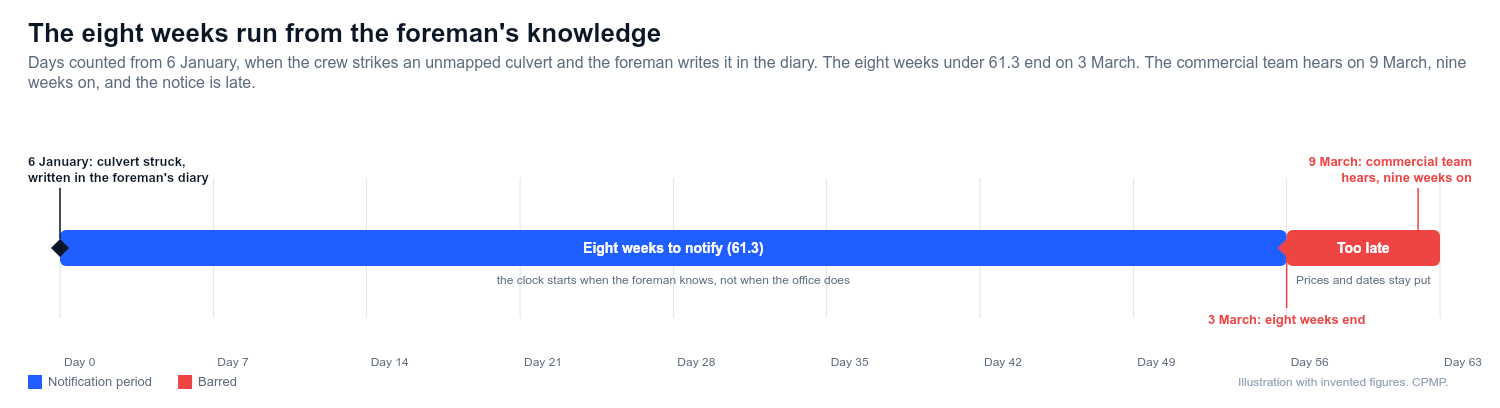
The one that matters most is the eight-week rule for compensation events. In NEC4 ECC (clause 61.3) you have eight weeks from becoming aware that an event has happened to notify it. Miss that and the Prices and dates generally stay put. A few other cut-offs exist, but most NEC deadlines have a milder consequence and are not time bars at all.
In plain English
A time bar means a missed date destroys the right itself. Many deadlines only reduce what you recover, or give the other side a next step. Knowing which is which tells you how hard to chase. Whether a bar bites in a specific dispute can be a legal question, so take advice on anything large. The NEC3 version of 61.3 turns on awareness of the event rather than awareness that it has happened.
The genuine cut-offs
- Notifying an event (61.3). Eight weeks from awareness. Late means no change to Prices and dates, subject to the exceptions below.
- Final event cut-off (61.7). In NEC3, no event may be notified after the defects date. In the NEC4 subcontract, after the Defects Certificate. In NEC4 ECC, check your own wording.
- Challenging the final assessment (53.3). Four weeks from issue to start the dispute route. Otherwise it becomes conclusive of what is finally owed.
- Objecting to an Adjudicator's decision (W1.4, W2.4). Four weeks to give notice that you will go to the tribunal. Otherwise the dispute cannot go further.
- Referring a dispute under W1. Limits in the Dispute Reference Table and W1.3. Miss them and the route to the Adjudicator can close.
Option W2 applies where the UK Construction Act does. Adjudication is available at any time (W2.2), as a contract cannot remove that right, but the four-week tribunal notice after the decision still applies.
When the eight weeks do not apply
An event arising from an instruction, notification, certificate or changed decision of the Project Manager or Supervisor is outside the bar. The Project Manager should have notified those themselves (clause 61.1), so your lateness does not remove them. NEC3 also covers a corrected assumption. A Scope change that was instructed but never notified is therefore still open months later, whereas a ground condition reported late is not.
Also note what starts the clock: you knowing about the event, not you realising it might be a compensation event. A foreman's knowledge usually counts.
Deadlines that look like bars but are not
- Early warning (15.1). No fixed date. Lateness means the event may be assessed as if you had warned (61.5, 63.7).
- Your quotation (62.3). The Project Manager may assess it instead (64.1). The event itself survives.
- The Project Manager's reply (61.4). Lateness opens the route to treated acceptance once you give notice.
- First programme (31.1). Where the Contract Data identified none, 25% is held back from the Price for Work Done to Date (50.5).
- Payment application (50.2). The Project Manager still assesses (50.4).
- Pay less notice (Y2.3). The notified sum generally stands for that payment. You lose the right for that cycle, not the point.
What people get wrong
A ground crew strikes an unmapped culvert on 6 January and the foreman writes it in a diary. The commercial team hears on 9 March, nine weeks later. The notice is late, and the Project Manager can reply that Prices and dates will not change. Another common error is bundling repeated incidents. A second blockage might be a new event or part of the first, so notify each one separately.
Staying safe
- Brief the people who see events first. Foremen start the clock, but rarely know it.
- Notify early and often. A notification doesn't fix your final position.
- Read your Z clauses. They often add bars or conditions on notices.
- Diary every four-week dispute window the day a final assessment or decision lands, and treat it as immovable.
Related guides
- Time bars for subcontractors
- Missed the eight-week deadline
- Early warnings and compensation events
- Time limits for disputes
This guide is general information, not legal advice. Check it against your contract.