
Compensation event notification checklist: make it stand up
A practical checklist for NEC compensation event notifications covering timing, content, form, evidence and follow-up.
On this page
A compensation event notification is short, but it carries a lot of weight. A vague or late one is easy to reject. This checklist is for the Contractor; a Subcontractor can use it against the terms of its own subcontract. Check your contract, Contract Data and any Z clauses for the specifics.
Before you write
- Is it on the list? Find the event in the compensation event clause (clause 60.1) of your contract. Note the exact wording. See compensation events in plain English.
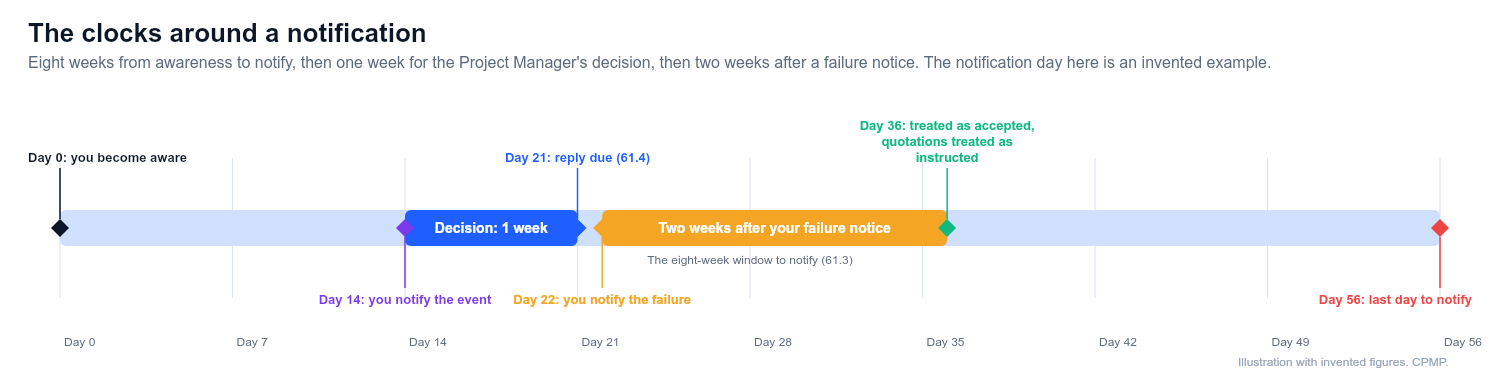
- When did you become aware? The Contractor must notify within eight weeks of becoming aware that the event has happened (clause 61.3; seven weeks under the NEC4 subcontract), or the Project Manager can reply that the Prices and dates will not change. Awareness of the event is what counts, not awareness that it might be a compensation event.
- Did it arise from the Project Manager's or Supervisor's own communication? Events from an instruction, notification, certificate or changed decision are exempt from the eight weeks, and the Project Manager should notify them itself at the same time (61.1). If it did not, notify the event yourself and quote the instruction and its date. That date is the dividing date for the assessment. Late access, Others' work, missed replies, ground and weather have no such communication behind them, so the bar applies in full.
- Is there an early warning? An early warning is not a notification, but it helps. See early warning.
What the notification should say
- Which contract and which Project Manager it goes to.
- What happened, in plain facts, with dates and locations.
- Which compensation event you say it is, by reference to the wording of the list.
- When you became aware, and how.
- Why it is not your risk, briefly.
- The likely effect on cost, Completion Date and Key Dates, even if only in outline.
- What you propose to do next, including any instruction you need.
- A request that the Project Manager reply. It has one week to decide whether it is a compensation event (61.4), and the only reasons for saying the Prices and dates will not change are that it is your fault, it has not happened and is not expected, it was notified late, it has no effect on Defined Cost, Completion or a Key Date, or it is not on the list.
Form and delivery
- Use the contract's communication system and form (clause 13). Check the Contract Data.
- Make it clear it is a compensation event notification, with a subject line saying so.
- Send it to the right person, with copies to the right people.
- Keep proof of sending and receipt.
- Date it, and keep the version you sent.
Evidence to attach or hold
- Instruction, drawing, email or record that shows the event.
- Photographs and site diary entries.
- The relevant extract of the Accepted Programme.
- Early warnings and meeting minutes on the topic.
- Initial cost records, kept separate from normal work.
After you notify
- Diarise the response date. The Project Manager has one week (61.4). If it stays silent, notify the failure as a separate communication. If there is still no reply two weeks after that, it is treated as accepting that the event is a compensation event and as having instructed quotations.
- Prepare the quotation. Clause 62.2 requires proposed changes to the Prices and any delay to the Completion Date and Key Dates, with details of the assessment, and a revised programme if the programme for remaining work changes. In the standard ECC you have three weeks from the instruction to submit it (62.3). Check your Contract Data and Z clauses for amended periods. See CE quotation guide.
- Keep recording. Costs and delays continue to accrue.
- Update the programme in line with the revised programme clauses.
- Follow up if there is no reply.
Common weaknesses
| Weakness | Fix |
|---|---|
| "We believe there may be a claim" | State the event and cite the contract wording |
| No date of awareness | Give the date and how you learned of it |
| Sent by the wrong route | Use the contract's communication system |
| No evidence behind it | Attach or reference the key records |
| Several events lumped together | Notify each event separately |
| Sent late | Notify anyway and explain, see missed the eight-week deadline |
Final check
Before you send, read it as the Project Manager would. Could they tell what happened, which event it is, when you knew and what you want? If not, rewrite it.
Related guides
- Told on site to do extra work, nothing in writing
- Keeping records under NEC
- PM rejected my quotation
This guide is general information, not legal advice. Check it against your contract.