
Adjudication under NEC: how it works and how to prepare
A general guide to adjudication under NEC: when it is available, how it runs, when to use it, and how to prepare a strong referral.
On this page
Adjudication is a fast, binding way to resolve a dispute during a project. It is not the same as going to court or arbitration, and the decision stands unless and until a later process changes it. This guide is general. The detail of your procedure is in the dispute resolution Option in your contract and in the rules it refers to, so check those first.
Where it comes from
Most UK construction contracts give a right to refer a dispute to adjudication at any time, under the Housing Grants, Construction and Regeneration Act 1996 (as amended, "the Construction Act"). NEC contracts build this into the dispute resolution Option. Option W2 is the adjudication procedure for contracts the Act covers, and Option W1 is used where the Act does not apply. Under W1 there are Senior Representatives and strict time limits that can end the right to take a dispute further, so the steps below are not the same. In NEC4, Option W3 sets up a Dispute Avoidance Board instead of adjudication, and is generally not suitable for a contract the Act covers. Which Option applies is stated in the Contract Data. Check your version and any Z clauses.
What it is for
Adjudication is typically used for disputes about money or time: payment, the value of a compensation event, extension of time, Defects and termination. It works best when the question is focused and the documents are good.
How it generally runs
- A dispute exists. A disagreement has been raised, a response has been refused or ignored, and the matter has crystallised.
- Notice of adjudication. One party serves a notice describing the dispute and the relief it wants.
- Appointment. An adjudicator is named in the contract or chosen through the nominating body listed in the Contract Data.
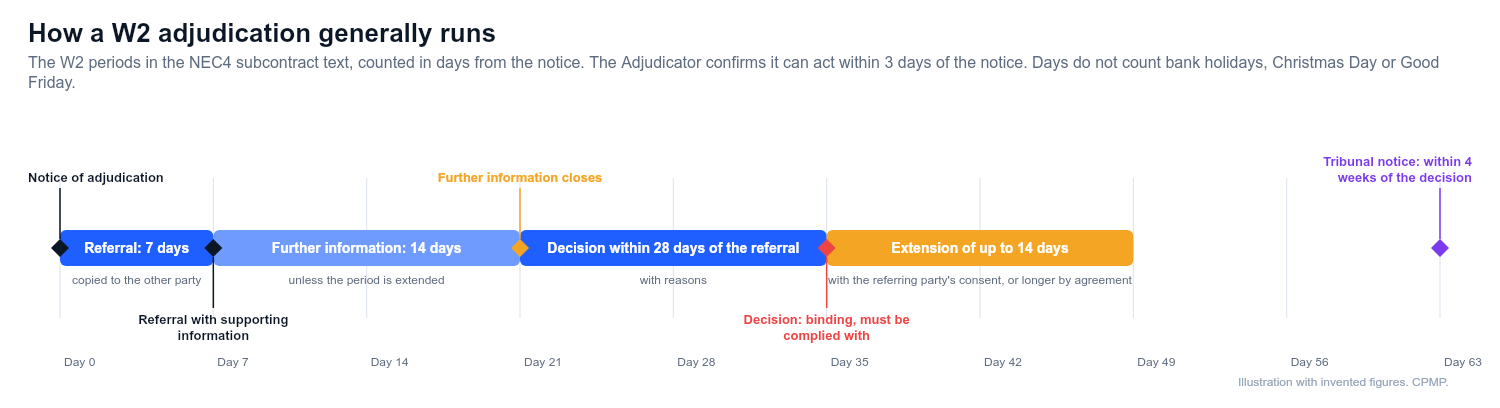
- Referral. Under W2 the referring party refers the dispute, with supporting information, within 7 days of the notice, and copies it to the other party. The adjudicator confirms it can act within 3 days of receiving the notice.
- Further information. Either party may provide more information within 14 days of the referral, unless that period is extended.
- Decision. The adjudicator gives its decision with reasons within 28 days of the referral. That can be extended by up to 14 days with the referring party's consent, or by any period both parties agree.
- Effect. The decision is binding and must be complied with. A party dissatisfied with it must notify its intention to refer the matter to the tribunal within 4 weeks of the decision being notified.
These are the W2 periods in the NEC4 subcontract text, and NEC3 W2 is very similar. Days do not count bank holidays, Christmas Day or Good Friday. Periods can be amended, so check your Contract Data and Z clauses. The timetable is tight, and missing a step can be costly.
When to use it
Adjudication is worth considering when:
- the dispute has a clear, limited question,
- you have documents that prove it,
- the money or time involved matters to cash flow,
- negotiation has been tried in good faith, and
- you can commit time and people to a short, intense process.
It is worth thinking twice when the facts are unclear, records are poor, or your case depends on a dispute that is really several disputes tangled together. A narrow referral is stronger than a broad one.
How to prepare
- Define the dispute. Write it as one or two sentences, and keep the referral to that dispute.
- Build the chronology. A dated list of events, each pointing to a document.
- Collect the contract documents. Contract Data, the relevant clauses, the Z clauses, the Scope (Works Information in NEC3).
- Gather the evidence. Notices, early warnings, compensation event notifications and quotations, programmes, correspondence, site records, cost records. See keeping records under NEC.
- Build the time case. If the dispute is about delay, you need a clear programme analysis. See delay analysis basics.
- Check your own compliance. Did you notify within the time limits? For compensation events, see missed the eight-week deadline.
- Plan the team. Decide who writes, who checks, and who is available during the short response windows.
- Take legal advice on jurisdiction, notice content, and the risk of costs.
Common mistakes
- Referring several disputes in one notice and losing focus.
- Underestimating how quickly the timetable runs.
- Exhibiting a huge bundle without guiding the reader through it.
- Treating the adjudicator as someone who will fill gaps in your evidence.
- Ignoring the other side's likely answer.
Related guides
This guide is general information, not legal advice. Check it against your contract.