
Running an early warning meeting that actually reduces risk
How to prepare, run and follow up an NEC early warning meeting so risks are owned, actions are recorded and the programme is protected.
On this page
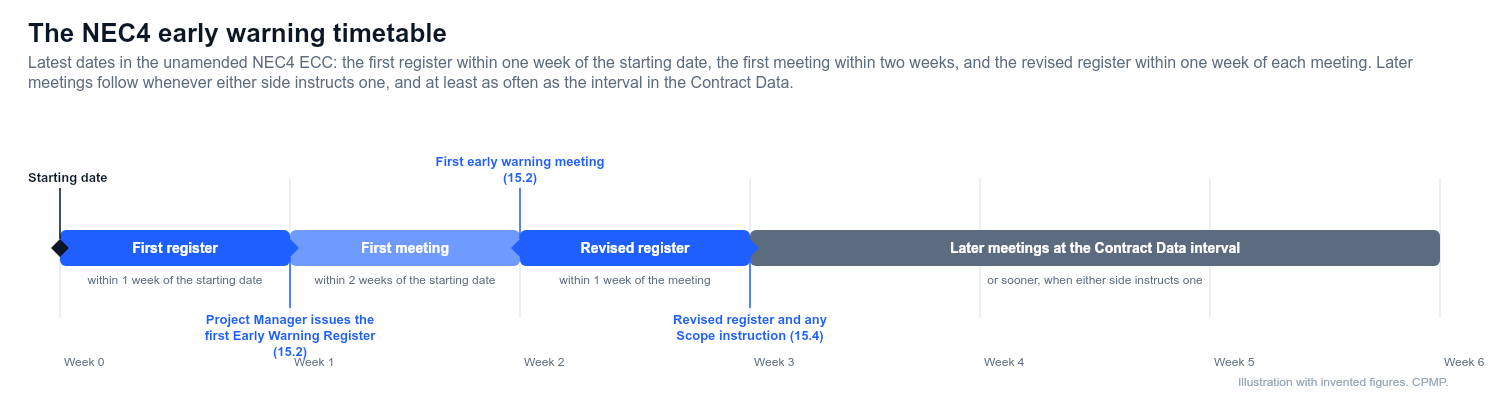
An early warning meeting is where NEC's collaborative intent is tested. Done well, it removes risk before it costs time or money. Done badly, it becomes a monthly ritual with no actions. The early warning meeting clause (15.2 in NEC4, 16.2 in NEC3) allows either the Project Manager or the Contractor to instruct the other to attend. NEC4 also sets a timetable: the Project Manager issues the first Early Warning Register within one week of the starting date, the first meeting is held within two weeks, and later meetings follow whenever either side instructs one and at least as often as the interval in the Contract Data, until Completion of the whole of the works. NEC3 has no fixed times. Check the Contract Data and any Z clauses, because these periods can be amended.
Purpose
The aim is to cooperate in making and considering proposals for how the effect of each risk can be avoided or reduced, to seek solutions that bring advantage to all those affected, and to decide who should take action. Those attending also agree which matters can leave the register, and under NEC4 they review the actions already recorded and change them if needed (15.3). Others, such as a designer or subcontractor, can attend if the other side agrees. A meeting can only decide actions that fit the contract: agreeing that someone will "just absorb it" does not change the Prices or the Scope. Clause 10.2 (mutual trust and co-operation) is the spirit behind it.
Before the meeting
- Circulate the register. Send the early warning register at least a day beforehand, with new items marked.
- Bring programme evidence. For each significant risk, know which activities it touches and how much float is left. A planner's view is useful here.
- Agree attendees. Include whoever can actually make decisions or take actions, not only whoever is available.
- Set a short agenda. New items, open items, actions overdue, risks that have closed.
Running it
| Step | What to cover |
|---|---|
| New warnings | Describe the matter, who raised it, possible effect on time, cost and quality |
| Ownership | Name one owner per risk, not a department |
| Options | Avoidance, reduction, transfer, acceptance. Note the cost and time of each |
| Decision | Agree the action, the person and the date |
| Programme effect | State whether it affects the critical path or a Key Date |
| Open items | Review progress on previous actions |
Keep discussion about the risk, not about who caused it. Fault arguments belong elsewhere.
After the meeting
- Issue a record promptly. Under NEC4 the Project Manager revises the register to show the decisions and sends it to the Contractor within one week of the meeting (15.4). If a decision needs a change to the Scope, the Project Manager's instruction goes out at the same time, and it is normally a compensation event. Without that instruction the Contractor has no contractual basis for changing what it builds. NEC3 sets no fixed time, so send your own note if nothing arrives.
- Update the register. Add owners, actions, dates and status.
- Update the programme. Add mitigation activities or change logic where decisions require it. Mention significant changes in the next programme narrative. See writing a programme narrative.
- Check compensation event status. If a risk becomes an event, remember the notification period in clause 61.3. A matter raised only by mentioning it in the meeting may not count as a separate notification, so follow up with a written notice the same day. See compensation events in plain English.
- Chase the actions. Raise overdue items at the next meeting.
What makes a meeting useful
- Short, regular and well prepared.
- Numbers where possible: days of float, cost ranges, dates.
- Named owners with dates.
- Honest discussion of the Contractor's own risks, not just the Client's.
- A register that is current, not a list of old items.
What makes it useless
- Long meetings that revisit closed items.
- No decisions, only discussion.
- Actions given to "all".
- No minutes, or minutes that arrive weeks later.
- Risks that never leave the register.
Subcontractors
If you are a Subcontractor, the subcontract may set up its own meetings. Ask for the Contractor's early warning process to be extended to you, and give your own warnings in writing.
Common failure: the meeting is held but the warning was ignored
If actions are agreed and then not delivered, record it and follow it up in writing. See the Client ignored my early warning.
Related guides
- Early warning register template
- I have noticed a problem: do I give an early warning?
- Float and time risk allowance explained
This guide is general information, not legal advice. Check it against your contract.