
Does an early warning protect my compensation event claim?
An early warning and a compensation event notice are different documents. Learn why one does not cover the other and how to avoid the eight-week trap.
On this page
You raised an early warning weeks ago, it is on the register, and everyone has discussed it at meetings. Surely the Project Manager (the person the Client appoints to run the contract day to day) knows about it? Unfortunately, that is not enough.
The short answer
No. An early warning flags a risk. A compensation event notice (a compensation event is an NEC event for which the Client carries the risk, so your price and dates can change) starts a different process. Only the notice protects you against the eight-week limit in clause 61.3. If you think an event qualifies and the Project Manager has not notified it, send your own separate notice now.
What to do, step by step
- List every warning on the register that might turn out to be a compensation event.
- For each one, find the date you became aware of the event. The warning itself often proves that date.
- Count eight weeks forward from that date. On the NEC4 subcontract the period is seven weeks.
- If time remains, send the notice now, as its own document. Do not wait for the next meeting.
- If the event came from a Project Manager or Supervisor instruction, the time limit does not apply, but notify anyway if the Project Manager has not.
- If the date has gone, read what to do after missing the eight-week deadline.
How the two documents differ
| Early warning | Compensation event notice | |
|---|---|---|
| NEC4 clause | 15.1 (16.1 in NEC3) | 61.1 for the Project Manager, 61.3 for you |
| Says | Something could affect cost, time or quality | An event has happened or is expected and is a compensation event |
| Aim | Reduce the effect | Change the Prices and dates |
| Deadline | As soon as you are aware | Eight weeks from awareness |
| Reply | Goes on the register | Project Manager answers within one week (61.4) |
What to record
- The date you first knew the event had happened or was coming.
- The wording of the warning, and every later email or minute that mentions the matter.
- The notice itself, with proof of when and how it was sent through the contract's communication system.
- The compensation event sub-clause you rely on.
What not to do
- Do not assume meetings and registers stop the clock. They do not, and a warning can even help the other side by showing what you knew.
- Do not combine both in one letter. Clause 13.7 expects a notification to be separate from other communications.
- Do not wait until the event is fully over. The clause also covers an event you expect to happen.
- Do not assume the Project Manager's own warning means they will notify the event.
When to get help
Involve your commercial manager if a warning is the only document you have and real money is at stake. A legal adviser is worth it if you are arguing that an old warning doubled as a notice, because that depends on its exact wording and expect a fight.
Example
A cable subcontractor warns on 3 February that Client-supplied switchgear may be late. On 17 February it misses the programme date, and the subcontractor knows. Two months of meetings follow. The eight weeks ended on 14 April, so a notice on 2 May is late and the Project Manager says so. A notice sent at any time from 3 February would have been in time, because the clause covers an expected event.
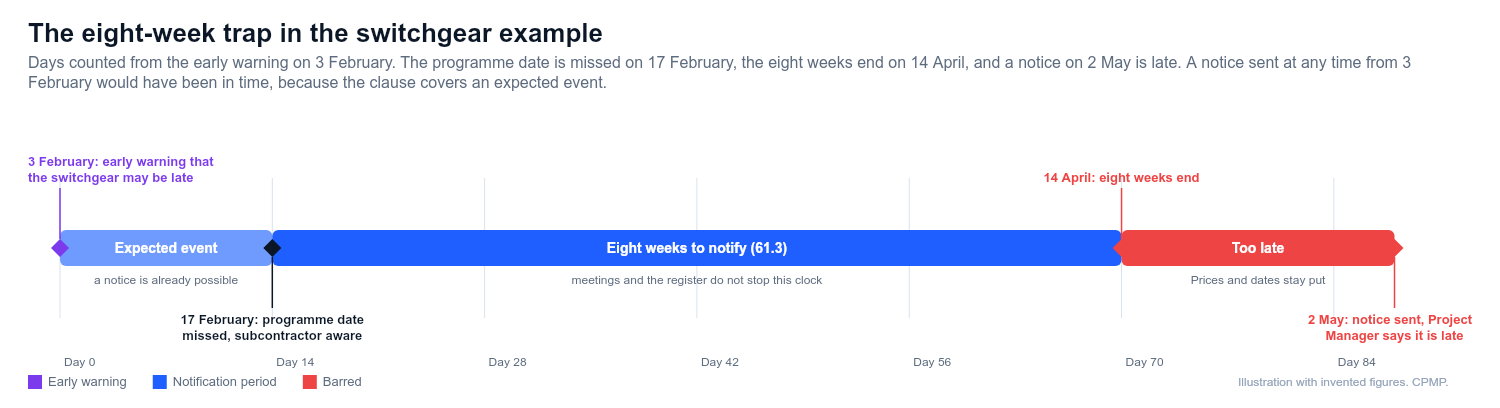
Suggested short forms: the warning says the switchgear may miss the programme date and could delay a key date. The notice, sent separately, says the Client has not provided it by that date, states when you became aware, and names the sub-clause relied on.
Related guides
- The compensation event process step by step
- NEC time bars explained
- Compensation event notification checklist
- Does giving an early warning admit fault
This guide is general information, not legal advice. Check it against your contract.