
Acceleration under NEC clause 36: how a Client buys an earlier Completion Date
How NEC acceleration works for contractors: the quotation process in NEC3 and NEC4, what is not acceleration, and how to price a request.
On this page
Clause 36 is the route by which you and the Client can agree an earlier Completion Date. It works through a quotation containing a price and a revised programme, and the date shifts only if the Client accepts it. Neither side can impose it. Working faster off your own bat, with no quotation, earns no earlier date and no payment under this clause.
The starting step changed between editions, so check which one you are on.
In plain English
Acceleration is a deal to finish earlier for extra money. It is optional on both sides and is agreed through a quotation, never by instruction.
NEC3 and NEC4 side by side
NEC3 ECC
- Only the Project Manager can start it, by instructing you to provide a quotation (36.1).
- You then either quote or tell them why you will not, inside the period for reply (36.2). A refusal ends the matter.
- The quotation carries the price, a revised programme showing the earlier Completion Date and any changed Key Dates, and the details of how you assessed it.
- If it is accepted, the dates change and so do the Prices (36.3, Options A to D) or the forecast of total Defined Cost (36.4, Options E and F), and the revised programme becomes accepted.
NEC4 ECC
- Either side may suggest it (36.1).
- If you are not prepared to consider it, nothing follows. If both are willing, the Project Manager instructs a quotation.
- The quotation has the same contents as under NEC3 (36.2).
- On acceptance the Prices, Completion Date and Key Dates change and the revised programme is accepted (36.3).
Time limits vary by form. Under the NEC4 ECS, the Subcontractor has two weeks to quote and the Contractor four to reply. Published commentary on the NEC4 ECC suggests up to three weeks for the quotation and three for the reply, so do not carry ECS figures across. Check clause 36 in your own contract.
What is not acceleration
- Catching up on your own delay. If you add resources to recover lost time, the Completion Date does not move and there is no payment through this route. Show recovery on the revised programme (32.1).
- Finishing early. You can plan to complete ahead of the Completion Date, leaving terminal float. The date stays put. See terminal float.
- An instruction. The Project Manager's power under 14.3 covers the Scope and Key Dates, not the Completion Date, so an earlier date cannot simply be ordered.
Example: a footbridge replacement
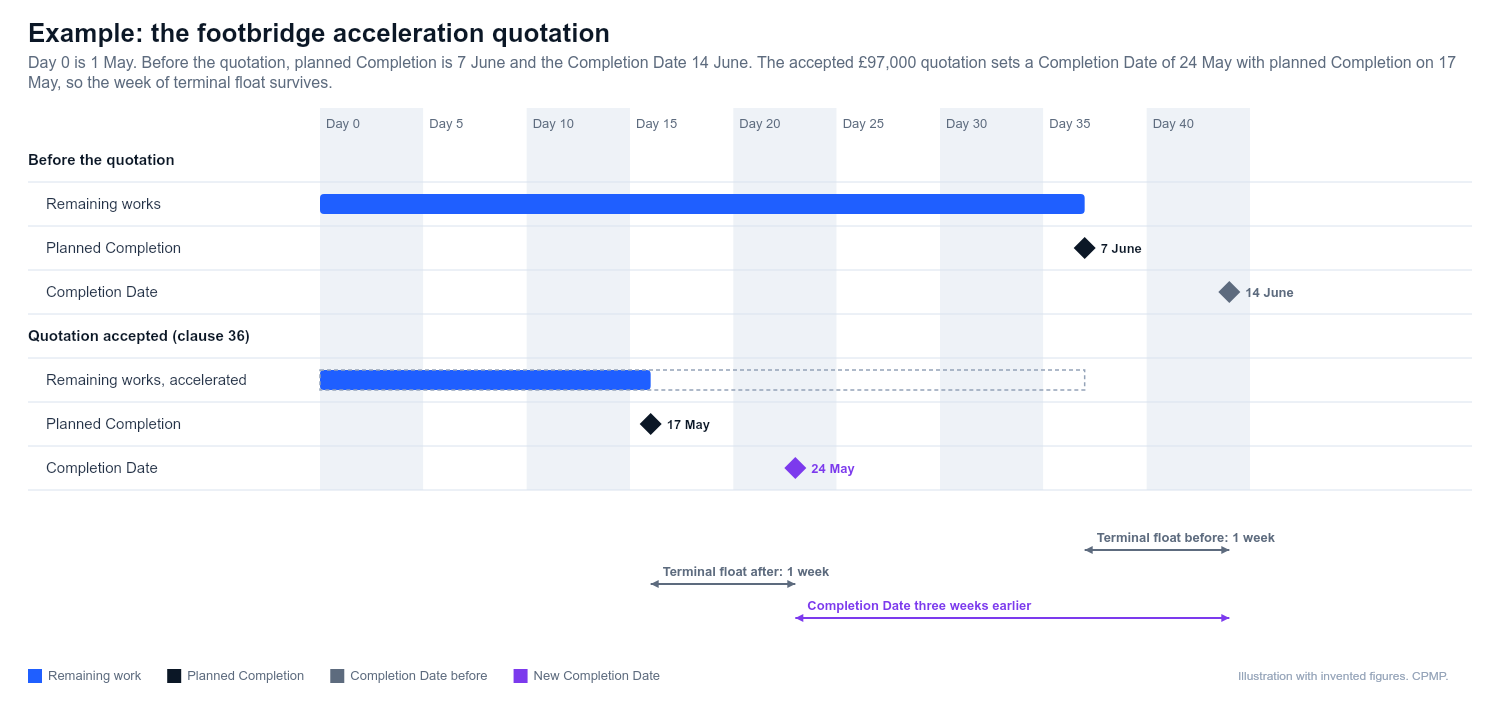
Invented figures. The Client wants a footbridge open three weeks early for a seasonal event. The Completion Date is 14 June and planned Completion is 7 June.
| Item | Amount |
|---|---|
| Extra crane and a second erection crew for six weeks | £64,000 |
| Overtime on fabrication | £18,000 |
| Express delivery of the deck units | £11,000 |
| Saving on time-related costs | (£8,000) |
| Risk allowance and Fee | £12,000 |
| Quotation for a Completion Date of 24 May | £97,000 |
The one-week gap before the old date survives, so planned Completion moves to 17 May. Clause 36 offers no formula, so price, date and float are all things the two sides can negotiate.
Practical points
- Talk first. A quotation costs money to produce, so test the Client's appetite before you spend it.
- Be exact about the target date and which Key Dates change.
- Check secondary Options. Delay damages under X7 run from the new date once accepted, and a bonus under X6 is measured to it, so the risk to you rises.
- Understand what happens if it is refused: dates stay as they were. Refusal does not fall within 60.1(9), which excludes it, so do not plan to recover your preparation cost as a compensation event.
Related guides
- Project Manager instructions
- Delay damages under X7
- Behind programme: your options
- Programme and compensation events
This guide is general information, not legal advice. Check it against your contract.