
NEC Option X7 delay damages: what late completion will cost you
How X7 sets a daily rate for late Completion, how part take over reduces it, and how a later compensation event can reverse the damages.
On this page
Option X7 fixes a daily sum you owe the Client for every day Completion comes after the Completion Date. The ECC has no agreed daily rate without X7, which makes its inclusion a major decision when the Contract Data is filled in. For you it is a direct measure of what lateness costs, and it only bites when the Completion Date has been properly adjusted for events that were not your fault.
The three clauses
The same three exist in NEC3 and NEC4.
- X7.1: the meter runs from the Completion Date until whichever comes first, Completion or take over (the point the Client takes over the works). If the Client moves in, the meter stops, even with work outstanding.
- X7.2: if the Completion Date later moves out after damages were paid, the Client repays the excess with interest. A late compensation event can therefore reverse damages already taken.
- X7.3: if part of the works is taken over before Completion, the rate steps down from that date, reflecting how much benefit the Client gets from that part. The Project Manager assesses it.
NEC changed the NEC4 wording in October 2020, so on the ECC and ECS damages also end on a termination certificate. See which version your contract carries.
An invented example
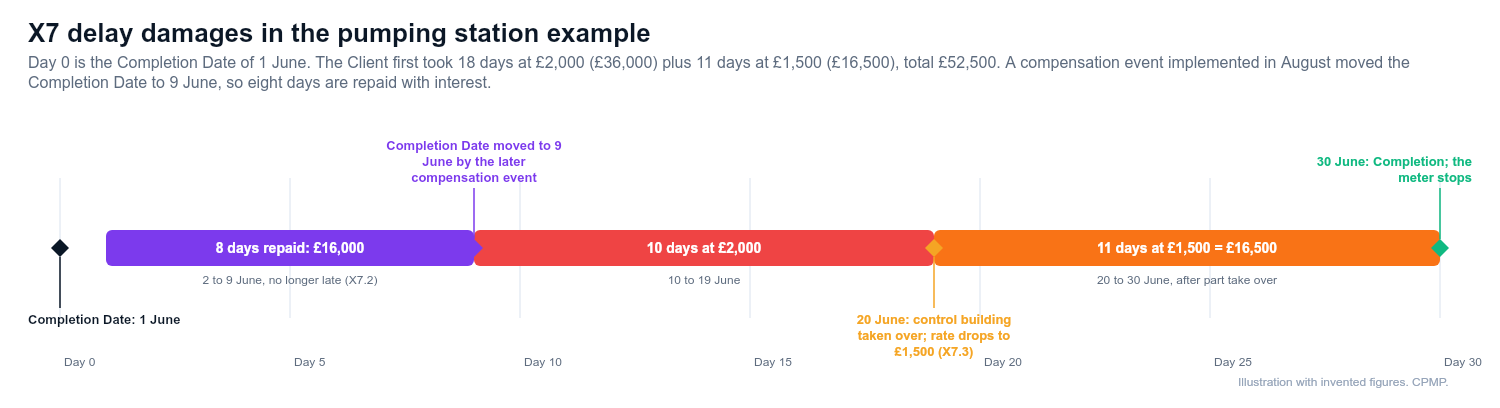
A pumping station refurbishment has a rate of £2,000 a day and a Completion Date of 1 June.
- Completion is missed. Damages run from 2 June.
- On 20 June the Client takes over the control building. The Project Manager assesses its benefit as 25% of the whole, so the rate drops to £1,500.
- Completion is achieved on 30 June.
- Days 2 to 19 June: 18 days x £2,000 = £36,000. Days 20 to 30 June: 11 days x £1,500 = £16,500. Total £52,500.
- In August a compensation event is implemented that moves the Completion Date eight days later, to 9 June. Only 10 days now count at the full rate, so the Client repays eight days at £2,000, which is £16,000, with interest from payment to repayment.
The repayment date doubles as an assessment date, so the money travels through the normal payment process.
Questions to ask at tender
- What rate is entered? The Client should have reasoned it from its real interest in timely completion, and ideally you can see how. A rate far above likely loss may be open to challenge.
- Entering zero or nil may mean there are no damages whatever, which is not the same as leaving the door open to general damages. Take advice if it matters.
- Without X7, a Client must prove actual loss to claim general damages.
- Are separate rates per section set under Option X5?
How it connects to other clauses
- X18: delay damages are among the matters left outside the overall liability cap, so the cap does not limit them. A cap would need a Z clause.
- Compensation events: while events are unassessed, the Completion Date is not settled. A Client deducting against a disputed date invites argument, so get the events dealt with first. See how to claim prolongation.
- Pay less notices: Y(UK)2 requires notice before anyone pays less than the notified sum. See pay less notices for how a deduction like this must be handled.
- Option C: damages sit outside the share calculation, so report them on their own line.
Mistakes to watch for
- Damages deducted when X7 is not in the contract, or at a rate other than the Contract Data one.
- Starting the count at the original date instead of the current Completion Date after implemented events.
- Ignoring part take over. If the Client uses part of the works, the rate may drop even if that was not planned.
Related guides
- Delay damages
- Delay damages have been deducted: can we challenge them?
- Completion, take over and the defects date
- Key Dates and sectional completion
This guide is general information, not legal advice. Check it against your contract.