
When the Client or third parties disrupt you: compensation event 60.1(5)
How NEC clause 60.1(5) works when the Client, a utility or another contractor works outside the programme or Scope, with evidence and a priced example.
On this page
Clause 60.1(5) is the usual route when a utility, a neighbouring contractor or the Client's own direct contractor gets in your way. A compensation event is an event the Client carries the risk for, so your Prices and dates get reassessed. This entry bites when the Client or Others keep to different times from those on the Accepted Programme, break the conditions set in the Scope, or do Site work the Scope never mentions. In NEC3 the substance is the same, with Employer and Works Information.
In plain English
If someone other than you disrupts the site in a way your programme or Scope did not allow for, you can notify it. Success depends on how well your own documents describe that third party.
The three limbs
| Limb | You compare against | Typical case |
|---|---|---|
| Wrong times | The Accepted Programme | A water main diversion shown at three weeks takes six |
| Wrong conditions | The Scope | Night working only is promised, but Others arrive by day and block your access road |
| Unmentioned Site work | The Scope | A telecoms firm digs through your area and the Scope says nothing |
Who counts as Others
"Others" is a defined term. Broadly, it covers everyone except the Client, you (including your Subcontractors and suppliers) and the holders of contract roles such as the Project Manager, Supervisor and Adjudicator. Utilities, statutory bodies, neighbours and the Client's direct contractors qualify. A late Subcontractor of yours does not, so that stays your risk.
Evidence
Clause 31.2 requires your programme to show the Client's and Others' work in the order and timing last agreed with them. That is the yardstick for the first limb, so the entry stands or falls on the care taken with those activities.
- The Accepted Programme in force then, with the third party's activities visible.
- Scope wording about conditions, working hours, sequence and interfaces.
- Dated records: diaries, photos, permits, gate logs, minutes, letters.
- A note of what you could not do, and which resources were idle or moved.
Worked example
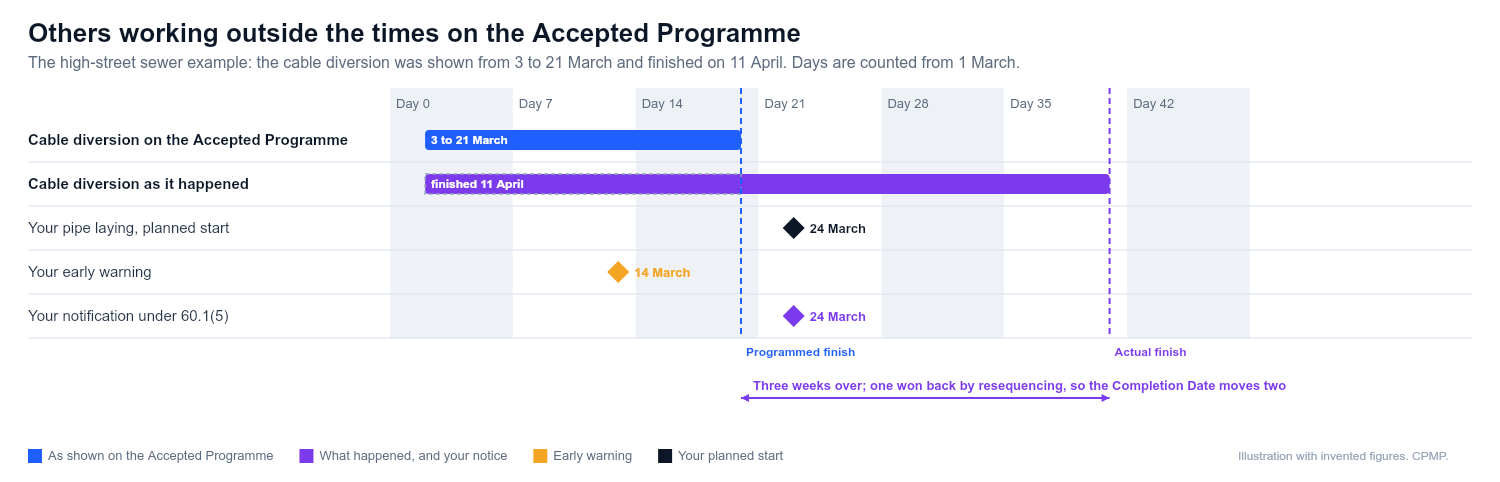
A fictional sewer renewal in a high street, on Option A. The Accepted Programme shows an electricity network diverting cables from 3 March to 21 March, with your pipe laying due to start on 24 March. The network's crew is short of jointers and finishes on 11 April.
You issue an early warning on 14 March. The diversion is on the programme, so the first limb applies, and you notify under 60.1(5) on 24 March.
| Item | Defined Cost |
|---|---|
| Pipe gang sent to another section for a week, with lost output | £5,200 |
| Traffic management held an extra three weeks | £12,600 |
| Time-related costs for two weeks' slip to planned Completion | £11,800 |
| Subtotal | £29,600 |
| Fee at an illustrative 10% | £2,960 |
| Change to the Prices | £32,560 |
The diversion ran three weeks over, but resequencing won one back, so the Completion Date moves two. If the diversion had appeared in neither programme nor Scope, you would use the third limb. The money might be alike, but the proof would differ.
How it is assessed
You normally notify this one, because no Project Manager action caused it. The Project Manager is the person the Client appoints to run the contract day to day. The dividing date is your notification, so earlier cost is actual and later cost is forecast. The eight weeks run from awareness, and since you may notify an expected event, waiting for the overrun to finish seldom pays.
What people get wrong
- Leaving third parties off the programme, which loses the first limb.
- Tolerating a vague Scope. "The Contractor co-ordinates with others" offers nothing to test against, so raise it at tender.
- Reaching for the Client breach entry, 60.1(18), when this one fits.
- Expecting the third party's own contract to help. Your remedy lies against the Client.
- Overlooking your own part: if you started late and pushed Others out of their slot, the event can shrink or fail.
- Refusing to share Working Areas. Clause 25.1 expects you to work alongside Others.
Related guides
- Another contractor is delaying us
- The full list of NEC4 compensation events
- Working areas explained
- Access dates and starting work
This guide is general information, not legal advice. Check it against your contract.