
NEC access dates: when you can start on site and what happens if access is late
How starting dates and access dates work in NEC, the 'later of' rule that catches contractors out, and how late access becomes a compensation event.
On this page
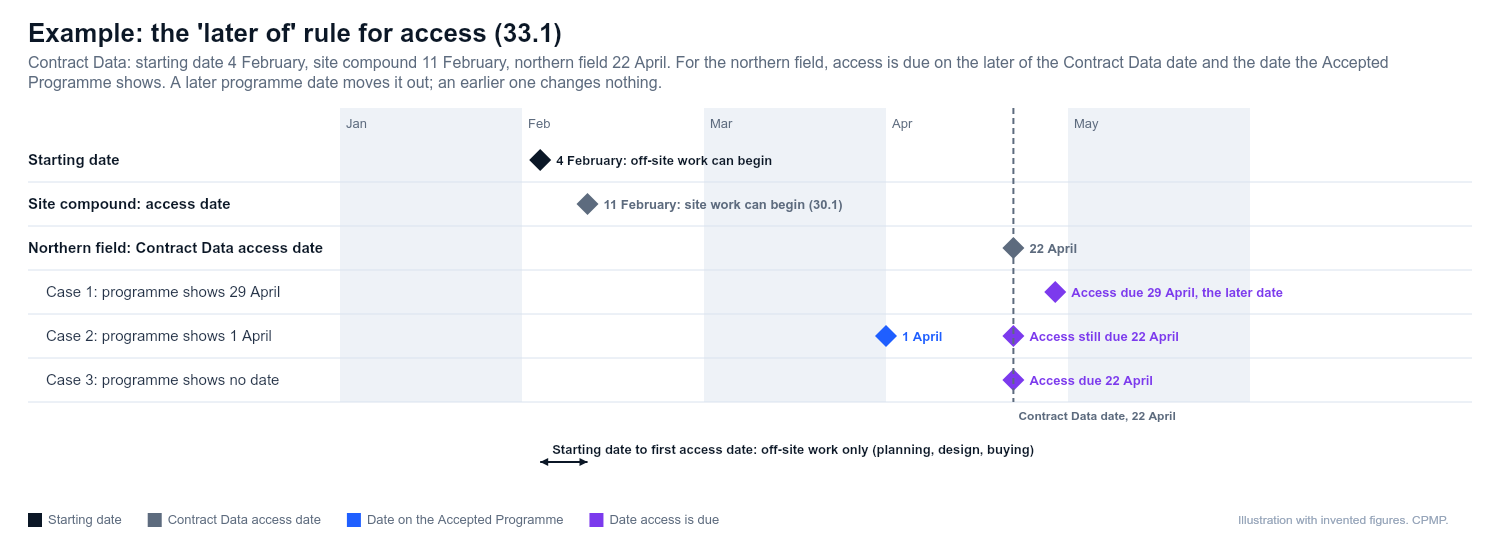
Each access date in the Contract Data (the part of the contract holding project-specific entries) says when you may get onto and use a given part of the Site. Site work cannot start before the first one (30.1). The Client must give access by whichever comes later: the Contract Data date or the date your Accepted Programme shows for that area (33.1).
That "later of" wording trips up many contractors. Clause numbers are identical in NEC3 and NEC4 ECC.
In plain English
The Client has to give you the site by the later of the contract date and the date on your accepted programme. A later date on your programme gives the Client more time. An earlier date on your programme gets you nothing.
The dates you will see in the Contract Data
Three entries matter.
- Starting date. Revised programme intervals count from it and, under NEC4, so do the first Early Warning Register and meeting. Say, 4 February.
- Access dates. A list pairing each part of the Site with a date, such as the site compound on 11 February and the northern field on 22 April.
- Completion Date. Fixed by the Contract Data entry.
The starting date and the first access date can be weeks apart. That gap is for off-site work, such as planning, design or buying. You can do those from the starting date, but you cannot begin on the Site until the first access date.
How the "later of" rule works
Suppose the Contract Data gives the northern field as 22 April. Three cases:
- Your programme shows 29 April. Access is due 29 April. You have told the Client you do not need it sooner, so you have given up the earlier date for now. Your programme has to show a later need for access (31.2), and once it is accepted that tends to help the Client. Think hard before pushing a date out.
- Your programme shows 1 April. Access is still due 22 April. A programme cannot drag the date earlier.
- Your programme shows nothing. Access is due 22 April.
Late access is a compensation event
Miss the later date and clause 60.1(2) comes into play. You notify, and time and cost are assessed as for any event. What counts is the effect on planned Completion, not simply the days of lateness, so a late area with spare float may bring cost but no extra time.
A gate key is not the whole of access. Clause 33.1 speaks of reaching and using each part. Where an area is handed over but other parties occupy it so that you cannot really work there, expect a debate about whether you were given use.
Example: a substation fence
Invented dates. The northern boundary of a substation has an access date of 9 June, and your Accepted Programme agrees. The Client's land purchase does not complete until 30 June. Fence foundations on that boundary have a week of float before they touch planned Completion.
- You give an early warning as soon as you hear of the risk, ideally in May.
- You notify the compensation event once you know access will be late.
- Three weeks late, less one week of float, moves planned Completion by two weeks, so the Completion Date moves two weeks. Cost, such as idle resources, is assessed separately.
If you stayed quiet when an experienced contractor would have raised the alarm, the Project Manager can record that when they ask you to quote, and the assessment is reduced to match. See missed early warnings.
Checklist before you start
- Match each access date to the part of the Site described in the Site Information and Scope.
- Note Scope restrictions on how an area may be used, for instance limited working hours or sharing with Others.
- Put your access dates, and any later needs, on the first programme so 60.1(2) can be tested cleanly.
- Photograph each handover and log the actual date and the state of the area.
- Record who else has access to each area.
If you are a subcontractor
The ECS follows the same pattern with the subcontract's own dates, but it is the main contractor who must give you access, not the Client. Where the main contractor itself is waiting for late access, check your subcontract before passing the lateness down.
Related guides
This guide is general information, not legal advice. Check it against your contract.