
Stop-work and Key Date instructions as a compensation event (60.1(4))
How NEC clause 60.1(4) works when the Project Manager tells you to stop, hold back or re-date work, what to record, and how it is priced.
On this page
When the Project Manager tells you to stop work, to hold back work you had not started, or to move a Key Date, clause 60.1(4) makes it a compensation event. That is an event the Client carries the risk for, so your price and dates get reassessed. The Project Manager, the person the Client appoints to run the contract day to day, notifies it along with the instruction. You therefore avoid the usual eight-week limit that catches your own notices.
In plain English
If they stop you, they should bear the consequences, unless the stoppage was your fault. Get the instruction in writing and start tracking cost from that day.
Where the powers sit
Clause 34.1 gives the power to stop or hold back work, and clause 14.3 the power to change a Key Date. NEC3 and NEC4 ECC treat both identically.
What is covered
- Stop. Work in progress must cease, entirely or in part.
- Hold back. Planned work must not begin, even though nothing has started.
- Re-dating. A Key Date is moved by instruction. Even a move that favours the Client is assessed for its effect on you.
A stop is never the final word. Under 34.1 the Project Manager must eventually tell you to restart or remove the work from the Scope (the document describing what you must deliver). Removal is a Scope change, so 60.1(1) enters as well.
If you caused the stoppage
The list entry is silent on fault, but the process is not. Where your own default is the cause, clause 61.2 means no quotations are requested and clause 61.4 allows the Prices and dates to stay put. Unsafe temporary works on your side get you nothing, while a Client funding review does. Ask for the reason to be written in the instruction.
Evidence
- The instruction: its extent, date and stated reason.
- Resources on Site when it landed, and where they went.
- Off-hire, demobilisation, remobilisation and subcontractor notices.
- The later instruction to restart or remove the work.
A phone call from someone on the Client's side saying "hold off" is not an instruction from the Project Manager. Insist on writing, or you have stopped on your own account.
A worked example
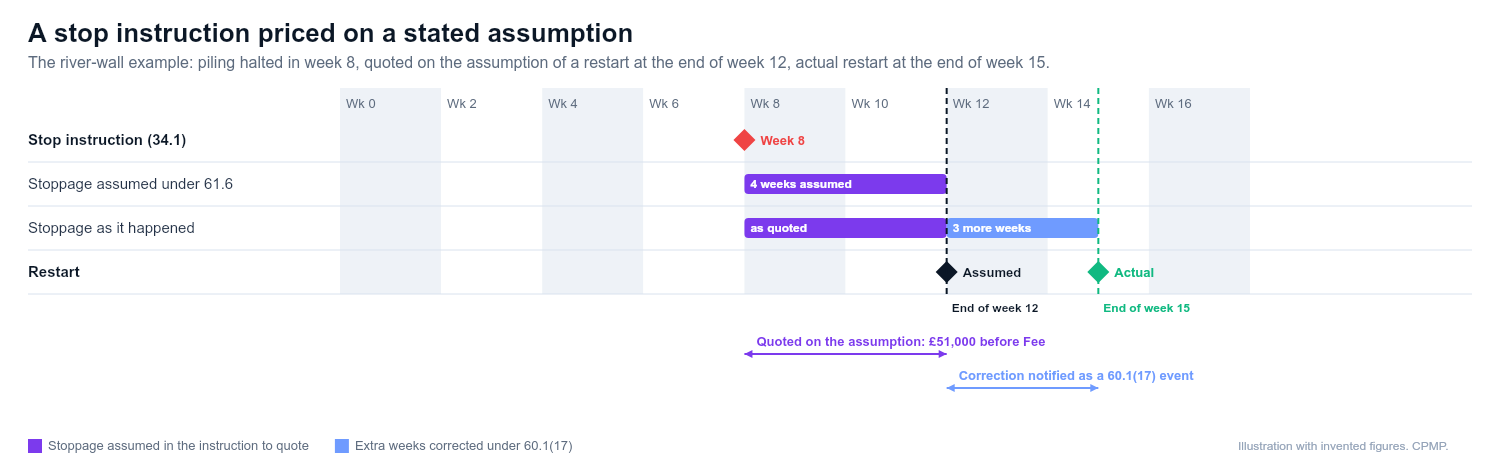
A fictional river-wall scheme on Option C. In week 8 the Project Manager halts sheet piling at the north end while the Client sorts out a boundary question. Nobody knows how long, so the instruction to quote states an assumption under 61.6: restart at the end of week 12.
| Effect on that assumption | Defined Cost |
|---|---|
| Move piling frame off and back | £14,000 |
| Idle and redeployed gang, first week | £5,000 |
| Site time-related costs for four weeks' slip | £28,000 |
| Extra winter protection | £4,000 |
| Total before Fee | £51,000 |
Work actually restarts at the end of week 15. The Project Manager notifies the correction, a 60.1(17) event for the extra three weeks. With no assumption, you would have guessed and carried the risk.
How it is priced
The dividing date is the date of the instruction (63.1), so later costs are forecast. That is awkward when the restart is unknown, which is why assumptions suit this event. Time is measured on planned Completion using the Accepted Programme current at that date. A Key Date move is assessed separately and may cost money without touching Completion.
Long stoppages
A stop that is never lifted can end in termination. Clause 91.6 says who may terminate, depending on whose default lay behind it (reasons R18 to R20), after 13 weeks in NEC4 and NEC3 ECC or 14 in the NEC4 subcontract. Amended contracts may vary.
Common errors
- Assuming a right to suspend. Only the Project Manager can instruct this.
- Leaving everything on Site "just in case". Record why you decided as you did.
- Stopping more than the instruction covers.
- Forgetting to chase the restart instruction.
Related guides
- The Project Manager told us to stop work
- The full list of NEC4 compensation events
- Long suspension of work
- Key dates and sectional completion
This guide is general information, not legal advice. Check it against your contract.