
Concurrent delay and compensation events: how to deal with it, step by step
What concurrent delay means, why NEC's prospective method handles most of it, and how to assess time and money when your delay and the Client's overlap.
On this page
Concurrent delay is the situation everyone argues about: the Client does something that would delay Completion, and at the same time the Contractor has a problem of its own that would also delay Completion. Who gets the time? Who pays for the weeks? NEC never uses the words "concurrent delay". It gives you a method instead, and if you follow the method with an honest programme, most apparent concurrency resolves itself. This guide shows how, with four programme pictures and a step-by-step routine for the quotation.
The method is the one in our guide on showing a compensation event on the programme: take the Accepted Programme in force at the dividing date, bring it up to date, add the event, and measure how far planned Completion moves (NEC4 ECC 63.5; NEC3 ECC 63.3). Everything below builds on that.
The scenario
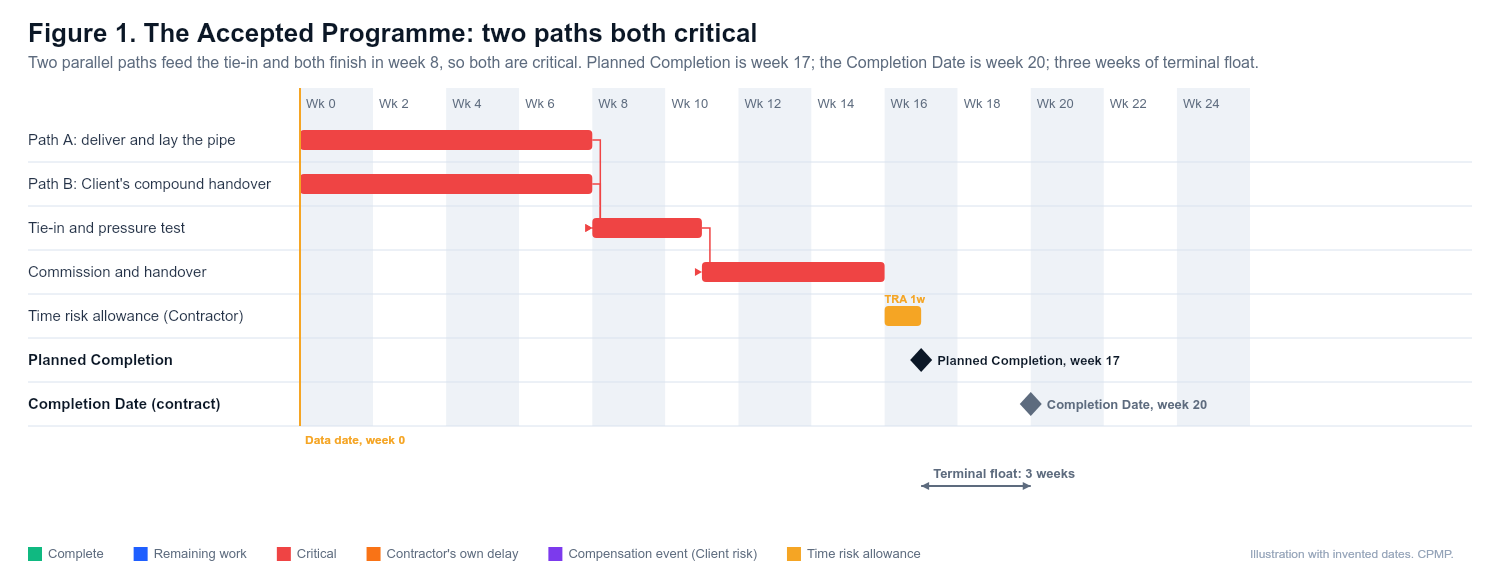
A water main renewal again. Two paths of work run in parallel into the tie-in: path A, the Contractor delivers and lays the pipe; path B, the Client hands over the tie-in compound. Both finish in week 8 of the Accepted Programme, so both are critical. Planned Completion is week 17 against a Completion Date in week 20: three weeks of terminal float belong to the Contractor.
Three things then go wrong, in three different ways. Each is a separate case below, because the answer is different each time.
Case 1. Your delay first, then the Client's event
Pipe delivery slips two weeks for the Contractor's own reasons. Two weeks in, the Client tells you the compound will be three weeks late. This is not concurrency at all, although it is often argued as if it were. The dividing date is week 2. By then your two-week delay is a fact and belongs in the progressed programme. The event is measured from there.
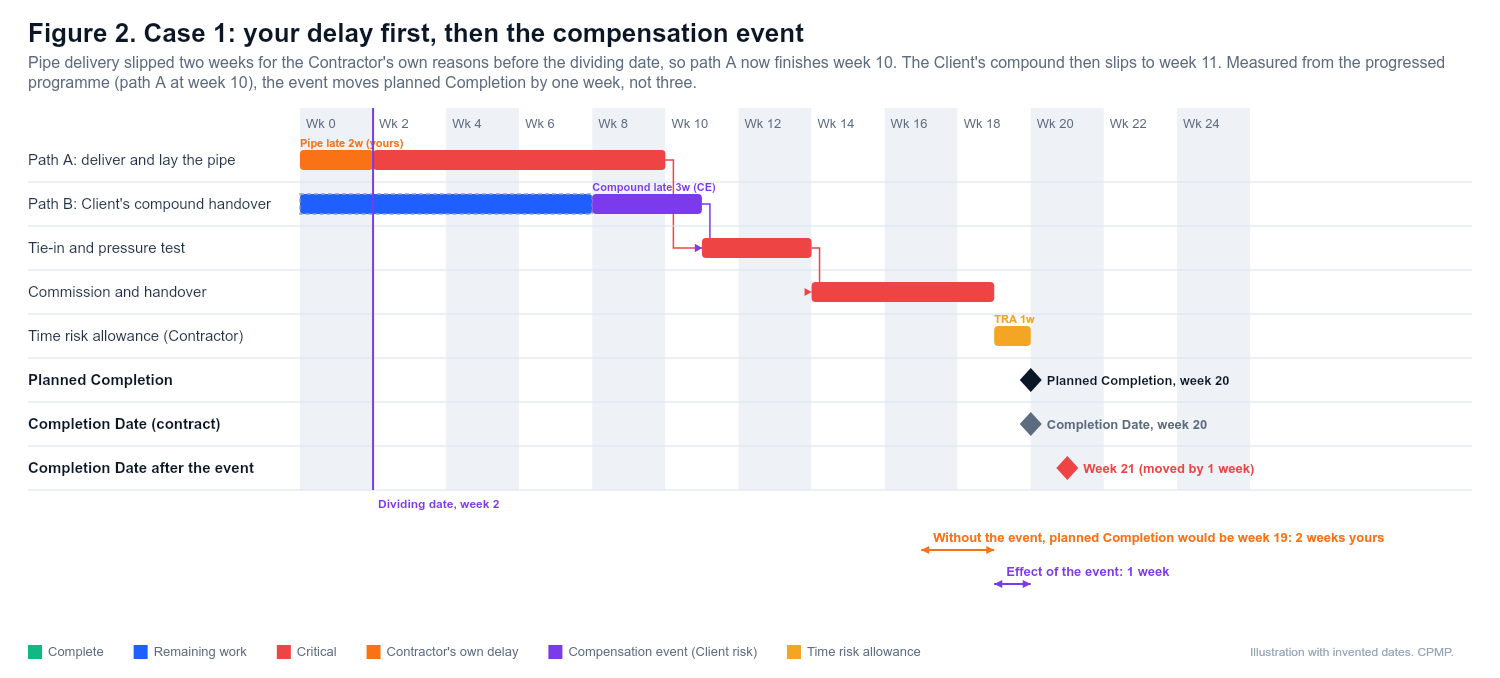
Result: the event gets one week of time, not three, because two of the three weeks had already been lost by you. Your two weeks are yours; you still hold one week of terminal float. The cost of the event is the forecast cost of the one week of delay the event actually caused, plus its direct costs.
This is exactly what NEC4 63.5 is driving at when it says the assessment takes account of delay already in the programme and events between the programme date and the dividing date. Leave your own slippage out and you have overstated the claim.
Case 2. Both delays start together, both critical
In week 4 your supplier fails and, in the same week, the Client withdraws the compound for its own works. Each delay on its own would push planned Completion back three weeks. This is true concurrency: two independent causes, each sufficient, running at the same time on parallel critical paths.
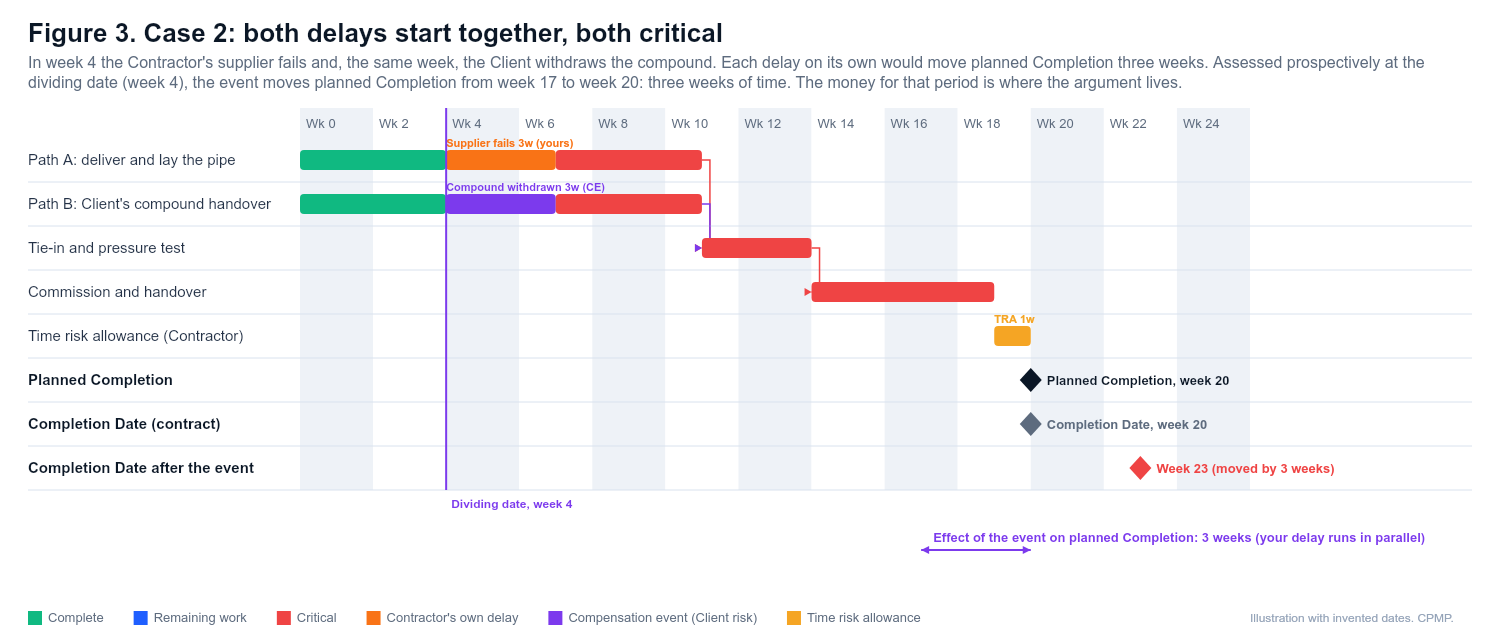
Time. Assess the event the normal way. At the dividing date (week 4) the progressed programme shows planned Completion in week 17. Insert the event and planned Completion moves to week 20. The effect of the event is three weeks, so the Completion Date moves three weeks. The fact that your own delay would also have caused three weeks does not reduce the event's effect under the NEC method, because the method asks what the event does to the programme, not whether something else would have happened anyway. This matches the widely followed Society of Construction Law Delay and Disruption Protocol principle that concurrent delay does not reduce the time due.
Money. This is where the argument lives. A compensation event changes the Prices by the effect of the event on Defined Cost (63.1). Where your own delay would have kept you on site for the same three weeks regardless, the Client will say the prolongation cost of those weeks was not caused by its event, and the Protocol's guidance leans the same way: time-related cost for a truly concurrent period is generally not recoverable. The direct costs of the event itself (for example, standing time for a crew that was ready for the compound and had nothing else to do) are a different matter and should be claimed and evidenced. Expect to negotiate, and take advice before you fix a position in writing.
Case 3. The event lands on a path with float
Same week-4 supplier failure on path A, but this time path B has three weeks of float and the Client's delay to the compound is two weeks. Path B still finishes before path A. The three weeks of delay to planned Completion are entirely yours.
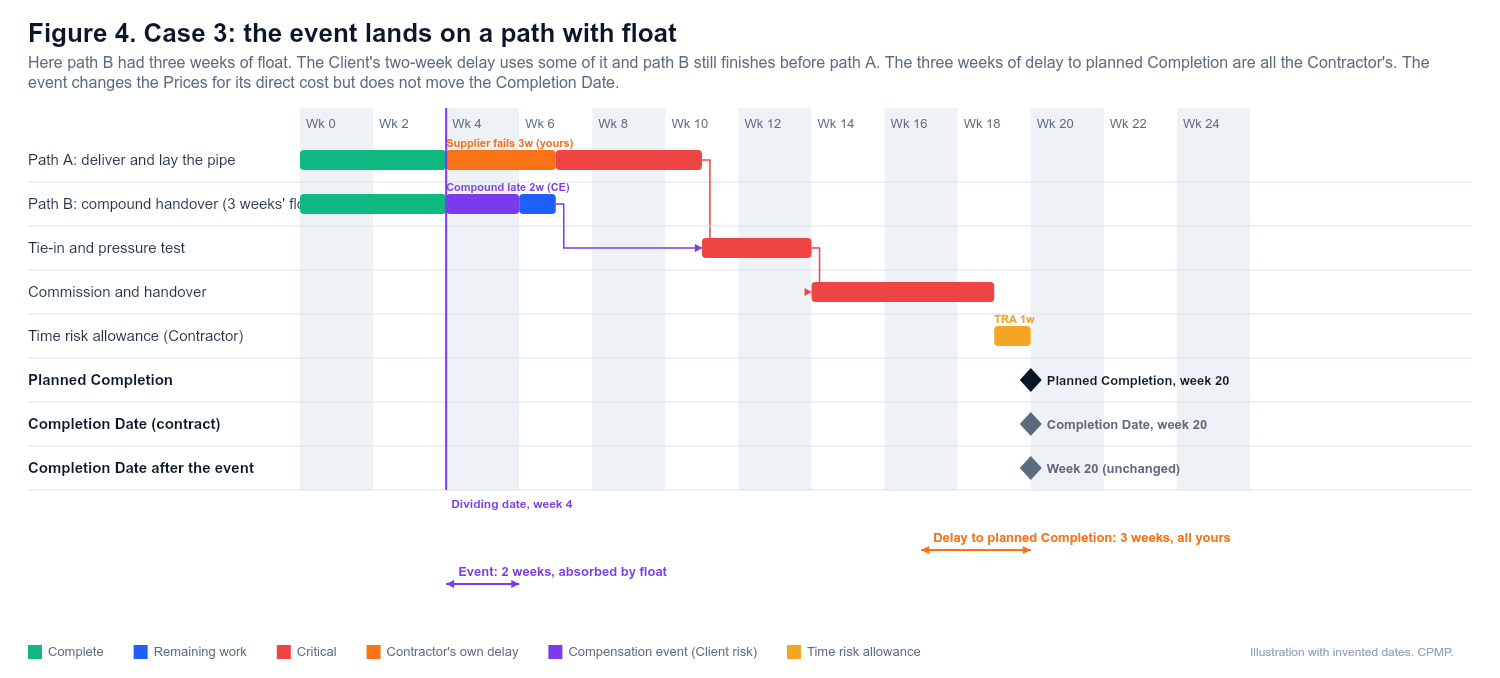
Result: no change to the Completion Date. The event still changes the Prices by its direct cost, if any. Do not try to dress this up as concurrency; a Project Manager with the programme in front of them will see the float.
The routine for a quotation where delays overlap
- Fix the dividing date for the event (NEC4 63.1): the date of the instruction, notification, certificate or changed decision, or, for an event you notified, the date of your notification.
- Take the Accepted Programme in force at that date and bring it up to date with recorded progress, including your own delays. Your delays before the dividing date are not concurrency; they are the starting point.
- Insert the event as a fragnet with its own logic and justified risk allowances (NEC4 63.8). Change nothing else.
- Measure the event's effect on planned Completion and each Key Date. That is the time claimed, whatever else is going on in parallel.
- Separate the causes on the programme. Label your delays and the Client's delays as distinct activities, so a reader can see which path drives which date. If two paths both reach planned Completion on the same day, say so.
- Price the event's direct costs in full and with evidence.
- Price the time-related costs carefully. Claim them for the delay the event caused. For a period where your own delay would have kept you on site anyway, expect the Client to resist prolongation cost and decide, with advice, whether to argue the point or to show you have not claimed it. Say which you have done in the quotation so there is no suspicion of double counting.
- Treat each event separately and in order. A second event is assessed on the programme as it stands at its own dividing date, which by then includes the first event. Do not roll several events into one global claim.
- Write the assumptions down. The assessment is a forecast and, once implemented, is not normally revisited (NEC4 66.3). State the progress, the logic and the durations you relied on.
What the Project Manager and the Client expect to see
- The dividing date for each event and the Accepted Programme used, by revision number.
- A progressed programme that shows your own delays as yours, before the event goes in.
- The event's activities and logic shown separately, so its effect can be traced.
- Both critical paths where two exist, with the dates they drive.
- A time claim equal to the event's measured effect on planned Completion and Key Dates, no more.
- A money claim that distinguishes the direct cost of the event from prolongation, and says plainly how you have treated any period where your own delay ran in parallel.
- Native programme files, not only a PDF.
What goes wrong
- Treating your own earlier slippage as concurrent delay. It is sequential, and it is yours.
- Measuring the event against the Completion Date rather than planned Completion, and losing your terminal float.
- Rebuilding the whole programme while inserting the event, so nobody can tell which change did what.
- Claiming prolongation for a period you would have spent on site anyway, without saying so.
- Rolling several events and your own delays into one claim. See delay analysis basics for why global claims fail.
- Letting the programme lapse so there is no Accepted Programme at the dividing date, which hands the assessment to the Project Manager (64.1, 64.2).
Related guides
- How to show a compensation event on the programme, step by step
- How the programme measures delay from a compensation event
- Terminal float
- Who owns float
This guide is general information, not legal advice. Check it against your contract.