
Project Manager rejected my compensation event quotation: what now?
What to do when the Project Manager rejects your NEC compensation event quotation or assesses the event themselves, and how to protect your entitlement.
On this page
You submitted a compensation event quotation and the Project Manager has either rejected it or assessed the event themselves. This guide is for the Contractor, but a Subcontractor will face the same situation with the Contractor.
The short answer
Read the reasons and the dates first. Check whether the Project Manager followed the contract's process and timings, then decide whether to submit a revised quotation or challenge the assessment. Keep the clock in mind: the dispute resolution Option in your contract has time limits, and a decision left unchallenged can stand.
Why quotations get rejected
The commonest reasons are:
- The quotation did not include a programme, or the programme was not realistic, when it should have shown the effect on remaining work (clause 62.2).
- The cost is not backed by details of the assessment.
- The Project Manager disagrees that an event has happened, or says it was notified late. That is a decision under 61.4 about the event, not about the value, and only five reasons are allowed: your own fault, not happened and not expected, notified late (NEC4), no effect on Defined Cost, Completion or a Key Date, or not on the list.
- A risk allowance has no explained basis, the cost items fall outside the Schedule of Cost Components, or the quotation is priced at bill or tender rates instead of Defined Cost and Fee.
- The Project Manager has stated under 61.5 that an experienced contractor could have given an early warning, so the event is assessed as if it had been given (63.7 in NEC4, 63.5 in NEC3).
- The quotation was late, or did not follow the contract's rules on timing.
- The Project Manager disagrees with the time effect.
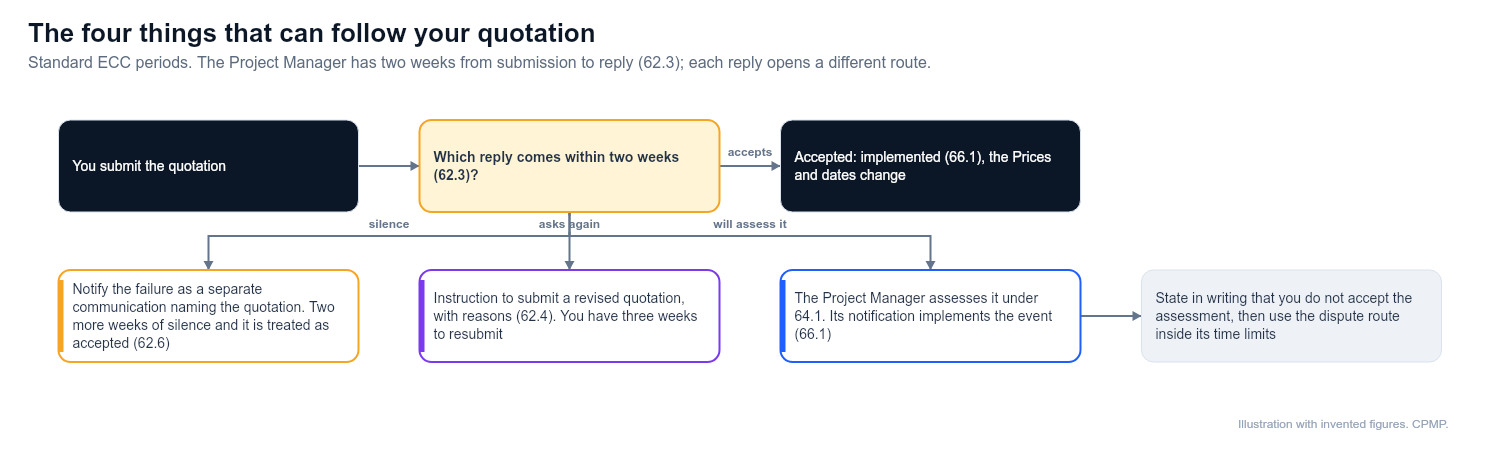
In the standard ECC the Project Manager has two weeks from submission to reply (62.3). The reply is an acceptance, an instruction to submit a revised quotation, or a statement that it will assess the event itself. A revised quotation instruction must come with reasons (62.4), and you then have three weeks to resubmit. Under 64.1 the Project Manager can assess the event itself in four cases: the quotation was not submitted in time, it decides the quotation was not assessed correctly and does not instruct a revision, the programme or alterations required with the quotation were not submitted, or it has not accepted the latest programme for a reason the contract gives. When it assesses, it uses its own view of the remaining work if there is no Accepted Programme or a required programme was not submitted (64.2). Both sides can extend a period only by agreement before it falls due (62.5), the NEC4 subcontract uses longer periods, and Z clauses often change them, so check your Contract Data.
If the Project Manager is silent, notify the failure; if there is still no reply two weeks later, the quotation is treated as accepted (62.6). The same applies to a late assessment by the Project Manager (64.4). Notifying that failure is a separate communication that names the quotation.
What to do, step by step
- Read the communication. Note its date, what exactly is rejected, and what reasons are given.
- Check the process. Did the Project Manager reply within the period for reply? Did they give reasons? Were they entitled to assess it themselves? Look at the clauses on quotations and assessment in your contract, and at any Z clauses.
- Separate the issues. Decide whether the dispute is about entitlement (whether it is an event), time, cost, or process.
- Fix what can be fixed. If the Project Manager asks for a revised quotation, give one that answers each point. Use the CE quotation guide.
- Update the programme. If the programme is the problem, produce a revised programme that shows the effect clearly. See revised programme submission timeline.
- Meet the Project Manager. Ask to discuss the assessment. Many are settled by agreeing assumptions.
- Preserve your position in writing. State that you do not accept the assessment and why.
- Escalate if needed. If you cannot agree, look at the dispute resolution Option in your contract and its time limits. Take advice before the limits run.
What to record
- The quotation, with date and how it was submitted.
- The Project Manager's response and date, and any reasons given.
- The programme submitted and the one assumed by the Project Manager.
- Cost records behind each element of the quotation.
- Meeting notes and emails after rejection.
- A comparison of your assumptions against the Project Manager's.
What not to do
- Do not ignore a Project Manager's assessment. Its notification implements the event, so the Prices and dates change without your agreement (66.1 in NEC4, 65.1 in NEC3), and an implemented assessment is not normally revised.
- Do not resubmit the same quotation unchanged and expect a different result.
- Do not argue entitlement and quantum in one muddled letter.
- Do not rely on an old programme for the revised quotation.
- Do not miss a dispute time limit while negotiating.
- Do not forget that payment is assessed under clause 50 and certified under clause 51, so an unresolved event can also affect cash flow. See how payment works under NEC.
When to get help
Speak to your commercial manager as soon as you get the rejection. Involve a planner if time is the dispute. Take legal advice before you refer a dispute to adjudication, and be aware of the Construction Act's rights where they apply.
Related guides
This guide is general information, not legal advice. Check it against your contract.