
How a compensation event moves from notice to new price and date
The five stages of an NEC compensation event, the time limit at each stage and what you and the Project Manager must do, with a worked timeline.
On this page
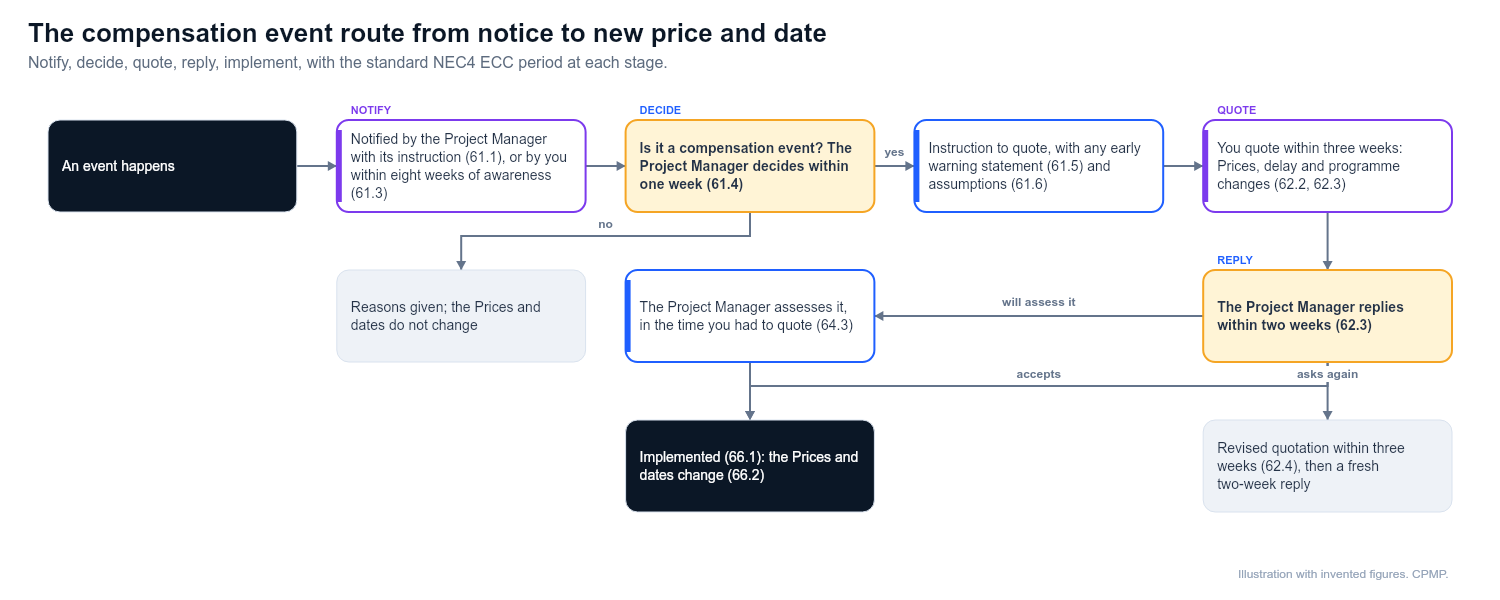
Every compensation event follows five stages: notify, decide, quote, reply and implement. A compensation event is an event the Client carries the risk for, so your price and dates can change. Under NEC4 the route from your notice to an accepted quotation can take about six weeks if every period is used and nothing goes round twice. The periods below are the same in NEC3, though some clause numbers differ, and your Contract Data or Z clauses can alter them.
In plain English
Someone notifies the event. The Project Manager (the person the Client appoints to run the contract day to day) confirms it counts. You price it. They accept or challenge. Once accepted, the price and dates change.
The stages
- Notification. If an instruction, certificate or reversed decision caused the event, the Project Manager notifies it at once (61.1). Otherwise you notify it within eight weeks of becoming aware that it has happened (61.3). You can also notify one you expect.
- Decision. For your notice, the Project Manager has one week, or longer if you agree, to say it is a compensation event or give reasons it changes nothing (61.4).
- Instruction to quote. This comes with the notification or decision. It is where the Project Manager says if an early warning should have been given (61.5) and states assumptions if effects are too uncertain to forecast (61.6). It may also ask for alternative quotations (62.1).
- Your quotation. You have three weeks to submit the change to the Prices, any delay to Completion or Key Dates, your details, and any changes to the Accepted Programme (62.2, 62.3).
- The reply. Two weeks to accept, ask for a revised quotation, or say they will assess it themselves (62.3). If they assess, they get the same time you had to quote (64.3).
- Implementation. The event is implemented on acceptance, on notification of their assessment, or when a quotation is treated as accepted (66.1). Prices and dates change then (66.2).
Who does what
| Stage | Project Manager | You |
|---|---|---|
| Notify | Events they or the Supervisor caused | Everything else you believe qualifies |
| Decide | Applies the tests in 61.4 | Chase, and notify a failure to reply |
| Quote | Answers questions, discusses options | Build the assessment and programme changes |
| Reply | Accepts, asks again or assesses | Notify a failure to reply |
| Implement | Notifies acceptance or assessment | Put the change into the next payment application and programme |
A worked timeline
A fictional pumping-station job: a power company has not arrived to connect the supply on the date shown on the Accepted Programme. You believe 60.1(5) applies.
| Week | What happens |
|---|---|
| 0 | Your foreman reports the crew has not turned up |
| 1 | You notify the event |
| 2 | Project Manager confirms and instructs quotations |
| 5 | You quote an illustrative £64,000 and two weeks |
| 7 | Project Manager accepts. Completion moves two weeks and the Prices rise |
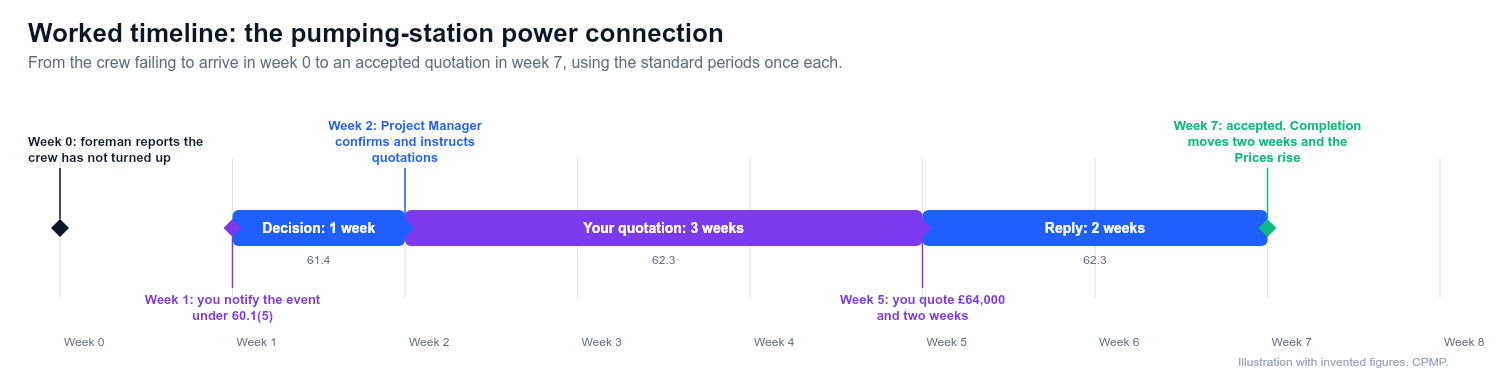
The connection may still not be finished in week 7. That is fine: work not done at the dividing date is priced as a forecast.
Where it goes wrong
- No real notice. An email or minute mentioning the issue is not a notification. Clause 13 expects a separate one.
- Quoting only when the work is done. It turns a forward-looking process into an argument about the past.
- Reply periods lapsing. A busy Project Manager can discover that treated acceptance has started.
- Endless revisions. At some point they should assess it themselves.
- No Accepted Programme. You end up with a weaker position on time.
Related guides
- Quotations for compensation events
- Compensation event notification checklist
- A table of key NEC time periods
- Revised quotations
This guide is general information, not legal advice. Check it against your contract.