
How payment works under NEC
How assessment dates, the Project Manager's certificate and payment periods work under NEC, and what the Construction Act adds on top.
On this page
Payment under NEC follows a fixed rhythm: an assessment date, an assessment by the Project Manager, a certificate, and then a due date. If you understand the rhythm, you can see exactly when something has gone wrong and what you can do about it. This guide covers the ECC, with notes on how it applies to subcontracts.
The payment cycle in outline
| Step | Who | What happens |
|---|---|---|
| Application | Contractor | NEC4: the Contractor applies before the assessment date, showing how the amount was worked out (clause 50.2). NEC3: an application is optional and is considered if sent on or before the date. |
| Assessment date | Project Manager | The date on which the amount due is assessed. The Project Manager sets the first date, no later than one assessment interval after the starting date, and the interval in the Contract Data sets the rest. |
| Assessment | Project Manager | Clause 50: the Project Manager assesses the amount due at each assessment date. |
| Certificate | Project Manager | Clause 51.1: the certificate is due within one week of the assessment date. |
| Payment | Client (Employer in NEC3) | Within three weeks of the assessment date (not of the certificate), unless the Contract Data gives another period (clause 51.2). |
| Interest | Paying party | Late payment carries interest, including where it is late because no certificate was issued. Interest is daily at the Contract Data rate, compounded annually (clause 51.4), and is added to the next assessment once the late payment has been made. |
If a NEC4 Contractor misses the application date, the amount due cannot rise: it becomes the lesser of the Project Manager's own assessment and the amount due at the previous date (clause 50.4). The unpaid value is not lost, but it waits for the next assessment. Where the Contract Data names no programme, a quarter of the Price for Work Done to Date is held back until a first programme showing the required information has been submitted (NEC4 50.5, NEC3 50.3). A wrong assessment is corrected in a later certificate (50.6), with interest in some cases (51.3).
Check the Contract Data for your assessment interval and the payment period. Z clauses often change them.
What the Project Manager assesses
The amount due depends on the main Option in your contract:
- Options A and B: the Price for Work Done to Date is the total of the Prices of completed activities (Option A, from the Activity Schedule) or of completed quantities at the bill rates (Option B), plus the effect of implemented compensation events. An Option A activity is either complete or not: there is no percentage complete, and an activity with a notified Defect that holds up following work does not count as complete.
- Options C and D: the Price for Work Done to Date is the Defined Cost the Project Manager forecasts will have been paid by the next assessment date, plus the Fee, so it looks ahead rather than measuring progress. The target and share mechanism is applied at the end.
- Options E and F: the same forecast Defined Cost plus the Fee, with no target.
The assessment also takes account of other amounts the contract provides for, and of Disallowed Cost where relevant. See Defined Cost, Fee and Disallowed Cost in plain English.
The programme matters more than people think
Under Option A, payment depends on activities being complete, and each programme has to show how its operations relate to the Activity Schedule (clause 31.4; NEC3 applies the same rule to Option C, but NEC4 Option C no longer does). A programme that does not match the Activity Schedule invites disputes about whether an activity is complete. Separately, until a first programme showing the required information has been submitted, a quarter of the Price for Work Done to Date is held back where the Contract Data names no programme. Keep revised programmes submitted and accepted under clauses 31 and 32.
What the Construction Act adds
The Housing Grants, Construction and Regeneration Act 1996 (as amended, "the Construction Act") applies to most UK construction contracts. In general terms it gives:
- a right to stage payments and a clear due date,
- a requirement for a payment notice stating the sum considered due, and a pay less notice if the payer wants to pay a different sum,
- a right to interest on late payment, and
- a right to refer a dispute to adjudication at any time.
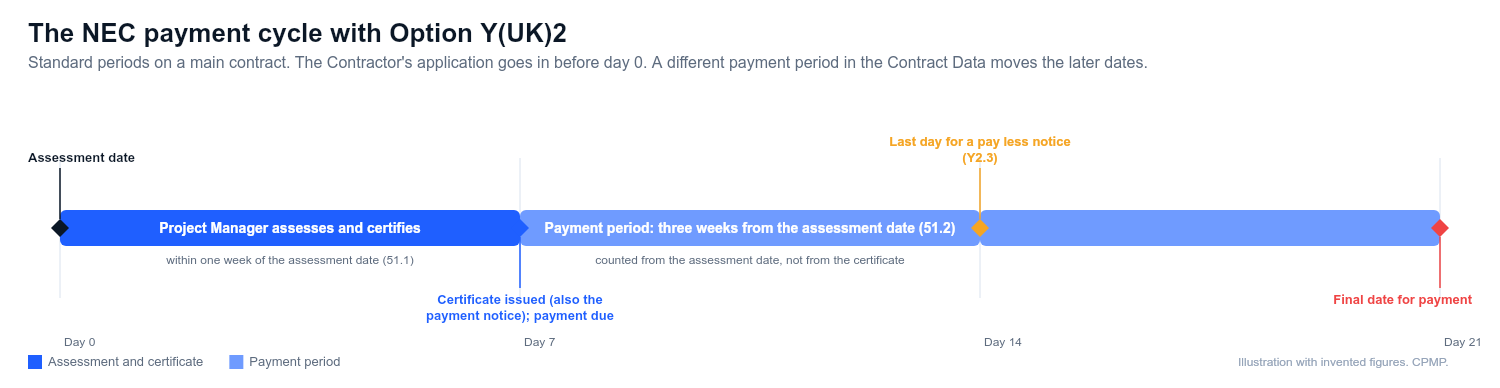
NEC contracts are drafted to fit this framework through Option Y(UK)2. With the standard periods, the assessment date is day 0, the certificate (which is also the payment notice) and the due date fall by day 7, the last day for a pay less notice is day 14 and the final date for payment is day 21. A pay less notice must be given no later than seven days before the final date and must state the sum considered due and how it was calculated. If no valid notice is given, the notified sum generally has to be paid even if the certificate was wrong; the error is then corrected in the next certificate. The Contract Data and Z clauses carry the detail, and some contracts are outside the Act. Which notices apply, who issues them and by when depends on your contract and the facts. Take legal advice before relying on any of this.
Subcontracts
Under the Engineering and Construction Subcontract (ECS), the Contractor takes the role the Client has in the main contract. The Contractor assesses, so it is the Contractor who certifies within two weeks of each assessment date and pays within four weeks, unless the Subcontract Data says otherwise (under Y(UK)2 the due date is day 14 and the final date day 28). The dates are set in the subcontract's own data and are usually lined up with the main contract cycle. If you are a Subcontractor, read the payment terms before you price. See NEC subcontracts explained.
Practical habits
- Diarise every assessment date at the start of the job.
- Submit your own application or assessment support before each date, even if the contract does not require one.
- Check each certificate against your own figures the day it arrives.
- Record the date every payment actually arrives.
- Keep your programme, compensation event and cost records current. See keeping records under NEC.
Related guides
- I have not been paid on time
- The Project Manager assessed my payment much lower than I expected
- Compensation events in plain English
This guide is general information, not legal advice. Check it against your contract.