
I have not been paid on time: what to do under NEC
Step-by-step help if a payment under your NEC contract is late: check the dates, record it, claim interest, escalate, and know when to take legal advice.
On this page
The date has passed, the money has not arrived, and you are carrying the cost. This guide is written from the point of view of a Contractor waiting on the Client, or a Subcontractor waiting on the Contractor. The steps are the same; where the other party's position changes the advice, it is noted.
The short answer
First confirm that the payment really is late, using the assessment date, the certificate and the payment period in your contract. Then put the lateness in writing, using the contract's communication system, and keep a running record of the amount and the days outstanding. A calm, dated, factual record protects your right to interest and your options later.
What to do, step by step
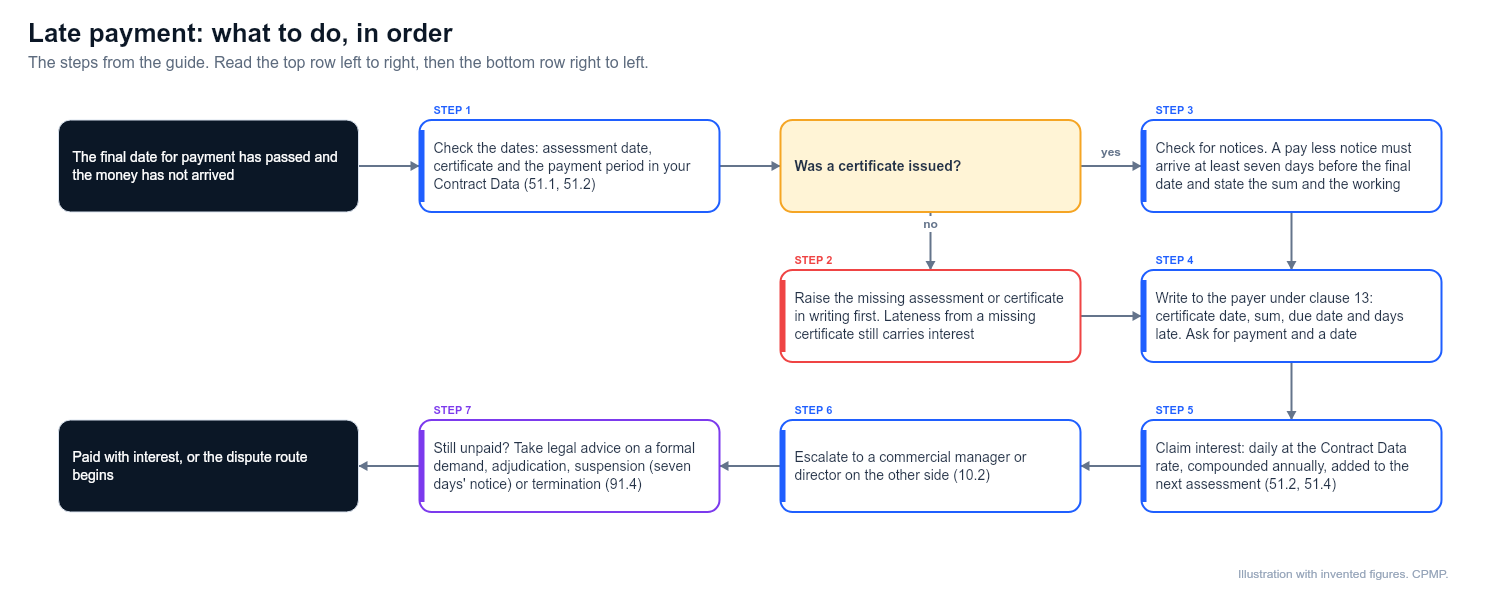
- Check the dates. Find the assessment date and the Project Manager's certificate (clause 50 and clause 51). The certificate is due within one week of the assessment date (clause 51.1) and payment within three weeks of the assessment date, not of the certificate, unless the Contract Data gives another period (51.2). Under Option Y(UK)2 with the standard periods, the due date is day 7, the last day for a pay less notice is day 14 and the final date for payment is day 21. A subcontract is slower: certificate within two weeks and payment within four. Confirm the periods in your Contract Data and any Z clauses.
- Check whether a certificate was issued. If the Project Manager has not assessed or certified at all, that is a separate failure. Raise it first and in writing.
- Check for notices. Look for any payment notice or pay less notice from the other party. These come from the Housing Grants, Construction and Regeneration Act 1996 (as amended, "the Construction Act") and your contract. Under Option Y(UK)2 a pay less notice must reach you at least seven days before the final date for payment and must state the sum the payer considers due and how it was calculated. If none arrived in time, the notified sum is generally payable in full even if the payer thinks the certificate was wrong; they correct it in a later certificate (clause 50.6). Whether a notice was valid is a legal question, so do not assume either way.
- Write to the payer. Use clause 13 communications. State the certificate date, the sum, the due date and the number of days late. Ask for payment and a date. Copy the Project Manager if the Client is the payer.
- Claim interest. Clause 51.2 provides for interest on late payment, including where the lateness comes from a missing certificate. It runs daily at the rate in the Contract Data and is compounded annually (51.4). Show the working in your letter, and check that it is added to your next assessment once the late payment has been made.
- Escalate. Raise it with the commercial manager or a director on the other side. Under clause 10.2 the parties act in a spirit of mutual trust and co-operation, which is a fair thing to point to.
- Plan ahead. If the payer stays silent, ask a legal adviser about your options. In general terms these include a formal demand, adjudication under the dispute resolution Option in your contract (W1 or W2, or W3 in NEC4 for the Dispute Avoidance Board route), and, where the Construction Act applies, the right to suspend performance once the sum is unpaid after the final date with no effective pay less notice. That needs at least seven days' written notice of your intention, stating the grounds. A proper suspension is a compensation event under Option Y(UK)2 (Y2.5 in NEC4, Y2.4 in NEC3), which you must notify within eight weeks. Suspension is risky if done wrongly, so take advice first. If the amount stays unpaid after the stated period, the contract also allows termination (clause 91.4): 13 weeks in NEC4 ECC and ECS, 11 weeks in NEC3 ECC. Amended contracts may differ.
What to record
- The assessment date, certificate date and certified sum.
- The date and amount of every payment actually received.
- Copies of all letters, emails and notices, with dates sent and received.
- The cost to you of the delay: finance costs, supplier terms, wages.
- Any reason the payer has given, and whether it was given in writing and in time.
What not to do
- Do not stop work or remove resources without legal advice.
- Do not rely on phone calls. Confirm every conversation in writing.
- Do not mix a payment complaint with unrelated claims in the same letter.
- Do not wait months before raising it. Silence can be read as acceptance.
- Do not deduct or withhold from your own suppliers just because you are unpaid, unless your subcontract allows it.
When to get help
Speak to a commercial manager as soon as the due date is missed. Take legal advice before you issue anything that talks about suspension, termination or adjudication, and when the payer has served a notice you do not understand. A CPMP planner can help if the dispute turns on programme, progress or compensation events, because those drive the amount.
If you are a Subcontractor, also read the Contractor has not paid me for points specific to your position.
Example
A Contractor's assessment date is the 1st. The Project Manager certifies 120,000 pounds. Payment is due three weeks later, on the 22nd, under the contract. On the 29th nothing has arrived. The Contractor writes on the 29th, sets out the dates, the sum and seven days of interest at the contract rate, asks for payment within a stated number of days, and keeps a copy on the contract file.
Related guides
This guide is general information, not legal advice. Check it against your contract.