
Delay damages deducted from your payment: how to check and challenge them
A checklist for testing a delay damages deduction under NEC Option X7, plus the steps, evidence and reply letter that put a wrong figure right.
On this page
A certificate has arrived with delay damages taken off, and the figure looks high. You want to know whether you can push back.
The short answer
Yes. Delay damages are frequently wrong on points you can check with a calculator and a calendar, so start there, before arguing about fault. The outcome turns on four things: whether Option X7 is in your contract, which Completion Date was used, the day counting stopped, and which compensation events were still open when the deduction was made. The same three X7 clauses sit in NEC3 and NEC4.
What to do, step by step
- Confirm X7 is chosen and a daily rate is in the Contract Data. If not, there is no contract rate to deduct, and anything else would be a claim to be argued separately.
- Check the rate. If Option X5 gives you sections, was the rate for that section used?
- Check the start date. It should be the current Completion Date after every implemented compensation event. A common slip is using the tender date.
- Check the end date. Counting stops at Completion or take over of the works, whichever is earlier. Days after that should not be charged, even if the certificate came later.
- Check for early take over of a part. Under X7.3 the rate falls from that date, whether or not anyone noticed.
- Check how the deduction was made. If it is in the certificate, it forms part of the amount due. If it was taken off afterwards, the payer needed a valid pay less notice, at least seven days before the final date for payment (Y2.3).
- Rebuild the figure on one page: start, end, days, rate, reductions, total.
- Notify any compensation event you have not yet raised. You have eight weeks from becoming aware (clause 61.3). Without it, the date cannot move later.
- Push open events along. Submit overdue quotations and use the failure-to-reply routes where responses are late.
- Write to the Project Manager asking for a correction in the next certificate under clause 50.6. A correction of a mistake carries interest (51.3).
- Diary your dispute route. Under W2, adjudication is open at any time. Under W1 a four-week limit runs from when you became aware.
If the Client paid less than the certified sum without a timely notice, the shortfall looks recoverable for that cycle even if damages are genuinely owed. That buys cash and time, not a final win, because the damages may be reclaimed in the next certificate.
What to record
- The certificate and the working behind the deduction.
- Every compensation event affecting planned Completion, with its stage and dates.
- The date Completion actually happened and any take over of a part.
- Proof of when any pay less notice arrived.
What not to do
- Do not accept the figure because the arithmetic looks official.
- Do not leave un-notified events unraised while arguing the damages.
- Do not argue about the Client's real loss. X7 is an agreed rate, so actual loss rarely helps either way.
- Do not assume the deduction was lawful just because it is in a certificate.
When to get help
Bring in your commercial manager early, and a planner when the Completion Date depends on the programme. Take legal advice if the Client threatens to claim more than the rate or you think the rate can be attacked.
Example
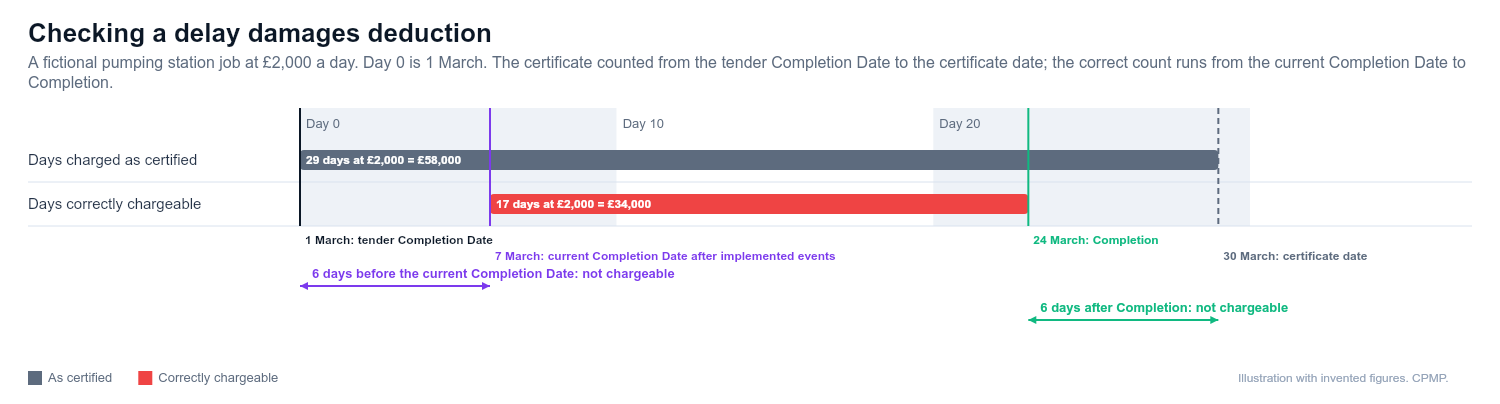
A fictional pumping station job at £2,000 a day.
| As certified | Corrected | |
|---|---|---|
| Start | Tender date, 1 March | Current date, 7 March |
| End | Certificate date, 30 March | Completion, 24 March |
| Days | 29 | 17 |
| Total | £58,000 | £34,000 |
Two corrections are worth £24,000 before any event is argued.
Expect "your events are not implemented, so the date stands". That is right for now, and repayment under X7.2 with interest follows later. Expect "you would have been late anyway" too: where an event delayed planned Completion on the Accepted Programme, the assessment is about that event, not general blame.
Related guides
- Delay damages under NEC
- The Client missed the pay less notice
- Key date missed: what does it cost?
- Time limits for NEC disputes
This guide is general information, not legal advice. Check it against your contract.