
I have just won an NEC contract: what should I do in the first four weeks?
A practical four-week plan for a contractor that has just been awarded an NEC contract: programme, early warnings, communications, subcontracts and records.
On this page
You have won the contract and the award letter is in. The first month sets the tone for the whole job: the habits you start now on programme, early warnings and records are the ones you will be judged on later. This guide is written for the Contractor. If you are a Subcontractor, apply the same steps to your own subcontract, and expect to receive many of them from the Contractor.
The short answer
Read the signed contract and Contract Data first, then get your first programme submitted on time, set up your communication system and early warning register, and start your records on day one. Do the formal things in writing, in the form the contract requires, from the start.
What to do, step by step
- Read the signed documents. The contract may differ from the tender. Check the Contract Data, Scope, Z clauses and any clarifications. See A Contract Data checklist for contractors before signing.
- Diarise the contractual dates. The period for submitting the first programme, the starting date, Key Dates and the assessment interval all start from the dates in your contract. Put them in a shared calendar.
- Prepare the first programme. Clause 31.1 requires a first programme to be submitted to the Project Manager within the period stated in the contract. Start from your tender programme, check it against the Scope and contents in clause 31.2, and update it for what you now know. See Clause 31 programme checklist.
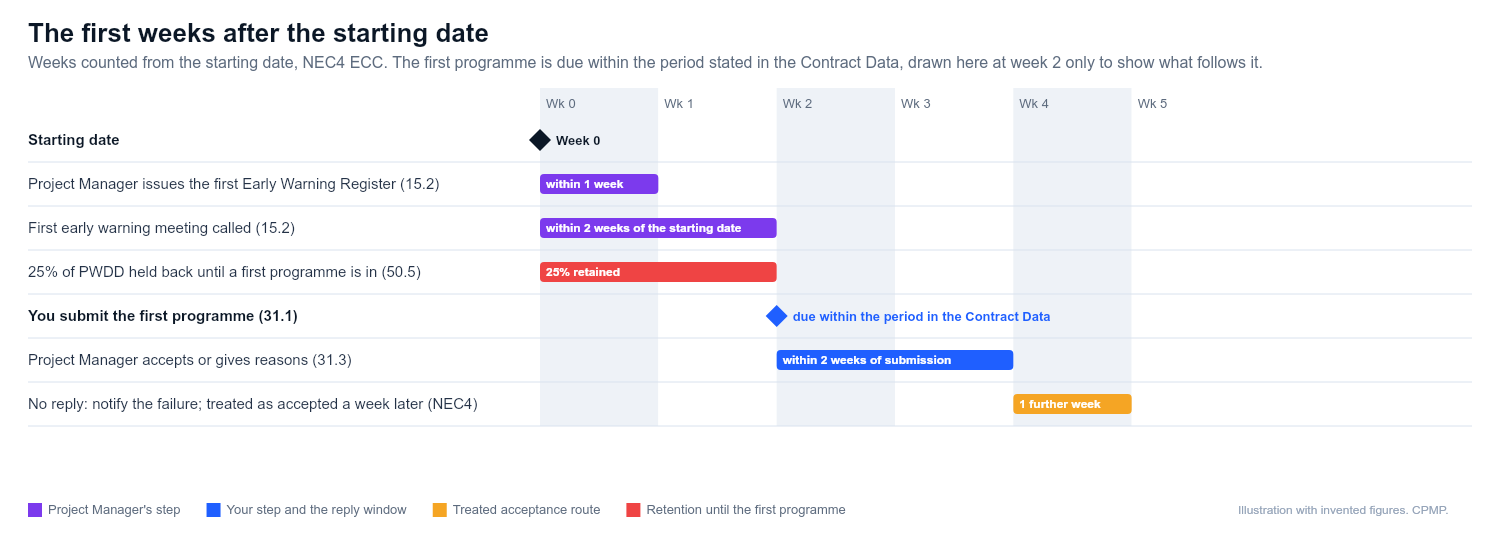
- Submit it and chase acceptance. The Project Manager has to accept it or give reasons for not accepting it within two weeks, under clause 31.3. If reasons are given, correct them and resubmit. Until you have submitted a first programme showing the information clause 31.2 requires, a quarter of the Price for Work Done to Date is held back in each assessment, unless the Contract Data names a programme (clause 50.5 in NEC4, 50.3 in NEC3). Under NEC4 ECC, if the Project Manager misses the two-week reply you can notify the failure, and the programme is treated as accepted if there is still no answer one further week later. See Why NEC programmes are not accepted.
- Set up the communication system. Agree with the Project Manager how communications are sent, logged and tracked under clause 13. Decide who is authorised to send what, and check that notices go to the right address.
- Open the early warning register. Clause 15.1 (NEC4) or 16.1 (NEC3) puts a duty on both parties to give early warning of matters that could increase the total of the Prices, delay Completion, delay meeting a Key Date or impair the performance of the works in use. Start the register straight away with the risks from tender. See Early warning register template.
- Plan the early warning meetings. Under NEC4 clause 15.2 the Project Manager prepares the first register within one week of the starting date and calls the first meeting within two weeks of it, with later meetings at least as often as the interval in the Contract Data. NEC3 clause 16.2 has no fixed times. Put these dates in the diary from the starting date.
- Flow down to subcontractors. Check what the main contract requires on subcontracting under clause 26, including acceptance of proposed Subcontractors and conditions. Issue subcontracts with dates, notice periods and Scope that match your own. See Preparing a subcontract package.
- Set up your records. Daily diaries, labour and plant records, photographs, instructions, delay and weather logs, and a clear filing structure. See Keeping records under NEC.
- Plan for payment. Check the assessment interval, how you will submit your application if the contract provides for one, and what evidence you will provide.
What to record
- The date of award, the starting date and every date the contract sets
- All information received from the Client, and when
- The version of the tender programme that was priced
- Assumptions made in the tender and any that no longer hold
- Meetings, with attendees and actions
- Early warnings given and received, and their outcomes
What not to do
- Do not start work on the assumption that the tender programme is the contract programme. It becomes the Accepted Programme only if the Contract Data identifies it, or once it is accepted (or, under NEC4, treated as accepted).
- Do not leave the first programme until the last week.
- Do not rely on telephone calls or site conversations for anything the contract says must be written.
- Do not issue subcontracts that fail to pass down your obligations, time bars and notice requirements.
- Do not assume the Client will tell you about their own changes. Check the Scope.
When to get help
Get a planner involved before the first programme is submitted, particularly on a large or constrained job. Involve your commercial manager at once if the signed contract differs from the tender, and take legal advice if there is a conflict you cannot resolve.
Example
A Contractor is awarded a pipeline renewal with a starting date two weeks after award. In week one the team reads the Contract Data and finds the first programme is due within a period stated in the Contract Data, shorter than assumed. The planner begins at once, an early warning register is opened for the permit risk, and the subcontract for traffic management is issued in week three with the same notice requirements as the main contract.
Related guides
- What programme you need at tender for an NEC contract
- Compensation events in plain English
- Hiring a P6 NEC planner
This guide is general information, not legal advice. Check it against your contract.