
NEC period for reply: which deadline applies and what a late answer costs
How the NEC period for reply works, which replies have their own deadlines, and when a late answer becomes a compensation event.
On this page
The period for reply is the standard time allowed for answering a communication under an NEC contract. You find the figure in Contract Data, because the contract does not supply one. It binds the Project Manager, the Supervisor and you. When the Project Manager or Supervisor is late, you may have a compensation event, which is a ground for extra time or money. The rule sits at clause 13.3 in NEC3 and NEC4.
First question: does a special period apply?
The words "unless the contract says otherwise" matter. These common NEC4 ECC replies have their own deadlines and ignore the Contract Data figure:
| What | Clause | Period |
|---|---|---|
| Project Manager answers a programme submitted for acceptance | 31.3 | 2 weeks |
| Project Manager answers your compensation event notice | 61.4 | 1 week |
| Your quotation | 62.3 | 3 weeks |
| Project Manager answers a quotation | 62.3 | 2 weeks |
Other forms, subcontracts and Z clauses can differ, so check yours. The general period picks up what remains: design submissions, quality plans, subcontractor names and plenty more.
Setting the number
There is no default, and the right figure depends on the job.
- Too short and the Project Manager will be late often, which hands you a steady run of 60.1(6) events and sours relations.
- Too long and your work stalls waiting for routine answers.
- NEC4 lets you state exceptions, so a large design package can have a longer period than a simple name submission.
- The NEC4 subcontract has separate entries for each side, while NEC3 ECC has one.
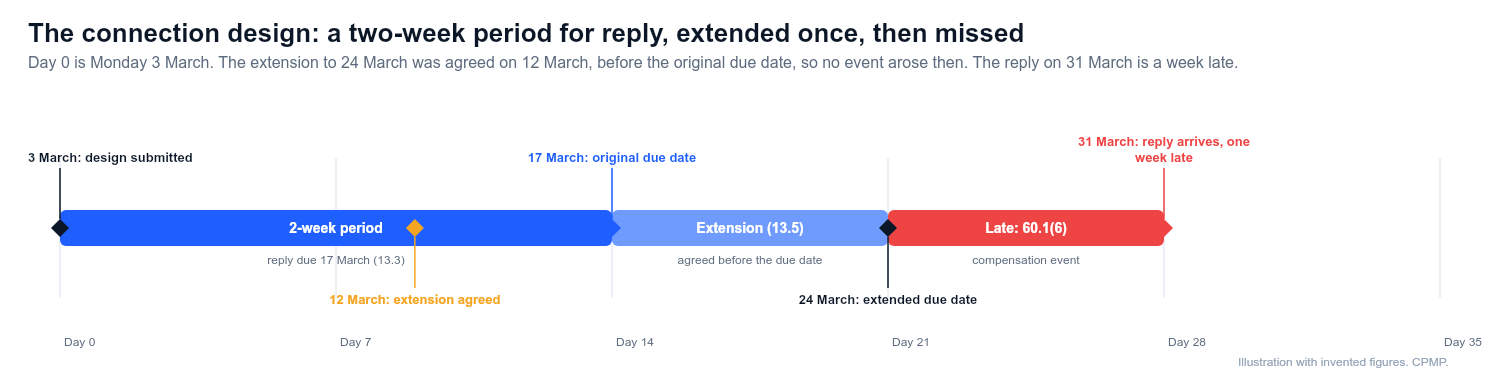
Example: the connection design
Suppose a depot job with a two-week period.
- On Monday 3 March you submit a steel connection design. The answer is due 17 March.
- On 12 March the Project Manager asks for longer because the engineer is away. You agree before the deadline to move it to 24 March (clause 13.5). No event arises.
- The reply arrives on 31 March, a week late.
- You notify a compensation event under 60.1(6) and show the delay held up fabrication. Your quotation might cover £11,000 and four days.
- Had the lateness made no difference to cost or time, the event would not change Prices or dates.
When the answer is not an acceptance
Your resubmission also runs on the period for reply (13.4). A refusal with reasons starts a fresh round: you resubmit within the period, then the Project Manager replies within the period. At two weeks, one refusal adds up to four weeks. A short meeting before the first submission usually saves more than a shorter period would.
What people get wrong
- Using it for everything. Quoting the general period against a quotation or a 61.4 reply is quoting the wrong number.
- Extending too late. Agreement has to come before the reply is due.
- Reading silence as yes. The general period has no deemed acceptance. NEC4's treated acceptance covers specific items only, after you have notified the failure.
- Accepting a holding reply. A request for more information can count as a reason (13.4), but "we are looking at it" is not a reply.
- Forgetting your own deadlines. No compensation event follows if you are late, but it can resurface when events are assessed.
- Counting from the day it was sent. A communication takes effect under 13.2, normally on receipt or through the named system.
A simple register of dates sent, received and due is the cheapest cure.
Related guides
This guide is general information, not legal advice. Check it against your contract.