
No reply to your compensation event notice: notify the failure
If the Project Manager stays silent on your notice, a failure notice starts a short clock after which the event is treated as accepted.
On this page
You notified a compensation event and the Project Manager has said nothing. The silence feels like it should count for something, but on its own it does not.
The short answer
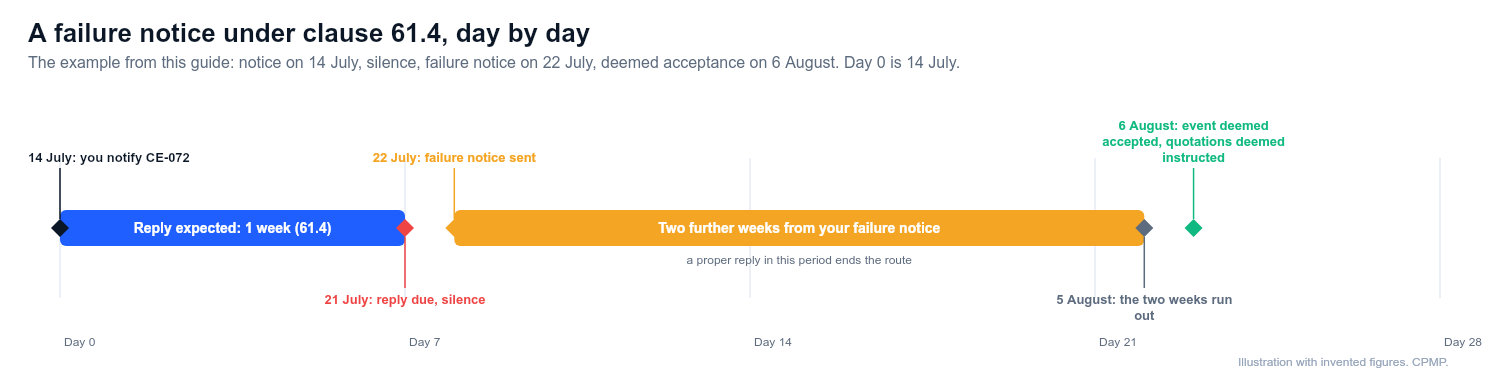
Notify the failure. Clause 61.4 lets you tell the Project Manager that no reply came. If the silence carries on through a further set period, the contract treats the event as accepted and treats you as instructed to submit quotations. Without your notice, nothing happens however long the silence lasts.
What to do, step by step
- Check for an agreed extension. Search for a written agreement to a longer period before calling the reply overdue.
- Check your notice went the right way. In NEC4 (clause 13.2), if the Scope names a communication system, your notice should have gone through it.
- Send the failure notice the day after the reply was due. Make it a separate notice (clause 13.7), identify the original notification and its date, and cite 61.4.
- Diary the further period. It counts from your failure notice.
- Start your quotation now. Once the further period ends, quotations are deemed instructed and the clause 62.3 time begins. That is three weeks under the ECC and two under the NEC4 subcontract.
- Confirm the outcome in writing on the first day after the period.
| Contract | Reply expected | Extra time once you give notice |
|---|---|---|
| NEC4 ECC | One week unless a longer time was agreed | Two weeks |
| NEC3 ECC | One week unless a longer time was agreed | Two weeks |
| NEC4 subcontract | Two weeks unless a longer time was agreed | Three weeks |
Z clauses (added amendments) often change these. A wrong date undermines your notice, so read yours first.
A sample notice, invented: "Our notice CE-072, sent on 14 July under 60.1(2), has had no reply by the due date of 21 July. This letter notifies that failure under clause 61.4. Should it last two more weeks, the contract treats the event as accepted and quotations as instructed."
What to record
- The original notification, its date and how it was sent.
- Any agreed extension.
- The failure notice and its date.
- Any reply and when it came.
What not to do
- Do not rely on a phone call. The further period counts only from the notice.
- Do not wait past the reply date.
- Do not confuse winning the event with winning a sum. Nothing is agreed on money, and the Project Manager can still reject the quotation and assess it itself.
- Do not accept "we are considering this" as a proper reply. It is not one of the answers clause 61.4 provides, though expect a debate.
When to get help
Speak to a commercial manager if a reply arrives that says it is not an event, since the route then ends and you challenge the refusal. If the other side later says the event was never valid, bear in mind that in the NEC4 subcontract under W1 the paying side can refer a treated acceptance to dispute within four weeks, while W2 lets adjudication start at any time. Take legal advice on that.
Example
| Date | What happens |
|---|---|
| 14 July | You notify |
| 21 July | Reply due; silence |
| 22 July | Failure notice sent |
| 5 August | Two further weeks run out |
| 6 August | Event deemed accepted; quotations deemed instructed |
A missed reply is also an event by itself, yet the failure route needs no proof of effect, which is why it is usually the better tool.
Related guides
- Failure to reply: treated acceptance
- Quotations for compensation events
- Late reply to a communication: 60.1(6)
- The compensation event process step by step
This guide is general information, not legal advice. Check it against your contract.