
The Client has said they will terminate: what to do under NEC
What to do if the Client says they will terminate, or serves a termination notice: check the reason and procedure, protect your position, get advice fast.
On this page
You have been told, in a meeting, a letter or an email, that the Client intends to terminate, or a notice of termination has arrived. This guide is written from the Contractor's side. A Subcontractor facing termination by the Contractor should follow the same steps against the subcontract. The Client is the Employer in NEC3.
The short answer
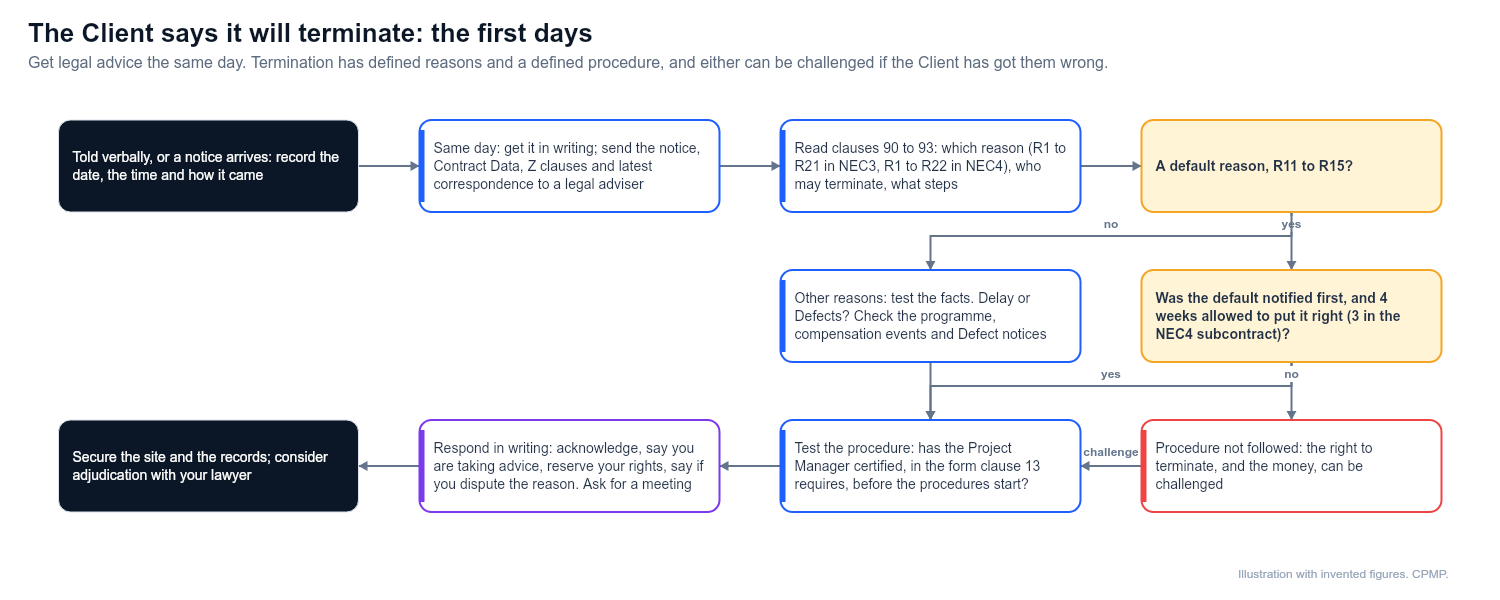
Get legal advice today, and do not react before you have read the termination clauses and the notice itself. Termination is a serious step with defined reasons and a defined procedure, and either can be challenged if the Client has got them wrong. What you do in the first days can decide the outcome.
What to do, step by step
- Get the document. If you were told verbally, ask for it in writing. If you have a notice, record the date and time it arrived and how.
- Contact a legal adviser. Send them the notice, the Contract Data, the Z clauses and your latest correspondence. Do this the same day.
- Read the termination clauses. They are in section 9 of your contract (clauses 90 to 93). Clause 91 lists the reasons, numbered R1 to R21 in NEC3 and R1 to R22 in NEC4. Identify the reason relied on, who is entitled to terminate, what notice or instruction the procedure requires, and what happens next. Check the Contract Data and any Z clauses, since termination provisions are often amended.
- Test the reason. Is the reason one the contract allows? Is it supported by the facts? For the Client's reasons based on your default (R11 to R15), the Project Manager has to notify the default first, and the Client can only go ahead if it is not put right or stopped within 4 weeks (3 weeks under the NEC4 subcontract). Under NEC4, a Client cannot terminate for its own convenience unless Option X11 is in the contract, while the NEC3 Employer can terminate for any reason. The amount due on termination depends on the reason, so a wrong reason changes the money as well as the right to terminate. If the Client is relying on delay or Defects, check the programme, compensation events and any Defect notifications. See defects under NEC and completion, take over and the defects date.
- Test the procedure. Has the Project Manager acted when the contract says the Project Manager must (notifying the default, and certifying the termination before the termination procedures start)? Has the correct notice been given in the correct form, and was the Client entitled to give it? Compare against the termination clauses and clause 13.
- Respond in writing. Within the time the procedure allows, and in any event promptly, acknowledge receipt, state that you are taking advice, reserve your rights, and say whether you dispute the reason. Keep the tone factual. Under clause 10.2 the parties act in a spirit of mutual trust and co-operation, and a measured letter reflects that.
- Open the right door. Ask the Client for a meeting to discuss whether the issue can be resolved. If the reason is something you can put right, a fix and a plan may defuse it.
- Secure the site and the records. Protect people, the works and your records. Plan for access to your own documents if the Client controls the site.
- Think about dispute resolution. The dispute resolution Option in your contract may let you refer the termination dispute to adjudication. See adjudication under NEC. Your lawyer will advise on timing.
What to record
- The notice, envelope or email, with date and time received.
- Notes of any meeting or call where termination was mentioned, written the same day.
- The programme, progress records and the latest Accepted Programme.
- Every early warning, compensation event and Defect notice, with the Client's responses.
- Payments due, certified and received.
- Your current resource levels and what is on site.
What not to do
- Do not walk off site or stop work unless your lawyer tells you to.
- Do not send an angry reply.
- Do not terminate in return without advice. A wrongful termination by you may make things worse.
- Do not let people on your team comment publicly or informally about the dispute.
- Do not delay getting advice because you hope it will blow over.
When to get help
Immediately. Termination affects money, bonds, guarantees, insurance, reputation and your subcontractors. A legal adviser should lead. A commercial manager can assemble the contract history, and a planner can help prove progress, delay causes and the effect of compensation events on the Completion Date. If you are a Subcontractor, also read the Contractor has not paid me where payment is part of the story.
Example
A Client's letter says it will terminate because of delay to a Key Date. The Contractor's lawyer checks the clause relied on and the procedure. The Contractor writes back the same day, reserves its rights, disputes the reason, and attaches a programme showing two unimplemented compensation events that move the Key Date. It asks for a meeting.
Related guides
This guide is general information, not legal advice. Check it against your contract.