
How NEC disputes are resolved: the routes, the people and your first steps
A newcomer's guide to NEC dispute routes (W1, W2, W3): who decides what, how to find your route and what to do in the first days.
On this page
The dispute Option written into your contract decides the route: W1 or W2 in most cases, or W3 in NEC4. Most UK building and civils work sits under W2, where either side may put a dispute to an independent Adjudicator whenever it likes. If you dislike the answer, the next stop is the tribunal, meaning the arbitrator or court the contract names.
In plain English
Your contract names a ladder for disagreements. Work out which ladder you are on before you write anything, because the rungs, and the clocks on them, differ between W1 and W2.
Find your route first
- Read the Contract Data. This is the part of the contract where project-specific details are filled in. It should say which dispute Option applies and name the Adjudicator and tribunal.
- Note the edition. NEC3 W1 and W2 have no Senior Representatives stage, and the time limits are different from NEC4.
- Look for Z clauses. These are the additions and amendments to the standard contract. Many add negotiation or mediation steps, or change periods. See reading Z clauses.
- Ask whether the Housing Grants, Construction and Regeneration Act 1996 applies. W1 is normally used where it does not, and W2 where it does. Whether your work falls within the Act is a legal point, so ask a lawyer if you are unsure.
Who does what
| Who | Role | Does it bind? |
|---|---|---|
| Senior Representatives | Each side's senior person meets the other to try to settle, then lists what was agreed and what was not | Agreed issues are put into effect |
| Adjudicator | An independent person who decides the dispute and gives reasons | Yes, until the tribunal revises it |
| Tribunal | The arbitrator or court named in the contract, which settles the matter finally | Yes, subject to general law |
| Dispute Avoidance Board (W3 only) | A standing panel that helps before positions harden | Its recommendation is not an Adjudicator's decision |
How W1 and W2 differ in NEC4
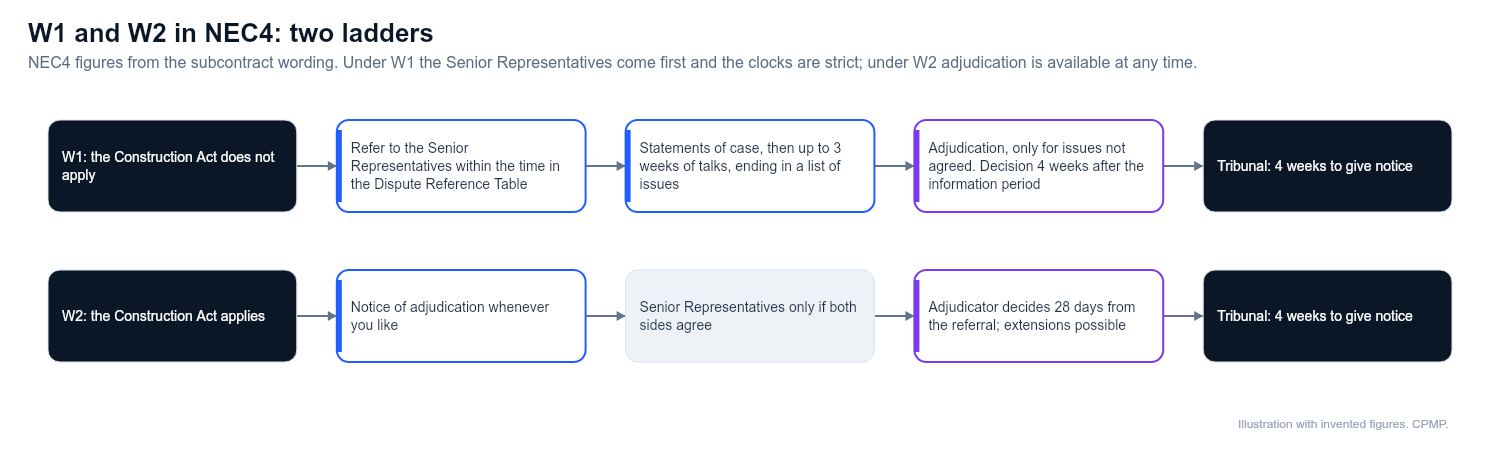
- Starting: under W1 you first refer the matter to the Senior Representatives within the time in the Dispute Reference Table. Under W2 you can give notice of adjudication whenever you like, and the Senior Representatives step happens only if both sides agree.
- Talks: up to three weeks, with statements of case first.
- Adjudication: under W1, only for issues the Senior Representatives did not agree. Under W2, always available.
- Decision: four weeks after the information period under W1, and 28 days from the referral under W2 (extensions are possible).
- Tribunal: four weeks to give notice, under both.
These are NEC4 figures taken from the subcontract wording, so confirm them in your own contract. The time limits guide goes through every period.
Is it a dispute yet?
Ask yourself:
- Has the other side actually decided something, or are you still talking?
- Is the point already inside a contract process, such as a compensation event quotation awaiting assessment?
- Could an early warning meeting or a quiet senior phone call fix it?
- What is it worth compared with the cost of an adjudication?
Under W1, informal talks do not pause the clock. Under W2 the timing is flexible, but evidence and memories fade, so do not sit on it.
Your first day
- Write down the decision you are disputing: who made it, when, and under which clause.
- Diarise every date that could bite, including final assessment dates. See final assessment.
- Secure the records: programmes, site diaries, emails, measurements and notices.
- Keep working. Both sides must continue performing normally while the dispute runs.
- Get advice before the notice goes out, not after.
- Weigh a commercial settlement. A negotiated figure is often the best result.
Example
A fictional drainage subcontractor quotes £95,000 for a change, and the Project Manager (the person the Client appoints to run the contract day to day) assesses it at £40,000. On W2 it could adjudicate at once. Instead it asks for a senior meeting, both sides agree to one, and the labour rates are settled. The gap closes to £15,000, which is small enough to settle by agreement or put to a narrow adjudication.
What people get wrong
- Skipping the Senior Representatives step under W1.
- Assuming Y(UK)2 sets the dispute process. The dispute Option does that.
- Quoting what was said in Senior Representatives talks later. Those discussions cannot be used in later proceedings.
- Re-referring a dispute that an Adjudicator has already decided. The Option does not allow it.
Related guides
- Adjudication under NEC, step by step
- Avoiding disputes under NEC
- Option W2 explained
- Adjudicate or keep negotiating?
This guide is general information, not legal advice. Check it against your contract.