
NEC Option W2: how adjudication works on a UK construction contract
The W2 dispute route explained for contractors: the timetable, the optional Senior Representatives step, and the four-week deadline that matters.
On this page
Option W2 is the dispute procedure for NEC contracts covered by the UK Construction Act. The headline is that either party may start adjudication whenever it wants, matching the statutory right, with the Adjudicator usually deciding inside 28 days of the referral. Adjudication is a fast, binding-for-now decision by an independent person, and on a W2 contract it is where most payment and compensation disputes end up.
NEC4 adds an optional step first: if both sides agree, Senior Representatives (people senior enough on each side to settle the matter) can try to resolve it before adjudication. Under W2 nobody can force this step on you. W2 normally sits alongside Y(UK)2. If the Act does not apply, the contract would use Option W1 instead.
The timetable
These are the NEC4 subcontract text periods. NEC3 follows a similar pattern. Day counts skip bank holidays, Good Friday and Christmas Day. Your own contract may differ.
- Notice of adjudication. The referring party gives it at any time, with a short description of the dispute and what it wants decided (W2.3).
- Adjudicator confirms. Within 3 days of the notice (W2.3).
- Nomination, if needed. If none is named or available, the nominating body appoints within 4 days of being asked (W2.2).
- Referral. The referring party sends its case and documents within 7 days of the notice (W2.3).
- Response. The other party has 14 days from the referral, unless extended (W2.3).
- Decision. Due 28 days after the referral. The referring party can allow 14 further days, and both parties together can agree longer (W2.3).
- Clerical corrections. Within 5 days of the decision (W2.3).
- Challenge. A party unhappy with the decision must tell the other it intends to go to the tribunal within 4 weeks of being told of it (W2.4).
Senior Representatives step
If you use it, the shape is the same as under W1: each side states its case in a week, talks run for up to three weeks, and a list of issues results. Whatever is agreed is put into effect. Nothing stops you going to the Adjudicator meanwhile. On a money dispute it is often worth a go, since it is cheap.
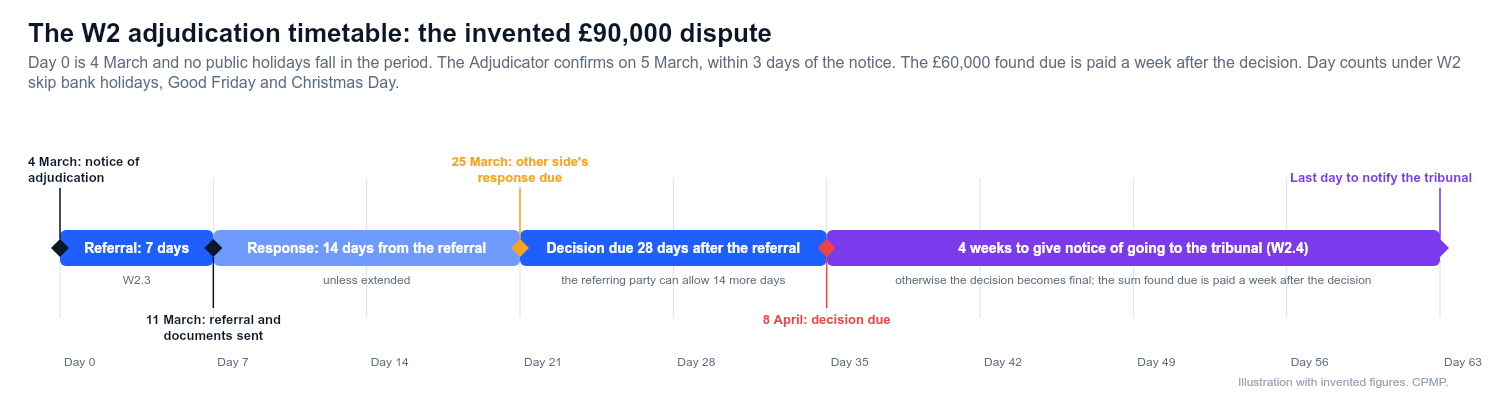
An invented timeline
You dispute a £90,000 assessment, and no public holidays fall in the period.
- 4 March: you give notice of adjudication.
- 5 March: the Adjudicator confirms.
- 11 March: you send your referral and documents.
- 25 March: the other side's response is due.
- 8 April: the decision is due.
The Adjudicator finds £60,000 is due. As that alters an amount already notified, it falls due a week after the decision. The losing side then has four weeks to give notice of going to the tribunal, otherwise the decision becomes final.
What the decision means
- It binds the parties for now, until a tribunal revises it. It is enforced as a contractual obligation rather than an arbitral award.
- Who bears the Adjudicator's own fees and expenses can be decided by the Adjudicator.
- The same dispute cannot be adjudicated twice, even if reworded.
- With consent, a main contract dispute may be heard together with a linked subcontract one. See back-to-back subcontracts.
Mistakes to avoid
- Assuming there are no time limits. Starting has no limit, but the tribunal notice must be given in four weeks or the decision stands.
- A late referral. Seven days is short. Build the referral before you give notice.
- Ignoring the Adjudicator's requests. They can decide on what they have.
- Leaving the nominating body blank in the Contract Data, which creates delay at the worst time.
- Mixing up W1 and W2. Check which one your Contract Data selects.
Related guides
- Adjudication under NEC
- How disputes work under NEC
- Time limits for NEC disputes
- Should we go to adjudication or keep negotiating?
This guide is general information, not legal advice. Check it against your contract.