
Which NEC main Option is this contract, and what does it mean for you?
Why Clients pick Options A to F, how each choice shifts risk and workload onto you, and what to check before you tender or sign.
On this page
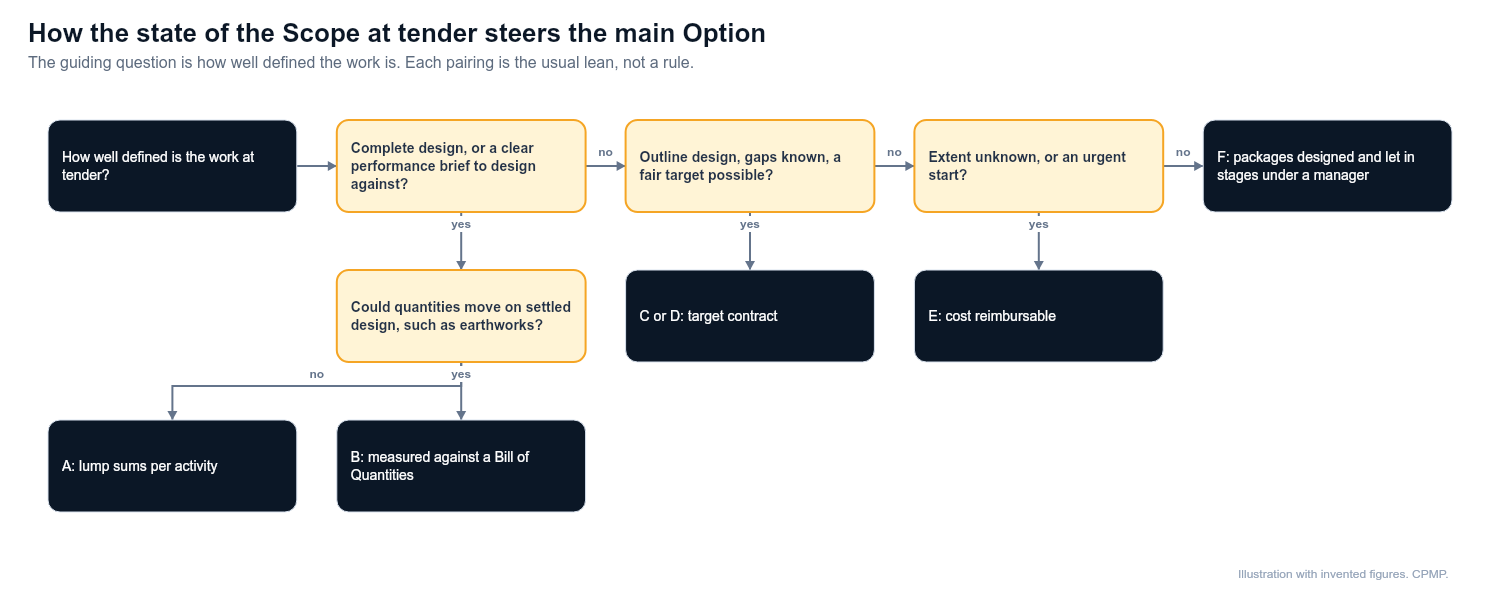
The main Option is the pricing and payment model an NEC contract runs on, and the Client normally chooses it before tender. As the contractor you rarely get to pick, but you must understand what you have been handed because it decides who carries cost risk, how you are paid and how much admin falls on you. The guiding question for the Client is how well defined the work is at tender. Firm Scope usually points to a priced contract (A or B). Partly firm points to a target contract (C or D). Where the work cannot yet be described, cost reimbursable (E) is the likely answer.
In plain English
The more certain the work, the more risk you are asked to price. The less certain, the more the Client pays as you go and the more it expects to look at your costs.
How the Scope drives the choice
| State of the Scope at tender | Usual lean |
|---|---|
| Complete design, or a clear performance brief for you to design against | A or B |
| Outline design where the gaps are known and a fair target is possible | C or D |
| Extent unknown, or an urgent start | E |
| Packages designed and let in stages under a manager | F |
If volumes could move on settled design, such as earthworks, a measured Option (B, or D with a target) avoids a risk premium in a lump sum.
What each Option puts on the Client's team, and so on you
- A: the Client's team checks which activities are finished. They rarely look at your cost.
- B: they check measured work, and a method of measurement has to be prepared or reviewed.
- C: they review your Defined Cost monthly and your forecasts of total cost. Finished activities matter only for the target.
- D: the same as C, plus the measurement duties of B.
- E and F: monthly cost review and forecast review, with no activity or measurement checking.
Where the Client has nobody to read your cost, Disallowed Cost protection means little. On C to F, expect your books to be examined.
Questions a contractor should ask
- Can I price the risk I am being given? Pushing risk onto someone who cannot control it mainly raises the price or breeds disputes.
- Does Contract Data fix the gaps? Sometimes the answer is better weather or ground data, not a different Option.
- What do I get for ideas? On C and D you share savings directly. On A and B the value engineering percentage gives some reward for accepted changes to the Client's Scope. Option X22, early contractor involvement, goes only with C or E.
- What happens at the subcontract boundary? The subcontract offers Options A to E, but its letter need not match the main contract. See back-to-back subcontracts.
Quick matches
These are invented projects for illustration only.
- Small school extension, full design: A.
- Road resurfacing, settled design, quantities that may change: B.
- Water treatment upgrade with live-plant interfaces: C.
- Coastal scheme with uncertain rock volume: D.
- Emergency flood repair: E.
- Large phased fit-out let in trade packages: F.
Traps
- Choosing by habit rather than by how defined this job is.
- Choosing A to hand over risk the contractor cannot price. You will see the cost return as a higher tender, more compensation events, or a dispute.
- Choosing C with no one to check cost.
- Overlooking secondary Option limits: X1 works only with A to D, X3 only with A and B, and X16 cannot be used with F.
This guide covers the main ECC. Consultancy and long-term service contracts offer smaller sets of main Options.
Related guides
- Risk allocation by main Option
- Option A vs Option C
- Choosing secondary Options
- Back-to-back subcontracts
This guide is general information, not legal advice. Check it against your contract.