
How termination works under NEC: notice, certificate and what you are paid
How NEC termination works for a contractor: the notice and certificate, how the Termination Table sets the money, and what to check before anyone serves notice.
On this page
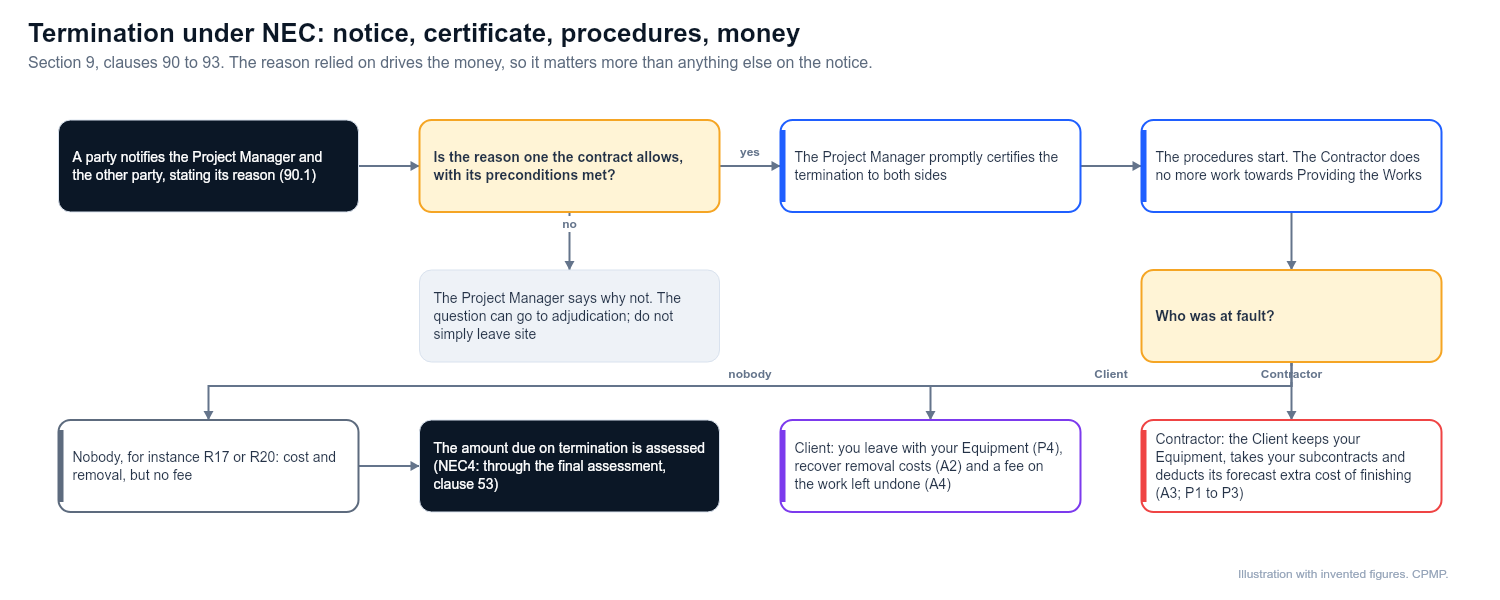
Termination under NEC is a process, not a walk-off. One side gives notice stating its reason, the Project Manager (the person the Client appoints to run the contract day to day) certifies it if the reason fits the contract, and a table then decides what each side must do and what is paid. It sits in Section 9, clauses 90 to 93. The reason you rely on drives the money, so it matters more than anything else on the notice.
In plain English
You cannot simply stop work and send a bill. The contract only lets you leave for listed reasons, through a certificate, and what you receive depends on who was at fault.
The sequence
- Notice. The party terminating tells the Project Manager and the other party, and gives its reason (clause 90.1).
- Certificate. If the reason is one the contract allows, the Project Manager promptly certifies the termination to both sides.
- Procedures. These start once the certificate is issued.
- Stopping work. The Contractor does no more work towards Providing the Works.
- Money. The amount due on termination is assessed. In NEC4 that happens through the final assessment at clause 53.
Reading the Termination Table
The table matches three things: who is terminating, which reason (R1, R2 and so on) and the resulting procedures (P1 to P4) and amounts (A1 to A4). The version here is NEC3 ECC, and the NEC4 subcontract wording with its 2019 amendments. Your contract may differ, especially for R17 and R20, so read your own table.
The pattern follows fault:
- Contractor at fault. The Client keeps your Equipment, takes the benefit of your subcontracts and deducts the forecast extra cost of finishing (A3). Procedures P1 to P3 apply.
- Client at fault. You leave with your Equipment (P4) and recover your removal costs (A2) and a fee on the work left undone (A4).
- Nobody at fault (R17 or R20, for instance). You recover cost and removal but no fee.
- Client terminating for no listed reason. NEC3 allows it with P1, P2 and A1, A2, A4. The NEC4 subcontract text allows it only if Option X11 is included.
What stops and what continues
| Stops | Carries on |
|---|---|
| Your work to Provide the Works | Liability for what you have already done |
| Delay damages, from the certificate, in NEC4 as amended in October 2020 (X7.1) | The right to refer a dispute |
| Insurance cover set out in the Table | Defects rules for finished work (take advice) |
| The normal programme and assessment cycle | Each side's payment rights on termination |
Before anyone serves notice
- Which reason applies, and has its precondition been met, such as a prior notice and a period to put things right?
- Is your evidence strong enough to persuade an Adjudicator?
- Has the notice gone to the Project Manager as well as the other party?
- What is the likely amount under each outcome, including the cost of being wrong?
- Do banks, bond providers, insurers or your own subcontractors need telling? Check bond and guarantee terms.
- What happens on site: security, safety, access and handover records?
- Have you taken legal advice? A wrongful termination can itself be a serious breach.
What to expect from the Project Manager
The certificate is not a rubber stamp. The Project Manager must decide whether your reason complies with the contract, so expect them to test the dates and preconditions. If it does comply they should certify promptly, and if not they should say why. If they stall, do not simply leave site: the question can go to adjudication.
Example
A fictional pipe-laying contractor on Option B has an invoice that has gone unpaid well beyond the period in its Contract Data for reason R16. It confirms the date the money should have arrived and notifies the Client and Project Manager, naming R16. The certificate follows, the contractor removes its Equipment from the Working Areas, and it is entitled to A1, A2 and A4. Before going this far it would be sensible to look at the Construction Act option and any right to suspend. See Y(UK)2.
Related guides
- Can a contractor terminate?
- Insolvency and NEC contracts
- Ending an NEC subcontract
- Long suspension of the work
This guide is general information, not legal advice. Check it against your contract.