
NEC Option A: fixed lump sums per activity, and what that means for you
How NEC Option A pays by completed activity, where the risk sits for the contractor, and the mistakes that cost money on an Option A job.
On this page
Option A asks you to divide the job into activities and put one lump sum on each. When an activity is finished, that sum becomes payable. If it costs you more than you priced, you carry the overrun unless a compensation event applies. Of the NEC main Options, it is the closest to what most people call a fixed price. This guide follows NEC4 ECC and notes where NEC3 differs.
What happens in practice
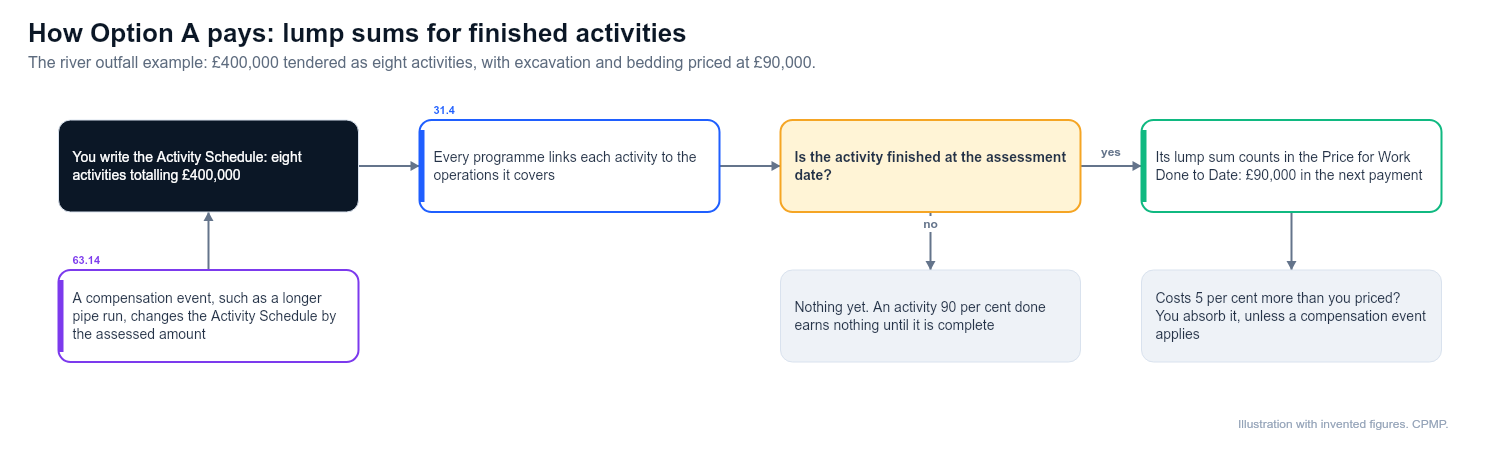
- You write the Activity Schedule. Unlike a Bill of Quantities, which the Client's team normally prepares, this breakdown is yours. The sum of the lump sums is your tendered price.
- It must line up with the programme. Clause 31.4 requires every programme you submit to link each activity to the operations it covers.
- Payment follows finished activities. Price for Work Done to Date, the figure that drives each payment, counts completed activities and completed groups. An activity 90 per cent done earns nothing yet.
- A small defect does not stop an activity counting. In NEC4 it still counts as complete unless a notified defect, once corrected, would hold up later work.
- Compensation events change the schedule. Under 63.14 the effect of a change lands in the Activity Schedule itself.
Who carries what
| Risk | Carried by |
|---|---|
| Productivity, labour and material costs | You, although Option X1 can hand inflation to the Client |
| Quantities needed to deliver the Scope | You, as there is no remeasurement |
| Errors in your own pricing | You; the Activity Schedule is not part of the Scope (55.1) |
| Compensation events | The Client, through a change to the Prices based on forecast and actual Defined Cost |
| A Scope change you propose and the Project Manager accepts | Shared through the value engineering percentage, 50 per cent unless Contract Data says otherwise (63.12) |
The Project Manager is the person the Client appoints to run the contract day to day. Compensation events are valued with the Short Schedule of Cost Components and People Rates, so you do not open your books for monthly payment, but you must support your quotations.
When it suits you
- You can price the Scope firmly, or you design to a clear performance brief.
- Ground conditions and interfaces carry little risk, or the risk is clearly placed.
- You accept cost risk in return for the margin you built in.
A moving Scope is the enemy of this Option. Every change needs a quotation and the certainty fades quickly.
Example: a river outfall
Suppose you tender a drainage outfall for £400,000 as eight activities. Excavation and bedding is £90,000. If it is finished and the Project Manager sees nothing outstanding, £90,000 is in the next payment. If it runs 5 per cent over cost, you absorb it. If the Project Manager instructs a longer pipe run, that is a compensation event and the schedule changes by the assessed amount.
What goes wrong
- Front-loading too hard. A lopsided schedule draws questions at tender, and clause 55.4 lets a revision be refused when changed Prices are badly distributed.
- Activities that are too big. A three-month activity means three months waiting for cash. Split it, with care.
- Schedule drifting from the programme. If your method changes so activities no longer match the Accepted Programme, submit a revised schedule under 55.3.
- Assuming the tender lump sums price compensation events. They do not. A compensation event is assessed on its effect on Defined Cost, unless both parties choose to price it from rates and lump sums.
NEC3 differences
The shape is the same. NEC3 differs in three ways: it uses the Shorter Schedule of Cost Components, its Activity Schedule clauses are 54.1 to 54.3, and it has no value engineering split. Instead, a Works Information change that cuts Defined Cost cuts the Prices (A63.10).
Related guides
This guide is general information, not legal advice. Check it against your contract.