
NEC Option C: target contracts, Defined Cost and sharing pain and gain
How NEC Option C pays actual cost plus Fee against a target, how the share works, and what contractors must get right on records and compensation events.
On this page
On Option C you are paid the cost you actually incur plus your Fee each month, and the tender price is only a target. When the job ends, any gap between the target and the final cost is divided using percentages that Contract Data sets. You gain a share of any saving and pay a share of any overrun. This guide covers NEC4 ECC with NEC3 differences noted.
Keep three sums apart
| Term | What it is | Used for |
|---|---|---|
| The Prices (the target) | Your Activity Schedule total, moved by compensation events | Final comparison only |
| Defined Cost | What the Schedule of Cost Components allows, minus Disallowed Cost | Basis for payment |
| Price for Work Done to Date | The Project Manager's forecast of your Defined Cost by the next assessment, with the Fee on top | The sum due each month, and your side of the share sum |
Most arguments on Option C jobs start with someone mixing these up. Completing an activity earns nothing by itself.
How you get paid
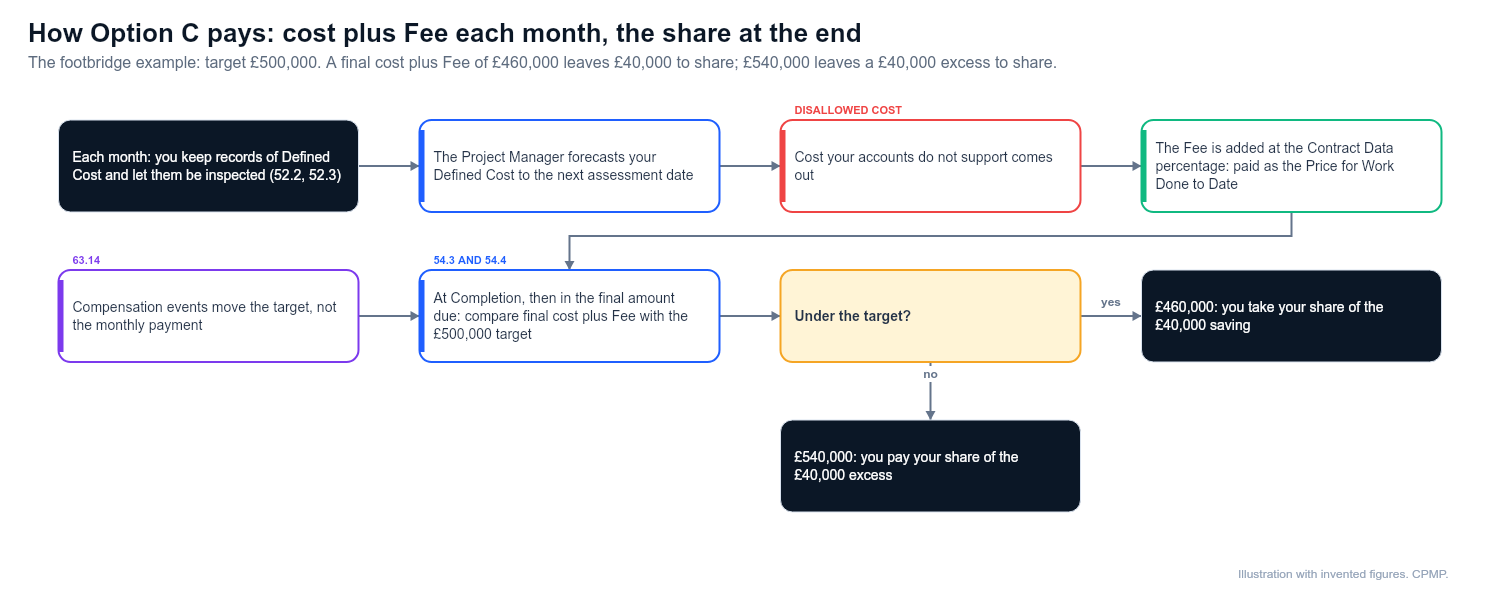
- Keep records of Defined Cost and let them be inspected (52.2 and 52.3).
- At each assessment date the Project Manager, the person the Client appoints to run the contract day to day, calculates Price for Work Done to Date. Because it looks forward, it sits a little ahead of what you have spent.
- Anything Disallowed Cost, such as cost your accounts do not support, comes out.
- Your Fee is added at the percentage in Contract Data.
- You send forecasts of total Defined Cost at the interval stated in Contract Data, and say what has changed since the last one.
How the share works
The rules are clause 54 in NEC4 and clause 53 in NEC3. Sharing does not happen month by month. A first calculation is made once the whole works are complete (54.3), and the last is made in the final amount due (54.4). Under target, you take your share of the saving. Over target, you pay your share of the excess. The split can change as the result moves further from target, depending on the share ranges.
What compensation events do
They do not alter monthly payment, as cost is already reimbursed. They raise or lower the target, with the change recorded in the Activity Schedule (63.14), and may move the Completion Date. If you miss notifying an event, you give away target and may lose time relief too.
One helpful rule: where you propose a change to the Client's Scope and it is accepted, the Prices are not reduced (63.13). The target stays put while cost falls, so the saving flows through the share.
Example: a footbridge refurbishment
Your target is £500,000. If final Defined Cost plus Fee comes to £460,000, there is £40,000 to share. If it comes to £540,000 and no events moved the target, the £40,000 excess is shared the same way, and your share is a real cost to you.
When it suits you
- The Scope is defined enough for a credible target but real uncertainty remains.
- Client and contractor are prepared to manage cost jointly, and your early advice has value.
- The Client will resource cost review.
Early contractor involvement through Option X22 is available only alongside Option C or E.
Where it goes wrong
- A target set too low to win. The overrun then sours the relationship.
- Weak records. Uninspected cost turns into a large end-of-job dispute. Agree early what evidence you will hold.
- Ignoring 50.9. NEC4 lets parts of Defined Cost be finalised during the work, avoiding a huge late audit. Check your periods.
- NEC3 assumptions. NEC3 has separate fee percentages for direct and subcontracted work, whereas NEC4 has one.
Related guides
This guide is general information, not legal advice. Check it against your contract.