
How target cost and your share of savings and overruns work in NEC
What the target is, how it moves, how your share is calculated and when it is paid, for contractors on NEC Option C or D.
On this page
On an NEC target contract (Option C or Option D) you are paid your actual costs as you go, but at the end your cost is compared with a target and the gap is split between you and the Client. If you finish under the target you receive part of the saving. If you finish over, you pay part of the excess. The split is not a monthly payment: it is worked out at set points, using figures that have usually moved a long way since tender.
The two numbers being compared
| The target | The final cost | |
|---|---|---|
| Called | The total of the Prices | The Price for Work Done to Date |
| Made up of | Your tendered activity schedule (Option C) or the priced bill of quantities as measured (Option D), adjusted for changes | Your Defined Cost (what you actually spent on the allowed cost headings) plus the Fee (your overhead and profit percentage) |
| Moved by | Compensation events, plus measurement on Option D | Real spend, anything disallowed, and the Fee |
Both sides of the comparison include the Fee. A frequent reporting slip is to set Defined Cost alone against the target, which makes the position look better than it is by the value of the Fee.
Why the target keeps changing
Nobody works to the tender figure for long. The target is altered by:
- Compensation events, the contract's way of changing the price and dates when the Client side causes a change. Under Option C they are entered as changes to the activity schedule (clause 63.14), and under Option D as changes to the bill (63.15).
- Measurement on Option D, because the final target follows the quantities actually built.
- Your accepted proposals. If the Project Manager accepts your idea for changing something the Client provided in the Scope, the Prices are not reduced under 63.13, so the saving flows into the share instead.
- Omissions the Client instructs, which bring the target down through the normal assessment.
The practical lesson: a compensation event you notify late or never quantify is target you do not get. Every unrecorded change is overrun that lands on your side of the share.
Working out the share
- Express the final cost as a percentage of the final target.
- Cut the difference into slices, one for each percentage range it passes through.
- Multiply each slice by the share percentage for that range (these are in the Contract Data).
- Add the answers together. That is your share.
- Under target, it is paid to you. Over target, you pay it.
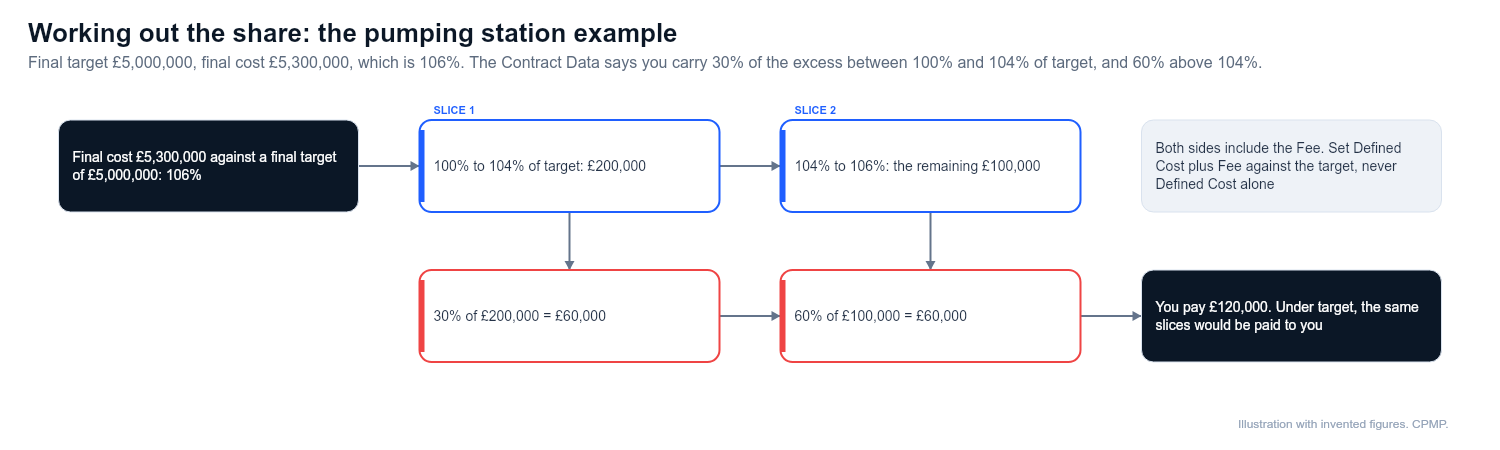
Invented example. A pumping station refurbishment has a final target of £5,000,000 and a final cost of £5,300,000, which is 106%. The Contract Data says you carry 30% of the excess between 100% and 104%, and 60% above 104%. The first slice is £200,000, giving £60,000. The remaining £100,000 gives £60,000. You pay £120,000.
When it is assessed
| Point | NEC4 ECC Option C | NEC3 ECC Option C |
|---|---|---|
| Rules for calculating and paying the share | 54.1 and 54.2 | 53.1 and 53.2 |
| Whole works reach Completion: a provisional share from forecasts, in the next amount due | 54.3 | 53.3 |
| Final amount due: share from final figures | 54.4 | 53.4 |
| Termination: a special calculation | 93.4 and 93.6 | 93.4 and 93.6 |
For Option D the matching rules start at 54.5 in NEC4 and 53.5 to 53.8 in NEC3.
Because you are paid at cost along the way, a looming overrun can sit unseen until Completion and then arrive as one sharp adjustment. Forecast it from the first months.
A monthly forecast to keep
- Latest total of the Prices including implemented events.
- Estimated value of events notified but not yet implemented.
- Your forecast final Defined Cost.
- The Fee on that forecast.
- The resulting gap and your share at the Contract Data percentages.
Run it with and without the unimplemented events. The difference shows how much risk your event backlog is holding.
What people get wrong
- Believing the target caps what the Client pays. It does not unless the share ranges are written that way.
- Forgetting disallowed cost. Cost the Project Manager rules out (see defined cost, fee and disallowed cost) comes off the cost side and you carry it alone.
- Reading the share as "gain" only. See pain and gain share for what the pain side does to your Fee.
- Accepting percentages unchecked at tender. Test them against a realistic overrun first.
Related guides
- NEC Option C: target contract with activity schedule
- NEC Option D: target contract with bill of quantities
- We are heading over target on Option C
- Risk allocation by main Option
This guide is general information, not legal advice. Check it against your contract.