
No reply to your quotation: using clause 62.6
How to turn a Project Manager's silence on your quotation into a treated acceptance, with the deadlines for the ECC and the NEC4 subcontract.
On this page
You submitted a quotation for a compensation event and the reply date has passed. The Project Manager has not accepted, rejected or answered it.
The short answer
Once the reply date has gone, give the Project Manager a failure notice under clause 62.6. If no proper answer follows within a further two weeks on the ECC, the contract treats the quotation as accepted and the Prices and dates change. Silence on its own achieves nothing. NEC3 treats the ECC the same way.
What to do, step by step
- Work out when you submitted and how long they had. Clause 62.3 sets the time, subject to any Z clause. Clause 62.5 allows an extension only if agreed before the reply falls due.
- Make sure no genuine reply exists. An instruction to revise the quotation, or a message saying the Project Manager will assess it, would be one.
- Send the failure notice on its own (clause 13.7), identifying the quotation, and the preferred one if you gave alternatives.
- Diary the two weeks from the notice.
- Confirm the outcome in writing at the end of the period, then update your register, the Prices and the Completion Date, and carry the sum into your next application for payment.
- Show the effect in your next programme.
| Stage | ECC (NEC3 and NEC4) | NEC4 subcontract |
|---|---|---|
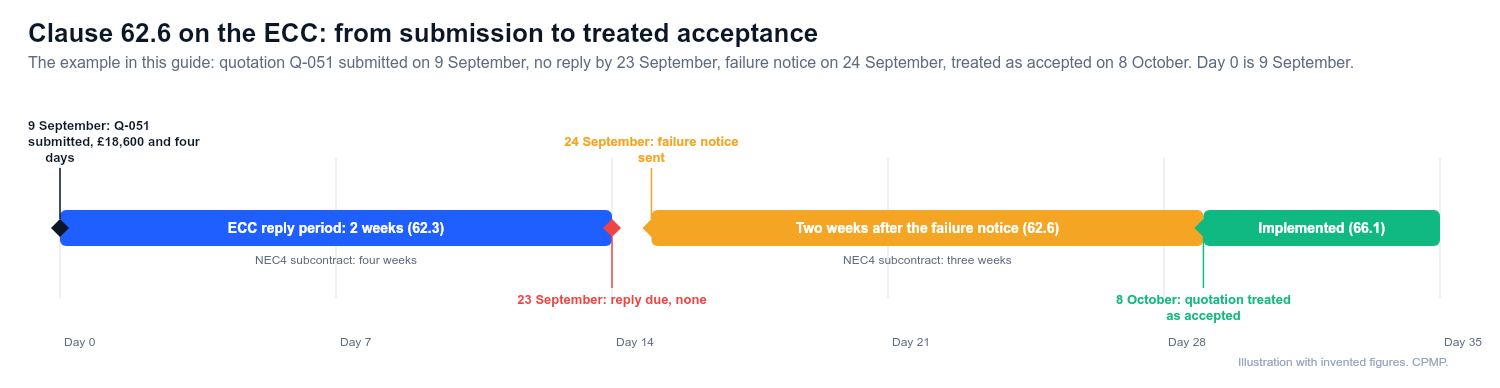
| Time for them to reply to a quotation (62.3) | Two weeks after submission | Four weeks after submission |
| Extra time after your failure notice (62.6) | Two weeks | Three weeks |
A sample notice, invented: "Quotation Q-051 for compensation event CE-066, submitted on 9 September, asks for £18,600 and a Completion Date four days later. The reply was due on 23 September and we have none. We give notice of that failure under clause 62.6 and note that, if it lasts two more weeks, the quotation is treated as accepted."
What to record
- The quotation and the proof of when it was submitted.
- Any agreed extension.
- The failure notice and when it was sent.
- Any reply received, with the date.
What not to do
- Do not treat silence as acceptance without sending the notice.
- Do not accept "under review" as a listed reply. It is not one, and you can say so.
- Do not submit a figure with a known error. Fix it before the period ends.
- Do not push an inflated number through this route. The contract does not demand that your figure be reasonable, but a quotation well above value can damage the relationship and invite disputes on other events.
When to get help
Bring in a commercial manager if the Project Manager answers within the two weeks. That is its right and it ends the route. Take legal advice if the Client later claims it never agreed the figure: a treated acceptance implements the event under clause 66.1, and an implemented assessment changes only as the conditions allow (66.3, or 65.2 in NEC3). Dispute is still open to the Client, though W1 gives it little time.
Situations that change the answer:
| Situation | Result |
|---|---|
| It priced a proposed instruction | Opposite result: NEC4 65.2 says no answer means not accepted |
| You were told to revise, with reasons | That is a proper reply; the ECC gives you three weeks to resubmit |
| The Project Manager said it would assess but has not | The failure route sits in 64.3 and 64.4 instead |
| Amendments in the Z clauses | Some stretch these periods or delete the route |
Example
You submit on 9 September, the answer is due 23 September, and you send your failure notice on 24 September. With no valid reply by 8 October, the quotation is treated as accepted: the Prices rise by £18,600 and the Completion Date moves four days.
Related guides
- Failure to reply: treated acceptance
- Quotations for compensation events
- Implementing a compensation event
- The PM rejected my quotation
This guide is general information, not legal advice. Check it against your contract.